

TL;DR:
- Robust governance frameworks are essential for UAE crypto firms to ensure regulatory approval and long-term resilience.
- VARA evaluates governance based on board competence, duty segregation, conflict management, group oversight, and ESG disclosures.
- Early, tailored governance planning enhances compliance, access to funding, reputation, and adaptability to evolving crypto regulations.
Most crypto founders in the UAE spend months perfecting their technology stack and token economics, yet overlook the single factor that regulators scrutinise most closely: governance. The Virtual Assets Regulatory Authority (VARA) does not simply ask whether your platform functions correctly. It asks whether your organisation is structured to operate with integrity, accountability, and long-term resilience. A robust governance framework is not a box-ticking exercise. It is the legal and operational foundation upon which your VASP licence, your AML/CFT obligations, and your institutional relationships all rest. This guide explains what governance frameworks require, why they matter, and how to build one that satisfies VARA's standards in 2026.
Key Takeaways
| Point | Details |
|---|---|
| Governance is regulatory core | A tailored governance framework is essential for legal, operational, and reputational integrity in UAE crypto businesses. |
| VARA sets strict standards | UAE’s VARA requires bespoke frameworks, annual ESG disclosures, group oversight, and prior approval for changes. |
| Best practices avoid pitfalls | Early, ongoing governance reviews and fit-for-purpose controls can help avoid regulatory pushback or fines. |
| DAOs need extra care | Decentralised or DAO structures must document relationships and meet stricter approval and disclosure standards. |
What is a governance framework for crypto?
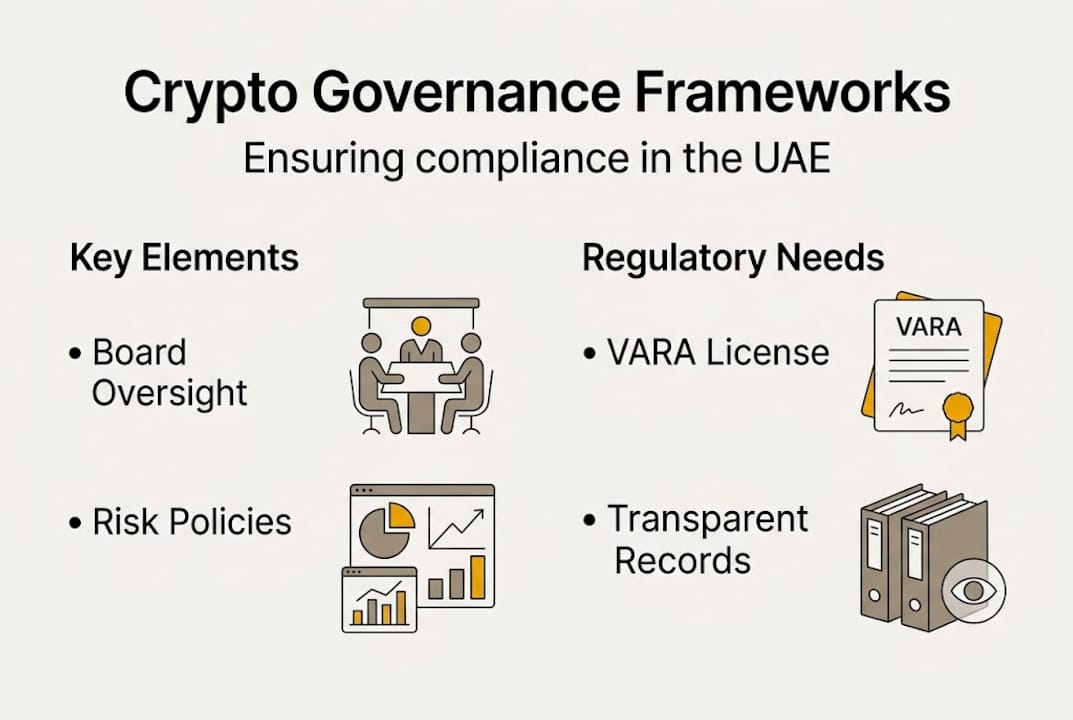
A governance framework, in the context of UAE crypto regulation, is the structured set of policies, controls, board arrangements, and oversight mechanisms that define how a virtual asset service provider (VASP) is managed and held accountable. It is not simply a compliance checklist. It is the architecture of how decisions are made, who is responsible for them, and how conflicts, risks, and regulatory obligations are managed across the entire organisation.
Under UAE crypto regulations, governance frameworks must address several interconnected components:
- Board competence: Senior personnel must meet fit-and-proper standards. This means demonstrating relevant qualifications, clean regulatory histories, and the capacity to exercise sound judgement over virtual asset activities.
- Segregation of duties: Operational roles must be clearly separated to prevent conflicts of interest and reduce the risk of internal fraud or regulatory breaches.
- Conflict of interest management: Policies must identify, disclose, and manage situations where personal or commercial interests may compromise decision-making.
- Group oversight: Where a VASP operates within a corporate group, governance must account for intra-group relationships, shared services, and the influence of parent or affiliate entities.
- Transparency requirements: Internal reporting lines, escalation procedures, and external disclosures must be clearly documented and consistently applied.
The VARA Company Rulebook confirms that governance frameworks ensure structured company operations, board competence, segregation of duties, conflict management, and group oversight for VASPs to maintain integrity and compliance.
The distinction between surface-level compliance and genuine governance is critical. Many founders assume that appointing a compliance officer and drafting an AML policy satisfies governance requirements. In practice, VARA evaluates whether governance is embedded into the culture and decision-making processes of the organisation, not merely documented in a policy folder.
Pro Tip: Governance frameworks should be drafted before you apply for a VARA licence, not after. Regulators assess organisational readiness from the outset, and a well-structured framework signals institutional maturity.
Why governance frameworks are crucial: Legal and reputational drivers
Governance frameworks are not optional enhancements for well-resourced VASPs. They are legal requirements with direct consequences for licensing, enforcement, and institutional access.
"Governance frameworks are essential for crypto startups and VASPs in the UAE to achieve regulatory compliance, reduce ML/TF risks via risk-based AML, and build institutional trust for funding." — VARA Company Rulebook
The regulatory drivers are clear and specific:
- Board fitness requirements: VARA mandates that all senior management and board members meet fit-and-proper criteria. Failure to maintain these standards can result in licence suspension or conditions being imposed.
- Annual ESG disclosures: VASPs must report on environmental, social, and governance matters annually, with the level of disclosure determined by the entity's size and activities.
- Group-level oversight: Where a VASP is part of a larger corporate structure, governance must extend to the group level, addressing how parent entities influence operations and risk.
- AML/CFT integration: A sound governance framework is the backbone of your UAE AML obligations for virtual assets. This includes the appointment of a Money Laundering Reporting Officer (MLRO), implementation of a risk-based compliance programme, and adherence to the Travel Rule for virtual asset transfers.
Beyond regulatory compliance, governance frameworks directly affect your access to funding and banking. Institutional investors and correspondent banks conduct detailed due diligence on governance structures before committing capital or services. A VASP with a documented, auditable governance framework is materially more fundable than one operating on informal arrangements.
Reputational considerations are equally significant. Partners, customers, and regulators form their trust judgements based on the visible quality of your governance. As UAE crypto regulation continues to mature, entities with weak governance will find themselves excluded from key market opportunities, regardless of their technical capabilities.
How does VARA assess governance for crypto companies in 2026?
VARA's assessment of governance is systematic and evidence-based. It is not sufficient to assert that governance policies exist. You must demonstrate that they are operational, proportionate to your risk profile, and subject to regular review.
VARA evaluates governance across the following criteria:
- Fit and proper assessments: All senior personnel and board members are individually assessed. VARA reviews qualifications, professional history, regulatory track records, and financial soundness.
- Outsourcing governance: Where functions are outsourced, VASPs must maintain documented outsourcing policies with risk assessments, clear contractual obligations, and ongoing monitoring of third-party providers.
- ESG disclosure compliance: VARA applies a tiered ESG disclosure framework based on entity size and activity scope.
- Change management: Any material changes to governance structures, including board appointments or corporate restructuring, require prior VARA notification or approval.
The VARA Company Rulebook confirms that fit and proper requirements for senior personnel, outsourcing policies with risk assessments, and ESG disclosure levels are all tailored to VASP size and activities.
ESG disclosure levels under VARA:
| Disclosure level | Applicability | Key requirements |
|---|---|---|
| Voluntary | Smaller or early-stage VASPs | Encouraged but not mandated; internal governance review |
| Compliance | Mid-tier VASPs | Formal governance policies, documented risk assessments |
| Mandatory | Larger or systemically significant VASPs | Annual public ESG reports, board-level sustainability oversight |
For decentralised structures, VARA applies additional scrutiny. The VARA Company Rulebook states that DAO-integrated VASPs require explicit VARA approval and governance frameworks detailing decentralised relationships to prevent regulatory arbitrage. This means that if your business model incorporates a DAO or relies on decentralised decision-making protocols, you must map those relationships explicitly and obtain VARA's approval before operating.

Pro Tip: Review the VARA licensing framework and VARA's supervision and enforcement approach before drafting your governance documentation. Understanding how VARA conducts reviews will help you structure your framework to align with their assessment criteria from the outset.
Key pitfalls and best practices for building a robust governance framework
Building a governance framework that satisfies VARA's requirements and remains operationally effective requires deliberate planning. Many VASPs make avoidable errors that create regulatory exposure or require costly remediation.
Common pitfalls to avoid:
- One-size-fits-all policies: Copying governance templates from other jurisdictions without adapting them to UAE law and VARA's specific requirements is a significant risk. VARA expects frameworks that reflect the actual structure and risk profile of your business.
- Over-reliance on technology: Automated compliance tools are useful, but they do not substitute for human oversight, board accountability, or documented decision-making processes.
- Ignoring group structure complexities: VASPs operating within multi-entity structures often underestimate the governance obligations that apply at the group level. Intra-group agreements, shared services, and parent company influence must all be addressed explicitly.
- Inadequate change management: The VARA Company Rulebook requires prior approval for governance changes involving DAOs or decentralised entities. Failing to notify VARA of material changes is a direct compliance breach.
Best practice steps for building your framework:
- Assess your structure: Map your corporate structure, identify all regulated activities, and document the relationships between entities, board members, and key function holders.
- Draft proportionate policies: Develop governance policies that are proportionate to your size, risk profile, and the specific virtual asset activities you conduct. Refer to compliance obligations for platform operators for activity-specific guidance.
- Appoint qualified personnel: Ensure all board members and senior managers meet VARA's fit-and-proper criteria before submission. Document their qualifications and regulatory histories thoroughly.
- Integrate AML/CFT governance: Appoint an MLRO, establish a risk-based AML programme, and ensure your governance framework explicitly addresses Travel Rule obligations.
- Schedule regular reviews: Governance frameworks must be reviewed at least annually, or whenever there is a material change to your business, structure, or regulatory environment.
Pro Tip: Engage legal counsel before submitting any governance documentation to VARA. Pre-application consultations can identify structural weaknesses that, if left unaddressed, would result in regulatory pushback or licence conditions.
Why most crypto businesses underestimate governance (and how to get it right)
There is a persistent tendency among crypto founders to treat governance as an administrative formality. The assumption is that if the technology works and the token economics are sound, regulatory approval will follow. This is a strategic misstep, particularly in the UAE.
VARA is not a passive regulator. It actively evaluates whether the people and structures behind a VASP are capable of exercising responsible oversight. A technically sophisticated platform with a weak board structure or undocumented conflict-of-interest policies will face significant obstacles, regardless of its product quality.
The deeper issue is that governance shapes every downstream outcome. Access to banking, institutional investment, and regulatory leniency in enforcement situations all correlate with the quality of your governance framework. Organisations that invest in governance early tend to resolve regulatory queries faster and attract better commercial partners.
Keeping pace with Web3 compliance trends also requires a governance-first mindset. As the regulatory landscape evolves, businesses with adaptable, well-documented frameworks can respond to new requirements without operational disruption. Those without them face repeated remediation cycles that drain resources and erode credibility.
Governance is not a cost centre. It is the structural foundation upon which sustainable crypto businesses are built.
How Cryptoverse can help you establish compliant governance
Establishing a governance framework that satisfies VARA's requirements is not a task that benefits from a generic approach. The regulatory expectations are specific, the consequences of non-compliance are material, and the complexity increases significantly for multi-entity structures, DAOs, and cross-border operations.
CRYPTOVERSE Legal Consultancy works with crypto startups, established VASPs, and platform operators to design governance frameworks that are regulator-ready from day one. Our team advises on VARA licensing requirements, board structuring, AML/CFT integration, and ESG disclosure obligations. We also support clients navigating Dubai's virtual asset regulatory environment and those seeking SCA licensing for broader UAE market access. Contact us to arrange a compliance review tailored to your structure and activities.
Frequently asked questions
What does a governance framework mean for crypto startups in the UAE?
It refers to the structures, policies, and board oversight that ensure regulatory compliance, risk management, and transparent operations for crypto entities under UAE law. The VARA Company Rulebook confirms that governance frameworks ensure board competence, segregation of duties, and group oversight for VASPs.
Are governance frameworks mandatory for all virtual asset service providers in Dubai?
Yes, VARA rules require tailored governance frameworks for all VASPs, covering board competence, segregation of duties, and annual ESG disclosures. The VARA Company Rulebook mandates that ESG and governance requirements are calibrated to each VASP's size and activities.
How does VARA treat DAOs and decentralised crypto businesses?
DAO-integrated VASPs must secure prior VARA approval and disclose their governance relationships to prevent regulatory arbitrage. The VARA Company Rulebook is explicit that DAO governance structures require detailed documentation and explicit regulatory sign-off.
What are the three ESG disclosure levels VARA requires?
VARA sets voluntary, compliance, and mandatory ESG reporting levels depending on the VASP's size and activities, all requiring annual reviews of governance policies and sustainability risks. The VARA Company Rulebook outlines annual ESG reporting obligations as a core component of ongoing VASP compliance.
Recommended
- Unlock the advantages of UAE crypto law for your business
- Crypto Regulations in UAE - VARA, DFSA, FSRA, SCA & CBUAE Explained
- UAE Blockchain Legal Frameworks 2026: Navigate Licensing - Cryptoverse Legal Consultancy
- Why regulate cryptocurrencies: safeguards for UAE & GCC businesses
- Secure AI Systems for Compliance: Minimizing Regulatory Risks | Ailerons IT Consulting