

TL;DR:
- UAE and GCC regulate digital assets to ensure market trust, protect consumers, and attract institutional investment.
- Businesses must navigate a multi-layered licensing system, with strict compliance requirements for various activities.
- Early engagement with regulation supports sustainable growth, enhances credibility, and reduces operational risks.
Many crypto entrepreneurs in the UAE and GCC still operate under a dangerous assumption: that digital assets exist outside the reach of formal regulation. This is not simply incorrect; it is commercially risky. The UAE has built one of the world's most structured virtual asset regulatory frameworks, spanning five distinct regulators with overlapping and complementary mandates. For businesses, understanding why this regulatory architecture exists is not a compliance exercise alone. It shapes your market access, your banking relationships, your investor credibility, and ultimately your licence to operate. This article explains the rationale behind crypto regulation, maps the current landscape, and shows what it means for your day-to-day operations.
Key Takeaways
| Point | Details |
|---|---|
| Regulation builds trust | Clear legal frameworks attract investors and enable safer business operations in the UAE and GCC. |
| Compliance is mandatory | Businesses must follow VARA, SCA, and FSRA rules to operate legally and avoid penalties. |
| Preparation gives advantage | Early compliance with crypto regulations can help secure partnerships, banking, and growth opportunities. |
| Cross-border risks persist | Coordinate with legal advisors to handle regulations affecting multiple jurisdictions in the GCC. |
Why regulation is essential in the cryptocurrency market
Governments do not regulate cryptocurrencies arbitrarily. There are clear, documented motivations that directly affect how you build and operate a virtual asset business. At the core, regulation addresses market failures that would otherwise undermine trust in digital assets as a legitimate financial instrument.
The primary drivers include:
- Consumer protection: Without enforceable standards, retail investors face significant exposure to fraud, market manipulation, and insolvency of unregulated platforms.
- Anti-money laundering and counter-terrorist financing (AML/CTF): Virtual assets have historically been exploited for illicit finance. Regulation brings crypto into the FATF-aligned compliance perimeter.
- Market integrity: Rules on disclosure, custody, and reporting create a level playing field and deter manipulative trading practices.
- Systemic risk management: As crypto integrates with traditional finance, unregulated exposure creates contagion risk for the broader financial system.
- Institutional confidence: Regulated markets attract institutional capital. Without clear rules, pension funds, family offices, and sovereign wealth funds cannot participate.
For the UAE and GCC specifically, there are additional strategic motivations. The region is actively positioning itself as a global hub for digital assets, and alignment with international standards is central to that ambition. The UAE's regulators have coordinated formally: the SCA-VARA agreement to coordinate oversight and compliance is a direct signal that fragmented, siloed regulation is being replaced by a unified, cross-authority approach.
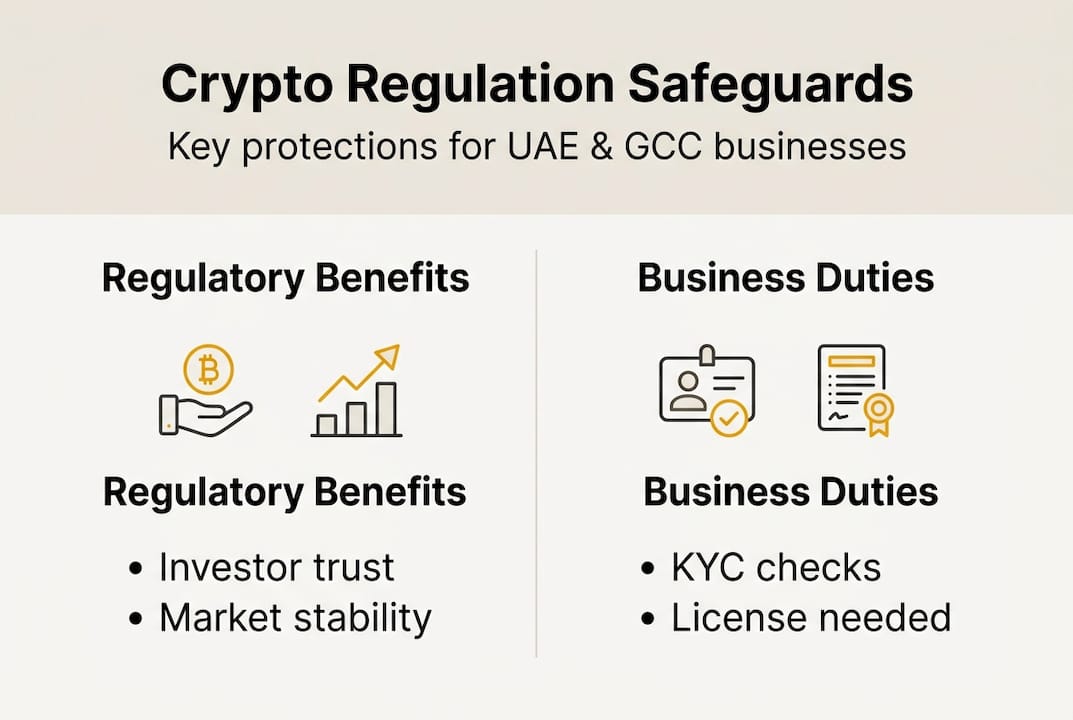
Importantly, anonymity-enhanced cryptos are prohibited and DeFi protocols come under regulatory scrutiny under the evolving UAE rulebook. This is not incidental. It reflects a deliberate policy choice to bring all significant virtual asset activity within a supervised perimeter, regardless of the technology used to deliver it.
For businesses seeking UAE crypto legal support, understanding these motivations is the first step. Regulation is not designed to obstruct innovation. It is designed to create the conditions under which innovation can scale sustainably. Meeting crypto platform compliance requirements early positions your business ahead of competitors who treat compliance as a later-stage concern.
Pro Tip: Businesses that engage with regulators proactively, rather than reactively, consistently report smoother licensing timelines and stronger institutional partnerships. Compliance is a commercial asset.
The regulatory landscape for crypto businesses in the UAE and GCC
The UAE's regulatory architecture for virtual assets is deliberately multi-layered. Each authority has a defined statutory remit, and your compliance obligations depend on where you are incorporated, what services you offer, and who your clients are.
| Regulatory body | Jurisdiction | Primary focus |
|---|---|---|
| VARA | Dubai (mainland) | Virtual Asset Service Providers, exchanges, custody |
| SCA | Federal (UAE) | Securities, investment tokens, cross-emirate coordination |
| FSRA | Abu Dhabi Global Market (ADGM) | Digital asset frameworks, DeFi scrutiny |
| DFSA | Dubai International Financial Centre (DIFC) | Crypto tokens, investment services |
| CBUAE | Federal (UAE) | Payment tokens, stablecoin issuers |
For businesses operating under VARA's regime, VARA-regulated activities cover a broad range of services including exchange, broker-dealer, custody, lending, and management of virtual assets. VARA's rulebook is one of the most detailed in the region, requiring separate approvals for each activity category.
The SCA licensing requirements apply where activities touch federally regulated securities or where a business operates across multiple emirates. The SCA and VARA have established coordination mechanisms to avoid regulatory arbitrage, meaning you cannot simply choose the more lenient authority.
For businesses starting out, the typical compliance pathway includes:
- Determining the correct regulatory authority based on your business model and jurisdiction
- Conducting a gap analysis of your existing governance and AML/CTF frameworks
- Preparing and submitting a licence application with supporting documentation
- Implementing required technology controls, including transaction monitoring systems
- Appointing a qualified compliance officer and establishing a board-level risk committee
One area requiring particular attention is the sponsored VASP model. Under this structure, high-risk derivatives require suitability assessments, leverage limits, and sponsored VASP models shift liability to licensed parties. If your business operates under a sponsor's licence, you inherit significant obligations and your sponsor bears regulatory accountability for your conduct. This affects your contractual arrangements, your indemnity exposure, and your operational autonomy.
Pro Tip: Cross-jurisdictional activities, for example, serving clients in both Dubai mainland and ADGM, often require dual compliance frameworks. Confirm your operating model with qualified legal advisors before committing to a corporate structure.
How cryptocurrency regulations impact your business operations
Regulatory frameworks translate into concrete operational requirements. For a crypto business in the UAE, this is not abstract policy. It shapes your onboarding process, your product design, your risk management function, and your reporting calendar.
A typical compliance pathway for a UAE-licensed crypto business involves the following steps:
- KYC/AML implementation: All clients must be identified, verified, and risk-rated before any transaction is processed. Enhanced due diligence applies to high-risk clients and politically exposed persons.
- Suitability assessments: For complex or high-risk products, you must assess whether a client has the knowledge and financial capacity to bear the associated risks before offering access.
- Leverage limits: Where derivatives are offered, regulators impose maximum leverage ratios to limit retail client exposure. Exceeding these limits constitutes a regulatory breach.
- Transaction monitoring: Automated systems must flag suspicious activity in real time, with escalation protocols and mandatory reporting to the UAE Financial Intelligence Unit.
- Periodic reporting: Licence holders submit regular compliance reports to their supervising authority, covering client activity, financial positions, and any material operational changes.
- Product restrictions: Certain crypto assets are simply not permissible. Privacy coins and anonymity-enhanced tokens cannot be listed or traded on UAE-regulated platforms.
Product design is directly constrained by these prohibitions. If your platform was built around privacy coin trading or unregulated DeFi yield products, you will need to restructure your offering before applying for a licence.
"DeFi protocols operating in the UAE must follow FSRA's scrutiny and reporting obligations, ensuring that decentralised structures do not become vehicles for regulatory evasion."
For DeFi platform legal support, the key issue is demonstrating that your protocol has identifiable governance, enforceable compliance controls, and a responsible entity that regulators can hold accountable. Anonymous or fully decentralised governance structures are unlikely to satisfy these requirements in their current form.
Engaging crypto compliance advisory services at the pre-launch stage prevents the costly scenario of rebuilding your compliance architecture after your application has already been reviewed and returned.

Pro Tip: Compliance delays are almost always more expensive than compliance preparation. Budget for legal and compliance infrastructure from day one, not as an afterthought once your platform is built.
Navigating cross-border crypto regulation and risk in 2026
As GCC crypto businesses expand regionally and internationally, the compliance picture becomes considerably more complex. Each jurisdiction has its own licensing regime, and operating across borders without proper legal structuring creates significant regulatory and commercial risk.
| Jurisdiction | Primary crypto regulator | Key 2026 focus |
|---|---|---|
| UAE (Dubai) | VARA | Derivatives, DeFi, VASP licensing |
| Saudi Arabia | SAMA / CMA | Pilot frameworks, restricted crypto activities |
| Bahrain | CBB | Crypto asset module, exchange licensing |
The SCA-VARA agreements help coordinate cross-jurisdictional compliance, and the sponsored VASP model shifts risk to licensed sponsors, creating a clearer liability chain for multi-entity operations. However, this coordination does not eliminate the need for jurisdiction-specific legal analysis.
Key risk considerations for cross-border and sponsored models include:
- Regulatory arbitrage risk: Choosing a jurisdiction purely for lighter regulation is increasingly ineffective as cross-border information sharing expands.
- Sponsor liability: If you operate under a licensed sponsor, their regulatory standing directly affects your ability to continue operations if they face enforcement action.
- Client location rules: Serving clients in a jurisdiction where you are not licensed, even passively, can trigger local regulatory requirements.
- Data and reporting obligations: Cross-border transactions may trigger reporting obligations in multiple jurisdictions simultaneously.
For 2026, the most significant emerging issues are the tightening of web3 VASP compliance risks around DeFi protocols and the continued prohibition of privacy coins across UAE-regulated markets. Businesses building products in these categories must engage with the regulatory landscape navigation process early, as retroactive compliance is significantly more disruptive than proactive structuring.
Pro Tip: Always confirm your operating model, including client geographies, token types, and service categories, with local legal advisors before expanding into a new jurisdiction. Assumptions about regulatory equivalence between GCC states are frequently incorrect.
Our insight: Regulation as a launchpad, not a barrier, for crypto innovation
There is a persistent view among early-stage crypto founders that regulation is a constraint imposed by institutions that do not understand the technology. This view is commercially counterproductive in 2026, and especially so in the UAE.
The businesses that have scaled most effectively in this region are not those that minimised their compliance footprint. They are the ones that treated regulatory approval as a market signal. A VARA licence tells institutional counterparties, banking partners, and venture investors that your business has been examined and approved by a credible authority. That credibility has real monetary value.
Waiting to engage with regulation until enforcement forces the issue is not a neutral strategy. It is a decision to forgo the partnerships, banking access, and investor confidence that licensed status provides. The DeFi regulation trends make clear that decentralised structures are not exempt from this dynamic. Regulators are closing the gaps, and the businesses that have already built compliant frameworks will be positioned to absorb new requirements far more efficiently than those starting from scratch.
Regulation and business strategy are converging. The sooner your business treats them as the same discipline, the stronger your competitive position becomes.
Get expert guidance for crypto regulation and compliance
The UAE and GCC regulatory environment is evolving at a pace that makes periodic legal review insufficient. Regulatory updates from VARA, SCA, and FSRA are frequent, and each change can affect your licence conditions, your product permissions, or your reporting obligations.

CRYPTOVERSE Legal Consultancy works with crypto businesses across the full compliance lifecycle, from initial VARA licensing services through to ongoing governance and AML/CTF framework management. Whether you are structuring a new exchange, advising on UAE digital asset consulting for a tokenisation project, or reviewing your obligations under SCA crypto licensing requirements, our team provides regulator-ready legal solutions built for the UAE market. Contact us to discuss your specific compliance needs.
Frequently asked questions
What are the key UAE regulatory agencies for cryptocurrencies?
In the UAE, VARA, SCA, and FSRA are the main agencies overseeing cryptocurrency regulation, each with distinct roles depending on your business type, jurisdiction of incorporation, and the services you offer. Cross-jurisdictional coordination via SCA-VARA agreements ensures that businesses cannot exploit gaps between authorities.
Are all cryptocurrencies permitted in the UAE?
No. Anonymity-enhanced cryptos are prohibited across UAE-regulated markets, and all crypto assets offered to clients must comply with the specific requirements of the relevant regulatory authority.
What compliance steps must a UAE crypto business follow?
Typical steps include obtaining a licence from VARA or SCA, implementing KYC/AML controls, conducting suitability assessments and adhering to leverage limits, and submitting regular compliance reports to your supervising authority.
How do UAE crypto regulations address DeFi platforms?
DeFi protocols face FSRA scrutiny and are subject to reporting obligations, meaning decentralised structures must demonstrate identifiable governance and enforceable compliance controls to satisfy regulatory requirements.
Recommended
- Regulatory Compliance for Safe Custody of Virtual Assets in the UAE - Cryptoverse Legal Consultancy
- Unlock the advantages of UAE crypto law for your business
- Regulatory Compliance for Virtual Asset Platform Operators in the UAE - Cryptoverse Legal Consultancy
- UAE Blockchain Legal Frameworks 2026: Navigate Licensing - Cryptoverse Legal Consultancy