

TL;DR:
- Launching blockchain tokens in the UAE without a clear legal workflow risks fines and license revocations.
- Multiple regulators govern different jurisdictions, requiring precise perimeter analysis for compliance.
- Ongoing compliance involves rigorous AML, KYC, asset safeguarding, and regular audits post-launch.
Launching a blockchain token in the UAE without a clear legal workflow is one of the most common and costly mistakes virtual asset service providers (VASPs) make. Projects have faced licence revocations, fines, and market bans simply because their legal preparation did not match the regulator's expectations. The UAE and wider GCC region have built some of the world's most sophisticated virtual asset frameworks, but they are also multi-layered, fast-evolving, and unforgiving of shortcuts. This guide maps the complete legal workflow, from jurisdictional analysis and licence preparation through to post-issuance obligations, so your project launches on solid regulatory ground.
Key Takeaways
| Point | Details |
|---|---|
| Jurisdiction shapes your workflow | Choosing the right UAE or GCC regulator is critical to effective token compliance and speed. |
| Early compliance saves months | Starting perimeter analysis and team setup early prevents costly mistakes and delays. |
| Ongoing audits are mandatory | Every token project must maintain strict reporting, audits, and risk management long after launch. |
| Expert guidance prevents pitfalls | Legal support familiar with the UAE and GCC landscape can help you avoid common regulatory setbacks. |
Understanding the regulatory ecosystem in the UAE and GCC
With the stakes laid out, let us clarify who governs your project's legal framework.
The UAE operates a multi-regulator model that requires every token project to conduct rigorous perimeter analysis before selecting a jurisdiction. Getting that analysis wrong means you may find yourself operating under the wrong regulator, or worse, none at all. The five primary authorities are:
- VARA (Virtual Assets Regulatory Authority): Governs virtual asset activities within the Emirate of Dubai, outside the financial free zones. VARA's rulebook covers token issuance, exchange, brokerage, custody, and advisory services.
- SCA (Securities and Commodities Authority): The federal regulator overseeing VASPs and virtual asset activity in non-free-zone onshore UAE. The SCA also regulates security tokens at the federal level.
- DFSA (Dubai Financial Services Authority): Regulates virtual assets within the Dubai International Financial Centre (DIFC), a common law free zone with its own courts and regulatory perimeter.
- FSRA (Financial Services Regulatory Authority): Operates within the Abu Dhabi Global Market (ADGM), another common law financial free zone that was among the earliest globally to produce a dedicated virtual asset framework.
- CBUAE (Central Bank of the UAE): Regulates payment tokens, including stablecoins, at the federal level. Its scope is separate from, but overlapping with, the above authorities.
Federal, emirate-level, and free-zone laws interact in ways that are not always intuitive. A token issued from ADGM is governed by FSRA rules, not VARA or SCA, even if the issuing company has operational staff in Dubai. The tokenisation legal process in the UAE therefore begins with mapping your entity's jurisdiction of incorporation, not just the jurisdiction where you plan to market your token.
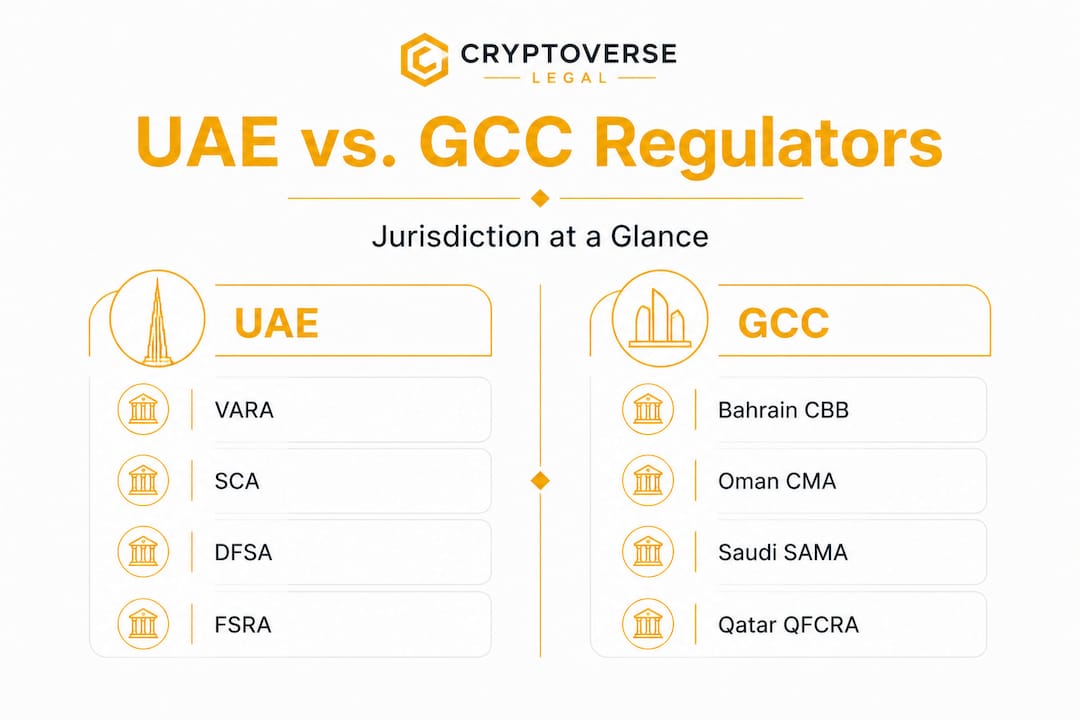
The UAE's multi-regulator structure creates jurisdictional arbitrage opportunities but simultaneously demands precise perimeter analysis to avoid inadvertent regulatory breach. A real-world asset (RWA) token issued by a company in DIFC and marketed to retail investors in mainland Dubai could simultaneously engage DFSA, VARA, and SCA remits.
Across the GCC, the picture varies considerably. Each GCC country brings a distinct regulatory posture to virtual assets:
| Country | Regulator(s) | Current posture |
|---|---|---|
| UAE | VARA, SCA, DFSA, FSRA, CBUAE | Most mature; full VASP licensing |
| Bahrain | CBB (Central Bank of Bahrain) | Crypto-asset module since 2019 |
| Oman | CMA Oman | Provisional framework; evolving |
| Saudi Arabia | SAMA, CMA Saudi | Cautious; restricted retail access |
| Qatar | QFC, QFCRA | Limited; evolving QFC sandbox |
| Kuwait | CBK | Largely restrictive; limited licensing |
For any token project targeting GCC markets, the UAE remains the primary regulatory home. Bahrain offers a credible secondary option for projects targeting the Islamic finance space. Saudi Arabia's regulatory climate, while cautious, is opening cautiously to institutional digital asset activity.
Preparation: prerequisites and compliance groundwork
Once you have selected the right jurisdiction and regulator, the groundwork for a compliant launch starts here.
Choosing the correct legal entity is foundational. VARA-regulated entities must be incorporated in Dubai as mainland or free-zone companies (excluding DIFC and ADGM). DFSA-regulated entities must be incorporated within DIFC. Each regulator has minimum share capital requirements, and some require a locally resident director in addition to a Money Laundering Reporting Officer (MLRO).

Token type determines your licence category. The VARA framework distinguishes between utility tokens, security tokens, asset-referenced tokens, and exchange tokens. Under VARA's Category 1 token issuance workflow, a Token Issuance Licence requires the applicant to obtain a VARA licence, publish a compliant whitepaper, maintain 100% reserves where applicable, and commit to ongoing audits and reporting cycles. The SCA, operating at the federal level, regulates VASPs outside free zones, while payment tokens fall under CBUAE remit, and key personnel including the MLRO must be UAE-resident.
The comparison below summarises the two most commonly sought licences:
| Feature | VARA Token Issuance (Cat 1) | SCA VASP Licence |
|---|---|---|
| Jurisdiction | Dubai (mainland/free zone excl. DIFC) | Federal onshore UAE |
| Capital requirement | Per VARA rulebook (varies by activity) | Per SCA guidelines |
| Key personnel | UAE-resident MLRO required | UAE-resident compliance officer |
| Token types covered | Utility, exchange, asset-referenced | Security tokens, utility tokens |
| Whitepaper required | Yes, regulator-reviewed | Yes, regulator-reviewed |
| Ongoing audits | Mandatory, annual minimum | Mandatory |
Whitepaper preparation is a distinct legal exercise, not a marketing document. VARA and the DFSA require whitepapers to include specific risk disclosures, details of the token's economic structure, rights attached to token holders, dispute resolution mechanisms, and information on token custody arrangements. An inadequate whitepaper is among the most common causes of application rejection.
Your team configuration also matters significantly. Regulators scrutinise the fitness and propriety of founders, directors, MLROs, and compliance officers. Offshore nominees or shell-director arrangements will not pass VARA or DFSA scrutiny. The full VARA licensing process requires detailed personal questionnaires, criminal background checks, and in some cases in-person interviews.
For projects considering the SCA route, note that the SCA's regulatory scope extends to token offerings that constitute securities. Misclassifying a security token as a utility token is a regulatory risk that has resulted in enforcement action in multiple jurisdictions globally.
Pro Tip: Conduct your perimeter analysis within the first week of project scoping, not after corporate structuring. Changing your jurisdiction after incorporation adds months to your timeline and can require full restructuring of your token economics.
Step-by-step execution: from application to issuance
With the compliance foundations in place, the execution phase transforms regulatory theory into real progress.
The application process across VARA, DFSA, and ADGM follows a broadly similar structure, though with regulator-specific documentation requirements and timelines. The steps below reflect the standard workflow:
- Initial scoping and perimeter analysis: Confirm the regulatory perimeter, identify the applicable regulator(s), and determine whether any activities require multiple licences across jurisdictions.
- Corporate structuring: Incorporate the correct entity type in the correct jurisdiction. This includes preparing constitutional documents, shareholder agreements, and any required local partner arrangements.
- Compliance framework build: Draft your AML/CFT (Anti-Money Laundering/Countering the Financing of Terrorism) policies, KYC procedures, sanctions screening protocols, and governance framework prior to submission. Regulators expect to see a functioning compliance architecture, not aspirational policies.
- Whitepaper and disclosure documents: Prepare, review, and finalise the token whitepaper, risk disclosure documents, and any marketing material that will be submitted alongside the application.
- Application submission: Submit the completed application via the regulator's official portal. VARA uses its own online platform. The DFSA and FSRA each have formal application portals with structured submission requirements.
- Regulator review and queries: Expect a formal query period. VARA's rulebook sets out capital requirements per token category, and DFSA regulated entities face monthly returns post-authorisation. ADGM's FSRA typically operates on a three to six month licensing timeline for new applicants.
- Approval and conditions: Upon approval, you receive your licence with conditions attached. These commonly include minimum capital requirements, technology audit obligations, and restrictions on token distribution channels.
- Token issuance: Issue your token in compliance with the approved whitepaper. Maintaining 100% reserves for certain token types, routine audits, and regulatory reporting are mandatory from day one of issuance.
Warning: Rushing legal submissions to meet a product launch deadline is one of the primary causes of avoidable application rejections. Regulators track submission quality, and a poor first submission can signal inadequate governance capacity to the reviewing team. Build your internal review cycle before submitting externally.
Common regulator queries during the review period include requests for additional information on the Ultimate Beneficial Owners (UBOs) of the applicant entity, clarification of the token's rights structure, evidence of technology and cybersecurity controls, and detailed business plans including financial projections and custody arrangements.
Understanding ongoing VASP compliance obligations in the UAE before you launch is essential because regulators expect your compliance infrastructure to be operational, not theoretical.
For a deeper look at the technical and legal sequencing involved in token issuance, the token legal process guide provides additional practical detail on each stage.
Pro Tip: Sequence your internal legal review, then your external auditor's review, before submission to the regulator. This approach surfaces documentation gaps before they become regulator findings, meaningfully reducing your overall approval timeline.
Verification: ongoing obligations and risk management
After the euphoria of launch, robust ongoing monitoring ensures lasting compliance and business survival.
Post-issuance, your compliance programme shifts from a project to an operational function. The regulatory obligations that apply to licensed token issuers in the UAE are extensive and non-negotiable. AML/KYC, Travel Rule compliance, sanctions screening, asset segregation, and technology audits are all standard requirements, with edge cases arising for stablecoin perimeters, legal opinions on RWA tokens, and distributor due diligence.
Core ongoing obligations include:
- AML/CFT compliance: Continuous transaction monitoring, customer due diligence (CDD), and enhanced due diligence (EDD) for higher-risk customers.
- Travel Rule: Compliance with FATF Recommendation 16, requiring the transmission of originator and beneficiary information for virtual asset transfers above the applicable threshold.
- Sanctions screening: Real-time screening of customers and counterparties against UAE, UN, OFAC, and EU sanctions lists.
- Asset segregation: Client virtual assets must be segregated from the company's own assets. See VARA's requirements on safeguarding client virtual assets for the specific custody model requirements.
- Technology and cybersecurity audits: Annual or bi-annual assessments of the token's technical infrastructure.
- Regulatory reporting: Periodic reports to the relevant regulator, covering financial position, transaction volumes, incident reports, and AML statistical data.
UAE virtual asset reporting volumes have risen significantly, reflecting intensified regulatory oversight as the market matures and new sandboxes and sovereign digital asset integration programmes come online.
The table below summarises ongoing obligations by regulatory category:
| Obligation | VARA licensed | DFSA regulated | FSRA (ADGM) regulated |
|---|---|---|---|
| AML/KYC | Mandatory | Mandatory | Mandatory |
| Travel Rule | Mandatory | Mandatory | Mandatory |
| Sanctions screening | Mandatory | Mandatory | Mandatory |
| Asset segregation | Mandatory | Mandatory | Mandatory |
| Technology audit | Annual | Annual | Annual |
| Regulatory reporting | Monthly/quarterly | Monthly | Quarterly |
| Capital adequacy review | Per rulebook | Per DFSA module | Per FSRA rules |
Common post-issuance failures include under-resourced MLRO functions, templated AML policies that do not reflect the actual token product, and failure to update compliance frameworks when the regulatory perimeter shifts. Edge cases demand particular attention: stablecoin issuers face additional reserve and audit requirements, RWA token projects may need separate legal opinions on the asset backing, and projects using distributors must apply due diligence standards to those distributors as if they were direct customers.
What most guides miss: compliance is a continuous process, not a box-ticking exercise
Most regulatory guides treat compliance as a phase that ends at licence issuance. In practice, the highest-risk period for a licensed token issuer begins the week after approval. Regulators are increasingly conducting supervisory visits, reviewing transaction monitoring outputs, and assessing whether the compliance framework in operation matches the one described in the licence application.
The trouble with templated offshore compliance solutions is that they are designed for a generic legal environment, not for the specific token type, business model, and customer base the regulator reviewed and approved. When you use a generic AML policy for a product it was never written for, every audit becomes a liability.
Agile projects win regulatory trust by treating their compliance framework as a living document. Real-world tokenisation legal workflows demonstrate that projects which update their risk registers in response to regulatory guidance, not just enforcement action, maintain significantly better standing with their regulators.
Pro Tip: Build genuine internal expertise. Train your MLRO and compliance team on your specific token type's risk profile. Regulators notice the difference between a team that understands its product's regulatory risk and one that is simply managing a checklist.
How we help you master blockchain token compliance in the UAE and GCC
If your goal is robust, future-proof compliance, expert support can make all the difference.
At CRYPTOVERSE Legal, we support token issuers and VASPs across every stage of the regulatory lifecycle. From initial perimeter analysis to VARA, SCA, DFSA, and FSRA licence applications, our team delivers regulator-ready legal work that holds up to scrutiny.
Our digital asset legal advisory services cover corporate structuring, whitepaper review, AML/CFT policy drafting, and ongoing compliance support. Whether you are pursuing VARA licence advisory for a new token project or need clarity on regulated activities under VARA, our team combines regulatory depth with practical experience across all five UAE regulators. Contact us to discuss your project and find the fastest compliant path to market.
Frequently asked questions
What is the VARA Category 1 token issuance process?
The VARA Cat 1 process involves obtaining the VARA Token Issuance Licence, publishing a regulator-reviewed whitepaper, maintaining 100% reserves where required, conducting mandatory audits, and fulfilling ongoing regulatory reporting obligations.
Which GCC countries allow blockchain token launches?
The UAE and Bahrain allow regulated launches under established frameworks. Oman has a provisional framework, Saudi Arabia permits limited institutional activity, Qatar operates an evolving QFC sandbox, and Kuwait remains largely restrictive.
What are the ongoing compliance duties for token issuers in the UAE?
Ongoing obligations include AML/KYC monitoring, Travel Rule compliance, sanctions screening, asset segregation, technology audits, capital adequacy maintenance, and periodic regulatory reporting to the applicable regulator.
Are there any banned token types in the UAE?
Yes. Privacy coins and algorithmic tokens are banned across the UAE under VARA rules and consistent federal guidance. Projects using these token types cannot obtain regulatory approval in any UAE jurisdiction.