

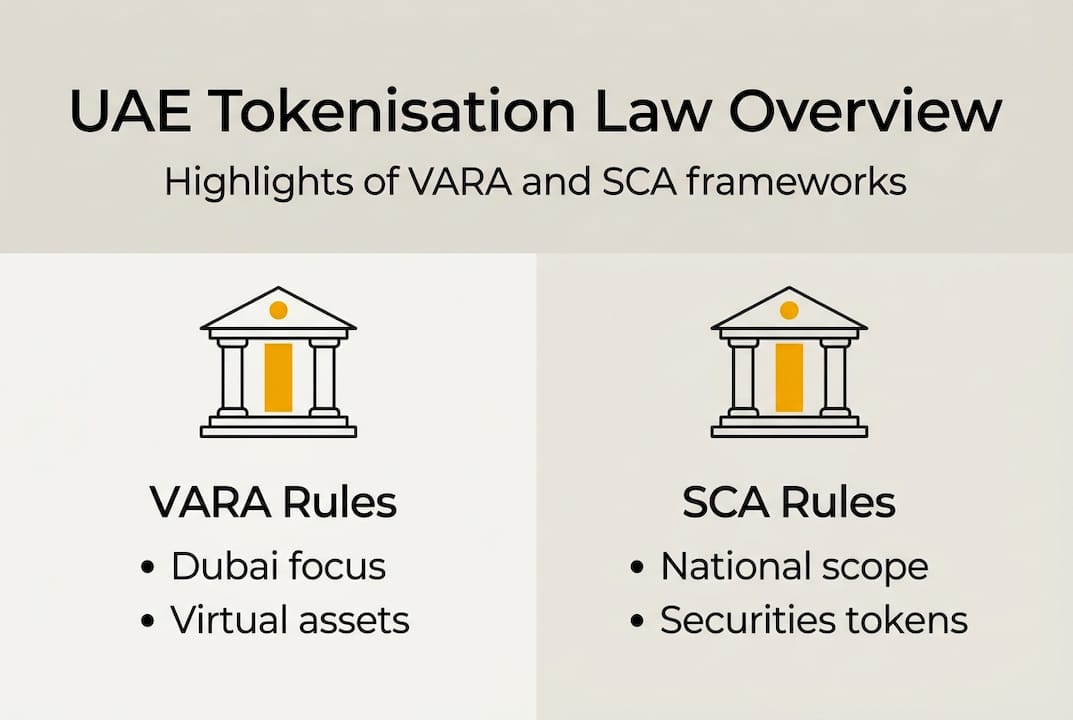
Tokenisation in the UAE operates under a dual regulatory framework that can confuse even seasoned crypto startups and VASPs. The Virtual Assets Regulatory Authority (VARA) governs Dubai's virtual asset issuances, while the Securities and Commodities Authority (SCA) oversees tokenised securities and commodity derivatives at the federal level. Missteps in licensing, whitepaper drafting, or on-chain registration can trigger fines, contract voidance, and reputational damage. This guide walks you through the essential legal steps to tokenise assets compliantly, covering prerequisites, execution protocols, and post-issuance risk management so you can launch with confidence.
Key Takeaways
| Point | Details |
|---|---|
| Dual regulatory framework | The UAE operates a dual regime with VARA governing Dubai issuances and the SCA regulating tokenised securities at federal level, requiring careful mapping of responsibilities. |
| Category based licensing | Licensing and disclosure depend on whether the token falls into VARA Category 1 FRVA ARVA or Category 2, with exemptions for low value or utility tokens. |
| On chain enforceability | Token rights must be registered on distributed ledger technology through legally binding agreements to ensure on chain enforceability under UAE law. |
| Proactive legal guidance | Engage experienced counsel early to navigate licensing across regulators and to map token structure before launch. |
Tokenisation legal prerequisites in the UAE
Before issuing a single token, you must secure the right licences and classify your asset correctly. VARA's Virtual Asset Issuance Rulebook categorises issuances into three tiers: Category 1 covers Fiat-Referenced Virtual Assets (FRVA) and Asset-Referenced Virtual Assets (ARVA) that require full licensing and whitepaper publication. Category 2 applies to tokens not meeting Category 1 criteria but still subject to disclosure rules. Exemptions exist for low-value or utility tokens outside VARA's scope.
Meanwhile, SCA regulates tokenised securities and commodity token contracts with a narrower focus on enforceability and licensed trading venues. If your token represents equity, debt, or commodity derivatives, SCA approval is essential. The regulator requires that token rights be registered on distributed ledger technology through legally binding agreements, ensuring on-chain enforceability under UAE law.
Understanding which regulator applies depends on your token's nature and issuance location. VARA jurisdiction covers Dubai's free zones, including DIFC and non-DIFC zones, while SCA authority extends across the UAE mainland. Real-world asset (RWA) tokens may qualify for exemptions under SCA rules if they meet specific criteria, but ARVA classification under VARA can still apply depending on structure.
Key prerequisites include:
- Determining whether your token is a security, commodity, FRVA, ARVA, or exempt asset
- Obtaining VARA Category 1 licensing if issuing FRVA or ARVA in Dubai
- Securing SCA approval for tokenised securities or commodity derivatives
- Drafting a compliant whitepaper disclosing risks, governance, and technical architecture
- Preparing registration agreements for on-chain enforceability
- Establishing segregated reserves if required by VARA for Category 1 tokens
Pro Tip: Engage legal counsel early to map your token structure against both VARA and SCA frameworks. Misclassification can delay launch by months and trigger retroactive compliance obligations.
Navigating crypto regulations in the UAE requires clarity on jurisdictional boundaries and asset definitions. A token that qualifies as a security under SCA rules may also fall under VARA's ARVA category, creating overlapping compliance duties. Legal advisors help you identify the primary regulator and coordinate filings to avoid duplication or gaps.
Step-by-step token issuance process under VARA and SCA
Once prerequisites are met, follow this structured process to issue tokens compliantly under UAE law.
-
Determine applicable regulatory framework and issuance category. Assess whether your token is FRVA, ARVA, security, commodity derivative, or exempt. Confirm whether VARA or SCA is the primary regulator, or if both apply.
-
Prepare and submit licensing applications and whitepapers. For VARA Category 1 tokens, submit a detailed application including governance structure, technical specifications, and risk management plans. Publish a whitepaper meeting VARA's disclosure standards. For SCA securities tokens, file registration documents and compliance attestations.
-
Draft and register legal agreements on distributed ledger technology. Create registration agreements that define token holder rights, issuer obligations, and dispute resolution mechanisms. VARA requires prior approval for Category 1 issuances with segregated reserves and monthly risk reporting. Register these agreements on-chain to ensure enforceability.
-
Conduct wallet whitelisting and audits per SCA rules. SCA mandates trading on licensed markets or alternative trading systems (ATS) and requires wallet whitelisting for tokenised securities. Complete independent audits of smart contracts and custody arrangements before launch.
-
Establish segregated reserves and risk management plans. VARA Category 1 tokens must maintain segregated reserves matching token supply. Implement daily reconciliations and risk assessments to monitor reserve adequacy and market volatility.
-
Enable trading only on licensed platforms or ATS. Ensure your token lists exclusively on VARA-licensed exchanges or SCA-approved trading venues. Unauthorised trading can void contracts and trigger enforcement actions.
Pro Tip: Use a phased rollout strategy. Launch a pilot under regulatory sandbox provisions to test compliance systems before full-scale issuance.
| Requirement | VARA Framework | SCA Framework |
|---|---|---|
| Licensing trigger | Category 1 FRVA/ARVA issuance | Tokenised securities or commodity derivatives |
| Whitepaper | Mandatory for Category 1, recommended for Category 2 | Required for securities tokens |
| On-chain registration | Encouraged for enforceability | Mandatory via registration agreements |
| Trading venues | VARA-licensed exchanges only | SCA-licensed markets or ATS only |
| Wallet whitelisting | Not mandated | Mandatory for securities tokens |
| Segregated reserves | Required for Category 1 tokens | Not specified |
| Reporting frequency | Monthly risk reports | Quarterly audits and ongoing disclosures |
Understanding VARA token issuance rules in Dubai and aligning them with SCA requirements prevents regulatory conflicts. If your token operates across both jurisdictions, coordinate filings and maintain dual compliance systems. Legal advisors can streamline this process by managing regulator communications and documentation.
Compliance extends beyond launch. Regulatory compliance for virtual asset platform operators includes ongoing monitoring, reporting, and system audits to maintain good standing with regulators.
Managing compliance and regulatory risks post-issuance
After your token goes live, ongoing compliance obligations intensify. Both VARA and SCA impose strict reporting, audit, and risk management requirements to protect investors and maintain market integrity.
Key post-issuance obligations include:
- Submitting monthly risk reports to VARA for Category 1 tokens, covering reserve adequacy, market exposure, and operational incidents
- Filing quarterly audit reports with SCA for tokenised securities, including wallet whitelisting updates and trading venue compliance
- Conducting daily reconciliations of token supply against segregated reserves
- Maintaining transparent custody arrangements with licensed custodians
- Refreshing wallet whitelists regularly to prevent unauthorised transfers
- Updating whitepapers and disclosure documents when material changes occur
- Implementing incident response plans for smart contract vulnerabilities or market disruptions
Strict ongoing obligations include quarterly risk reports, audits, and daily reconciliations under VARA. Non-compliance can result in fines, licence suspension, or contract voidance. VARA's enforcement powers include on-site inspections and mandatory remediation orders.

Multi-regulator oversight and nuanced distinctions require expert navigation to avoid fines and contract voidance. When VARA and SCA both apply, you must satisfy the stricter standard for each requirement. For example, if VARA mandates monthly reporting and SCA requires quarterly audits, you must comply with both.
RWA tokens present unique challenges. Real estate or commodity-backed tokens may qualify for SCA exemptions if structured through special purpose vehicles (SPVs) and meet specific criteria. However, VARA's ARVA classification can still apply if the token references multiple assets or operates in Dubai. Legal advisors help you structure SPVs and registration agreements to maximise exemptions while maintaining enforceability.
"The intersection of VARA and SCA frameworks creates compliance complexity that demands proactive legal strategy. Issuers must document every decision, maintain meticulous records, and anticipate regulatory evolution to sustain long-term market access."
Risk management extends beyond regulatory compliance. Smart contract audits, penetration testing, and disaster recovery plans protect against technical failures. Segregated reserves insulate token holders from issuer insolvency. Transparent governance structures build investor confidence and facilitate regulatory reviews.
Staying current with regulatory updates is critical. VARA and SCA frequently issue guidance notes, consultation papers, and rule amendments. Participating in regulatory sandboxes and industry working groups provides early insight into upcoming changes. Legal counsel monitors these developments and advises on necessary adjustments to maintain compliance.
Compliance risk management rulebook requirements under VARA and SCA demand robust internal controls, regular training, and independent oversight. Appointing a dedicated compliance officer and establishing a compliance committee strengthens your governance framework and demonstrates regulatory commitment.
Common challenges and expert tips for successful tokenisation in the UAE
Even well-prepared issuers encounter obstacles. Understanding common pitfalls and applying expert strategies can prevent costly delays and enforcement actions.
Typical challenges include:
- Launching tokens without proper licensing, assuming exemptions apply when they do not
- Drafting inadequate whitepapers that omit required disclosures or misrepresent risks
- Confusing VARA and SCA jurisdictions, leading to incomplete or duplicate filings
- Misclassifying RWA tokens, triggering unexpected ARVA obligations under VARA
- Failing to register token rights on-chain, rendering contracts unenforceable
- Listing on unlicensed exchanges, voiding trading activity and exposing issuers to penalties
- Neglecting ongoing reporting and audit requirements, resulting in licence suspension
Pro Tip: Prioritise regulatory strategy before technical development. Engage legal advisors during the token design phase to align smart contract logic with compliance requirements. Retrofitting compliance after launch is exponentially more difficult and expensive.
Prypco's May 2025 pilot showed rapid funding success under VARA but required strict ongoing compliance. The case demonstrates that regulatory approval accelerates market entry but demands sustained operational discipline. Issuers must budget for compliance costs, including legal fees, audit expenses, and technology infrastructure.
Navigating multi-regulator overlaps remains a critical challenge requiring strategic legal guidance. When VARA and SCA both apply, coordinate filings to avoid contradictory representations. Legal advisors can negotiate with regulators to clarify ambiguous requirements and secure written confirmations.
| Factor | VARA Framework | SCA Framework |
|---|---|---|
| Innovation focus | Broad, covering utility tokens, NFTs, and RWAs | Narrow, focused on securities and commodity derivatives |
| Regulatory approach | Principles-based with detailed rulebooks | Prescriptive with strict enforceability rules |
| Sandbox availability | Active sandbox for pilot projects | Limited sandbox, case-by-case approvals |
| Key compliance challenge | Segregated reserves and monthly reporting | Wallet whitelisting and licensed trading venues |
| Benefit | Faster approvals for innovative structures | Clear enforceability for traditional securities |
| Best suited for | Crypto-native startups, DeFi protocols, RWA tokenisation | Institutional issuers, traditional finance entering crypto |
Comparing Dubai versus Saudi tokenisation for real estate and gold reveals distinct regulatory philosophies. Dubai's VARA framework encourages innovation with flexible licensing tiers, while Saudi Arabia's Capital Market Authority imposes stricter securities rules. Understanding these differences helps you choose the optimal jurisdiction for your token structure.
Expert tips for success:
- Conduct a regulatory gap analysis before launch to identify all applicable requirements
- Build compliance into smart contract logic, automating reporting and reserve reconciliations where possible
- Establish relationships with licensed custodians, auditors, and trading venues early
- Participate in industry associations and regulatory consultations to influence rule development
- Maintain a compliance budget equal to at least 15% of operational costs
- Document all legal and technical decisions to support regulatory reviews and audits
Staying ahead of regulatory evolution is essential. VARA's 2.0 framework introduced enhanced tokenisation rules in 2025, expanding coverage to RWAs and clarifying ARVA definitions. SCA's 2025 amendments tightened wallet whitelisting and trading venue requirements. Legal advisors monitor these changes and advise on necessary adjustments to maintain compliance.
Expert legal consultancy for tokenisation in the UAE
Navigating VARA and SCA frameworks demands specialist legal expertise. CRYPTOVERSE Legal Consultancy provides end-to-end support for tokenisation projects, from initial licensing applications through post-issuance compliance and risk management.
Our team guides you through every step: determining regulatory classification, drafting compliant whitepapers, structuring on-chain registration agreements, securing VARA and SCA approvals, and implementing ongoing reporting systems. We help you avoid costly pitfalls by aligning token design with regulatory requirements from day one.
Whether you are tokenising real estate, launching a stablecoin, or issuing securities tokens, our tokenisation legal services deliver regulator-ready solutions. We advise on VARA regulations and licensing for Dubai-based issuances and coordinate SCA licensing for virtual asset service providers across the UAE. Our expertise spans multi-regulator coordination, SPV structuring, and smart contract compliance, ensuring your project meets the highest legal standards.
Frequently asked questions
What is the difference between VARA and SCA regarding tokenisation?
VARA governs virtual asset issuances primarily in Dubai, covering FRVA, ARVA, utility tokens, and RWAs under a principles-based framework. SCA regulates tokenised securities and commodity derivatives at the federal level, focusing on enforceability and licensed trading venues. VARA applies to crypto-native projects, while SCA oversees traditional securities entering blockchain infrastructure.
Do I need a licence to issue tokens in the UAE?
Category 1 tokens under VARA, including FRVA and ARVA, require prior licensing and whitepaper publication. SCA mandates approval for tokenised securities and commodity derivatives traded on licensed venues. Exemptions exist for low-value tokens, utility tokens outside VARA's scope, and certain RWA structures meeting SCA criteria. Legal advisors assess your token to determine licensing obligations.
How are token rights enforced legally on the blockchain?
Token rights must be registered on distributed ledger technology via enforceable registration agreements recognised by SCA and VARA. These agreements define holder rights, issuer obligations, and dispute resolution mechanisms. On-chain registration ensures enforceability under UAE law, preventing contract voidance and protecting investor claims.
What ongoing compliance is required after token issuance?
VARA requires monthly risk reports, daily reserve reconciliations, and quarterly audits for Category 1 tokens. SCA mandates quarterly compliance filings, wallet whitelisting updates, and trading venue attestations for securities tokens. Both regulators require incident reporting, whitepaper updates, and independent audits. Non-compliance triggers fines, licence suspension, or enforcement actions.
Can I tokenise real estate or commodities under UAE law?
Yes, but classification depends on structure. Real estate tokens may qualify as RWAs exempt from SCA securities rules if structured through SPVs meeting specific criteria. However, VARA's ARVA classification can apply if the token references multiple assets or operates in Dubai. Commodity tokens fall under SCA's commodity derivatives framework if traded on licensed venues. Legal advisors structure these tokens to maximise exemptions while ensuring enforceability.