

TL;DR:
- UAE's Web3 licensing depends on specific jurisdiction and business model, not a single regime.
- Full VASP licenses involve significant costs, capital requirements, and detailed compliance processes.
- Strategic planning from the start ensures smooth licensing, operational compliance, and scalable growth.
The UAE has positioned itself as one of the world's most advanced environments for virtual asset businesses, yet the regulatory landscape is genuinely complex. Choosing the wrong jurisdiction, misclassifying your activity, or underestimating compliance costs can cost you months and hundreds of thousands of dirhams. Rapid regulatory updates across VARA, the ADGM FSRA, the DFSA, and the DMCC mean that information from even twelve months ago may already be outdated. This guide provides a structured, practical roadmap covering UAE jurisdictions, legal structuring, licensing processes, cost benchmarks, and post-approval obligations, so you can move from concept to operation with clarity and confidence.
Key Takeaways
| Point | Details |
|---|---|
| Select the right jurisdiction | VARA, ADGM, and DMCC each serve different types of Web3 business models in the UAE. |
| Understand cost and timelines | Licensing and setup costs can range from AED30k to millions, with varying application lengths. |
| Prepare for full compliance | AML, technology vetting, and ongoing reporting are critical for long-term security and operation. |
| Plan for growth and scaling | Jurisdiction and licence structure affect your ability to expand services and products. |
Understanding UAE jurisdictions for Web3 businesses
The UAE does not operate under a single federal licensing regime for virtual assets. Instead, multiple jurisdictions govern Web3 activity: VARA covers Dubai (excluding DIFC), the ADGM FSRA covers Abu Dhabi Global Market, the DFSA governs the Dubai International Financial Centre, and the DMCC functions as a free-zone entry point for non-custodial Web3 activity. Understanding which authority applies to your specific business model is the single most important decision you will make before committing capital.
Each regulator operates with a distinct statutory remit and serves a different market segment:
| Regulator | Location | Primary focus | Best suited for |
|---|---|---|---|
| VARA | Dubai (excl. DIFC) | Retail and institutional VASP licensing | Exchanges, custody, broker-dealers, DeFi |
| ADGM FSRA | Abu Dhabi | Institutional finance, tokenisation | RWA projects, institutional DeFi, funds |
| DFSA | DIFC, Dubai | Financial services regulation | Institutionally oriented VA activity |
| DMCC | Dubai free zone | Non-custodial blockchain activity | Developers, NFT studios, non-VASP Web3 |
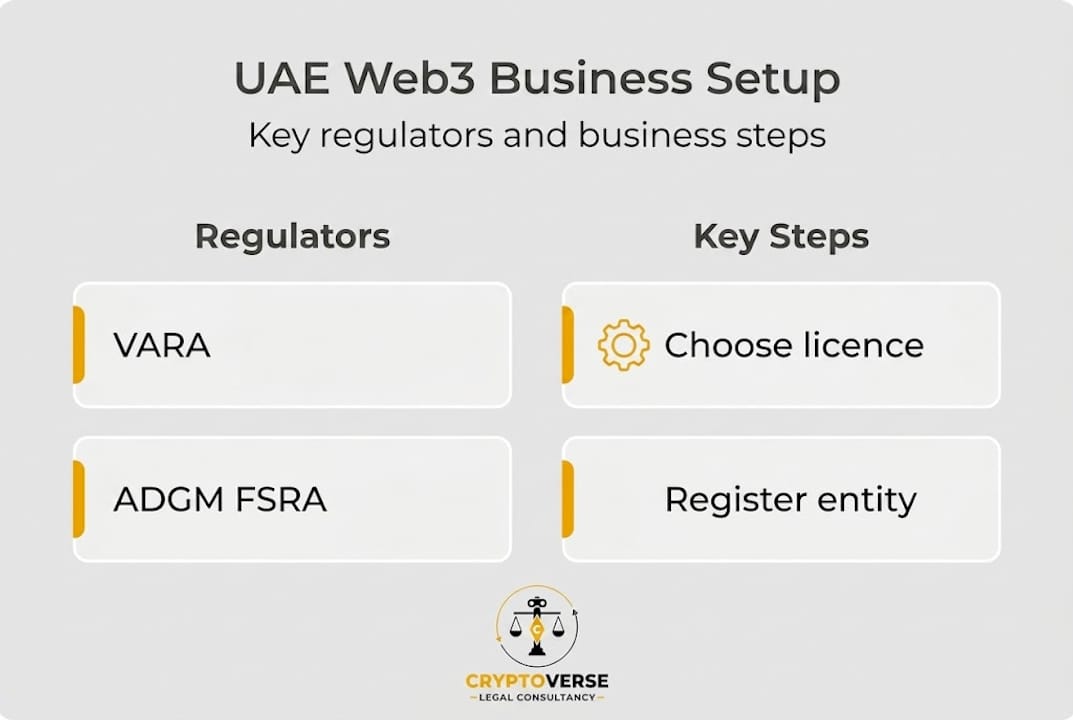
For founders targeting retail crypto trading or operating a centralised exchange, VARA is the primary regulator. Major global platforms including Binance, OKX, and Bybit have pursued VARA licensing precisely because it enables direct retail market access within Dubai, the region's most commercially active market.
For businesses focused on real-world asset (RWA) tokenisation, structured financial products, or servicing institutional clients, the ADGM FSRA offers a common-law framework with robust investor protections that institutional counterparties often require as a condition of engagement.
The DMCC Crypto Centre suits businesses that do not handle client virtual assets directly. Blockchain developers, NFT marketplaces operating on a non-custodial model, and Web3 software companies can incorporate quickly and cost-effectively without triggering full VASP licensing obligations.
The DFSA occupies a narrower niche, covering virtual asset activities conducted within the DIFC boundary. It is relevant if your commercial strategy involves co-locating with DIFC-based financial institutions or serving their client base.
Key principle: The regulator you choose determines not only your compliance obligations but also the types of users you can serve, the products you can offer, and your long-term scaling pathway. Misalignment between your business model and regulatory classification is one of the most common and costly errors at this stage.
The VARA licensing process differs substantially from ADGM's activity-based Financial Services Permission framework. Taking time to map your specific activities against each regulator's permitted scope before making any incorporation decisions pays significant dividends later.
Planning your entry: Choosing the right structure and licence
Now that you have identified the jurisdiction, the next step is to align your business model with the proper structure and licences.
The first question to resolve is whether your business qualifies as a Virtual Asset Service Provider (VASP). Under UAE regulation and aligned with FATF standards, VASP status is triggered when a business exchanges, transfers, safeguards, administers, or arranges participation in virtual assets on behalf of clients. If you are handling client funds or virtual assets in any capacity, full VASP licensing is required. If you are building non-custodial tools, software, or NFT platforms where users retain full control of their assets, you may operate under a lighter regulatory framework via DMCC or a comparable free-zone structure.
The range of regulated activities under VARA includes:
- Virtual asset exchange services (centralised or decentralised trading)
- VA broker-dealer services (facilitating trades for clients)
- VA custody services (holding client assets)
- VA lending and borrowing
- VA management and investment services
- VA transfer services
VARA also addresses DeFi protocols under its broader regulatory scope, meaning that even decentralised platforms with governance tokens or fee-generating mechanisms may attract regulatory scrutiny depending on their architecture.
Cost and capital benchmarks vary significantly by jurisdiction and activity:
| Jurisdiction / Activity | Approx. year-one cost | Minimum capital |
|---|---|---|
| Non-VASP (RAK/DMCC) | AED 30k–50k | Not specified |
| VARA VASP licence | AED 300k–6M | AED 500k–2M (activity-dependent) |
| ADGM FSRA FSP | AED 1.4M+ | USD 250k–1M (activity-dependent) |
The wide range within the VARA VASP category reflects the complexity of the regulated activity. An exchange operation incurs significantly higher capital requirements and compliance infrastructure costs than a single-activity broker-dealer.
MVP and RegLab pathways are available for lower-risk pilots. Both VARA and ADGM FSRA maintain innovation-friendly programmes that allow businesses to test regulated products under a supervised regime before committing to a full licence. These are not a shortcut to market but rather a structured opportunity to validate your product with regulatory oversight before scaling.
Pro Tip: Engage a qualified legal adviser before selecting your company structure. Decisions made at incorporation, including shareholder arrangements, shareholding thresholds, and constitutional documents, directly affect your regulatory approval timeline and capital obligations.
Step-by-step process: How to apply and get licensed
With your company structure and licence pathway clear, here is how to move through the actual application and approvals, step by step.

VARA licensing pathway
The VARA application process follows a two-stage structure: Approval to Incorporate (ATI), followed by the Full VASP Licence. Minimum capital requirements are activity-specific: AED 2M for exchange services, AED 1M for custody, and AED 500k for broker-dealer activity. The process runs approximately four to six months in total and covers:
- Initial approval from DET or DMCC (depending on your onshore or free-zone structure)
- Submission of Initial Disclosure Questionnaire (IDQ) covering ownership, business model, financial projections, and key personnel
- Payment of application fees (which vary by activity category)
- Submission of full documentation package, including AML/CFT policy, compliance manual, technology architecture review, and governance structure
- VARA's review and approval of the ATI, following which you may incorporate the entity
- Full licence application, including completion of capital requirements and appointment of a Compliance Officer and MLRO
- Technology and systems audit conducted by VARA or an approved third party
- Issuance of Full VASP Licence and registration on VARA's public register
ADGM FSRA pathway
The ADGM FSRA issues activity-based Financial Services Permissions (FSPs) for virtual asset activities. Capital requirements are: USD 250k or above for broker-dealer, USD 500k to 1M for exchanges, and USD 500k for custody. Every token or virtual asset your business intends to use must receive an Accepted Virtual Asset (AVA) approval from the FSRA before it can be listed or utilised commercially. ADGM operates under English common law, which institutional investors and fund managers frequently require as a contractual condition.
DeFi protocols and tokenisation projects fall within the FSRA's regulated perimeter in ADGM, making it the preferred jurisdiction for structured RWA transactions and institutional-grade digital asset products.
Common mistakes that delay or derail applications include:
- Submitting incomplete or generic AML/CFT policies that do not reflect the specific risks of your custody model or transaction flows
- Failing to appoint a qualified MLRO before the application stage
- Underestimating the technology review scope and timeline
- Providing inadequate financial projections or proof of capital adequacy
- Misclassifying the activity (for example, treating a custodial wallet product as non-custodial)
Pro Tip: VARA's review team scrutinises the substance of your AML/CFT framework, not just its existence. Generic templates derived from non-UAE sources frequently fail technical review. Your policies must be mapped to UAE Federal AML Law No. 20 of 2018 and its executive regulations, as well as VARA's own rulebook.
After approval: Operations, compliance, and scaling tips
Once established, ongoing compliance and operations are critical to ensure long-term business success.
Receiving your licence is the beginning of your regulatory obligations, not the end. VARA and ADGM FSRA both impose continuous compliance requirements that require sustained resource allocation. The most significant ongoing obligations include:
- Periodic regulatory reporting: Financial returns, suspicious transaction reports (STRs), and activity data must be filed at intervals specified in your licence conditions
- Annual AML/CFT programme reviews: Your AML framework must be reviewed and updated to reflect changes in your business model, product suite, and FATF risk typologies
- Technology and cybersecurity audits: Regulators expect evidence of ongoing controls testing, penetration testing, and incident response planning
- Travel Rule compliance: The UAE has implemented FATF Recommendation 16 (the Travel Rule), requiring VASPs to exchange originator and beneficiary information for virtual asset transfers above specified thresholds
- Licence amendment obligations: Adding a new product, listing a new virtual asset, or entering a new market segment may require formal notification or licence variation approval before you proceed
On the tax side for virtual asset brokers, free-zone entities that qualify under the UAE's Qualifying Free Zone Person rules benefit from 0% corporate tax on qualifying income. Mainland entities, or free-zone entities with non-qualifying income, are subject to the standard corporate tax rate of 9% on taxable income above AED 375,000.
Strategic scaling considerations for post-approval growth include:
- Upgrading regulatory permissions as you add product lines (for example, moving from broker-dealer to full exchange activity requires a licence variation and additional capital)
- Expanding across jurisdictions: Businesses that outgrow a single UAE jurisdiction may pursue concurrent licensing in ADGM and VARA, or expand internationally under frameworks such as MiCA, MAS, or FCA
- Governance reviews: As headcount and transaction volumes grow, your compliance function must scale proportionately. Regulators monitor whether your compliance infrastructure remains adequate relative to your operational risk profile
Common pitfalls in the operational phase:
- Compliance drift: Policies become outdated as the business evolves but are not formally updated or reviewed
- Slow response to regulatory change: VARA and ADGM issue guidance and rulebook amendments regularly. Businesses that fail to monitor and implement these changes risk enforcement action
- Inadequate record-keeping: Regulators expect full audit trails for all virtual asset transactions, client onboarding records, and internal compliance decisions
Pro Tip: Appoint a dedicated compliance officer with direct reporting access to senior management and the board. This structure signals regulatory seriousness and reduces the risk of compliance being deprioritised during periods of rapid commercial growth.
What most guides miss: Strategic choices for Web3 success in the UAE
Most compliance guides focus on process mechanics. What they understate is that your jurisdiction choice is a strategic business decision, not merely an administrative one. Choosing VARA positions you for retail market access and mainstream exchange activity. Choosing ADGM FSRA positions you for institutional counterparties, fund structures, and tokenisation. These are fundamentally different commercial trajectories, and switching after incorporation is expensive and time-consuming.
There is also a persistent myth that non-VASP or sandbox setups offer a practical route to operating a regulated business at low cost. In practice, the global VASP licensing landscape makes clear that businesses seeking to scale, raise institutional capital, or access banking infrastructure will eventually require full regulatory authorisation. Binance, Bybit, and OKX did not achieve market credibility through interim structures. They pursued full licensing because institutional partners, banking providers, and sophisticated investors require it.
Regulatory upgrades should be planned from day one, not treated as a distant problem. The cost and complexity of upgrading from a minimal licence to full VASP authorisation mid-operation is substantially higher than building toward it from the outset. Build your governance, technology, and compliance infrastructure to a standard that supports the licence you will eventually need, not merely the one you have today.
Get expert help setting up your Web3 business in the UAE
Navigating the UAE's Web3 regulatory environment is significantly more efficient with specialist legal support engaged from the outset. Misclassification, incomplete documentation, and inadequate compliance frameworks are the leading causes of application delays and rejections, all of which are avoidable with the right guidance.
At CRYPTOVERSE Legal, our team advises Web3 founders and established operators across VARA regulations and licensing, ADGM, DFSA, and beyond. Whether you are launching an exchange, structuring a tokenisation project, or building a DeFi protocol, our digital asset legal consultants provide regulator-ready frameworks that stand up to scrutiny. From ATI through to full VASP approval, we manage the process so you can focus on building your business. Speak with our team today to assess your licensing pathway and compliance requirements.
Frequently asked questions
What are the main steps to set up a Web3 business in the UAE?
Select the right jurisdiction, form a legal entity, and apply for the relevant licence with full documentation covering AML/CFT policies, governance, technology, and capital adequacy. VARA's two-stage process (ATI then Full VASP Licence) is the standard pathway for Dubai-based exchanges and VASPs, with minimum capital ranging from AED 500k to AED 2M depending on activity.
How long does it take to get licensed for a Web3 business in the UAE?
Non-regulated setups can be completed in two to four weeks, while a full VARA or ADGM FSRA licence typically takes four to six months from initial submission to approval, depending on document quality and the complexity of the proposed business model.
Do all Web3 businesses in the UAE need a VARA licence?
Only businesses handling client virtual assets or funds trigger full VASP licensing obligations. Non-custodial operators such as blockchain developers, NFT studios, and Web3 software companies can use the DMCC Crypto Centre at costs of AED 30k to 50k in year one, without a VARA licence.
How much does it cost to set up a Web3 business in the UAE?
Setup costs range from AED 30k to 50k for non-VASP structures through DMCC or RAK, AED 300k to 6M for a VARA VASP licence in year one, and AED 1.4M or above for an ADGM FSRA Financial Services Permission, excluding capital adequacy requirements.
What are common mistakes when setting up a Web3 venture in the UAE?
The most frequent errors are misclassifying custodial activity as non-VASP and failing to budget adequately for compliance infrastructure. Always assess whether your handling of client virtual assets or funds triggers full licensing, and use MVP or RegLab pathways only for genuine product testing rather than as a substitute for full authorisation.