

A public, permissionless blockchain such as Bitcoin or Ethereum prioritises open participation and censorship resistance, letting anyone read the ledger, submit transactions and validate blocks. A permissioned blockchain such as Hyperledger Fabric or R3 Corda restricts those roles to vetted, identified participants, trading some decentralisation for privacy, control and regulatory fit. Open, composable markets tend to favour the former; regulated enterprise workflows favour the latter, with hybrid designs bridging the two.
Permissioned vs public blockchain: the definitions that matter
Two separate questions get conflated constantly, and clearing them up resolves most confusion around this topic. The first is visibility: can anyone read the ledger, or is it restricted to a defined group? That is the public versus private distinction. The second is access control: can anyone submit transactions and validate blocks, or must participants be approved? That is the permissioned versus permissionless distinction, and the two axes combine independently. A network can be public yet permissioned, meaning anyone can read it while only approved entities validate, which matters enormously for auditability paired with controlled write access.
Bitcoin and Ethereum are the canonical permissionless, public examples: open ledgers, open validation, no gatekeeper. Hyperledger Fabric and R3 Corda sit at the other end, built specifically for consortium and enterprise deployments where selective visibility is a design requirement rather than an afterthought.
Each model's defining traits, stripped to essentials:
- Public/permissionless (Bitcoin, Ethereum): open read, open write, open validation, secured by economic incentives.
- Permissioned (Hyperledger Fabric, R3 Corda): restricted validation, known identities, institutional consensus, selective data sharing via channels or point-to-point exchange.
- Public/permissioned hybrids: open read access with a curated validator set, common in consortium-run public utilities.
How consensus, identity and visibility diverge in practice
The technical machinery behind each model explains why the trade-offs show up where they do. Public networks secure themselves through economic consensus, Proof of Work or Proof of Stake, where anyone can compete to validate blocks provided they stake capital or computation. Permissioned networks rely on institutional consensus instead, protocols like Practical Byzantine Fault Tolerance (PBFT) or Raft, where a known, finite set of validators agrees on state. Alchemy's overview of the two models frames this as the root cause of nearly every downstream difference in cost, speed and security assumptions.
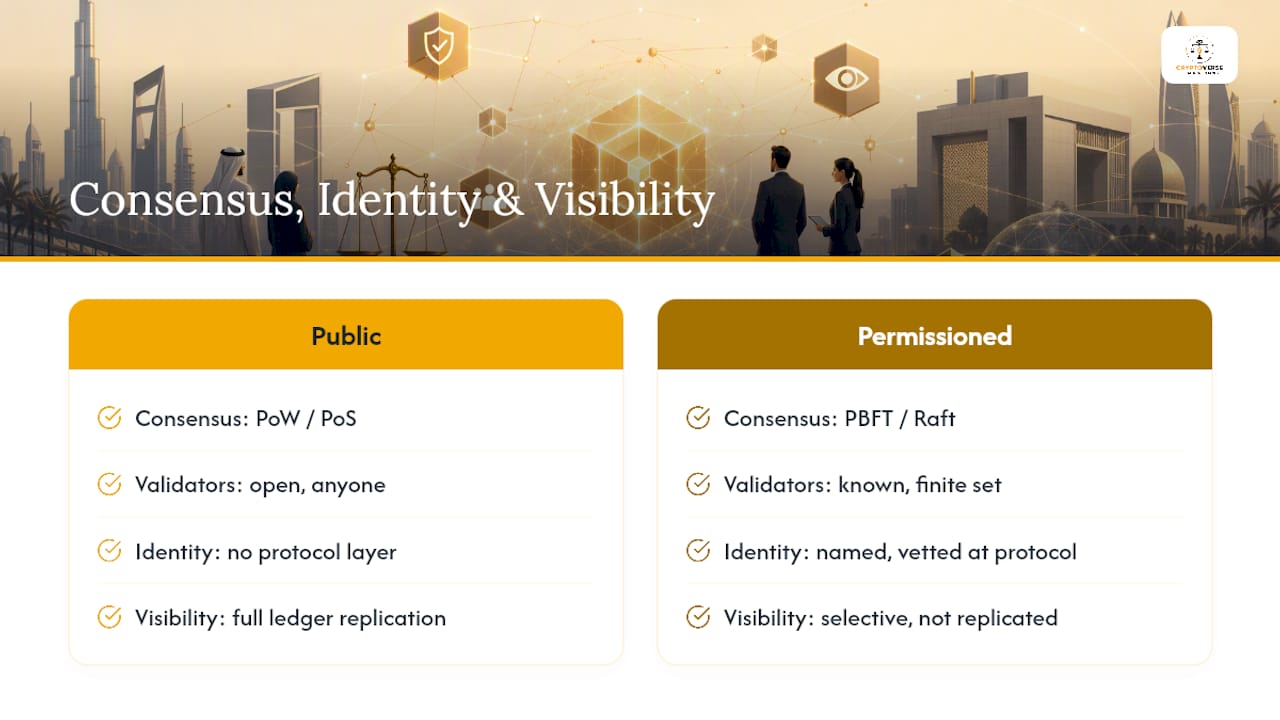
Identity is the second fork in the road. Permissioned networks embed identity at the protocol layer: every validator is a named, vetted entity, which gives on-chain accountability by default. Public networks have no such layer. Anyone can spin up a validator address, and identity, where it exists at all, lives at the application layer through exchanges or custodians, not the protocol itself.
Visibility architecture follows a similar split. Public chains replicate the entire ledger state to every node, which is precisely why they are trustworthy without a central authority, but also why privacy on them is hard to engineer. Retrofitting confidentiality onto a public chain, through zero-knowledge proofs or off-chain computation, is achievable but adds real engineering and verification overhead. Permissioned platforms build privacy in natively. Corda shares transaction data point-to-point between the parties involved rather than broadcasting it network-wide, while Fabric uses channels and private data collections to segment visibility by consortium member. For audit and incident response, that native segmentation usually means faster forensic tracing, since the pool of validators who touched a given transaction is already known and finite.
Permissioned vs public blockchain: a side-by-side comparison
| Attribute | Public / permissionless | Permissioned |
|---|---|---|
| Who can read the ledger | Anyone | Restricted to approved members (or public read with restricted write) |
| Who can submit transactions | Anyone with a wallet | Approved participants only |
| Who validates blocks | Open, competitive validator set | Known, vetted validator set |
| Consensus model | Economic (PoW, PoS) | Institutional (PBFT, Raft) |
| Privacy controls | Limited natively; added via cryptography | Native, via channels or point-to-point sharing |
| Throughput / latency | Lower throughput, slower finality | Higher throughput, faster finality |
| Cost model | Gas fees, resource-intensive validation | Lower marginal cost, resource-efficient validation |
| Typical use cases | DeFi, open tokens, public registries | Banking settlement, supply chain, healthcare data |
Three takeaways stand out from that table. First, permissioned networks generally deliver higher throughput and lower latency precisely because they limit validators to known entities and use less resource-intensive consensus. Second, privacy and openness sit on opposite ends of a genuine engineering trade-off, not a marketing choice. Third, cost models diverge sharply: public chains price scarcity through gas fees, while permissioned chains price predictability through licensing and infrastructure agreements.
Permissioned blockchain use cases versus public blockchain advantages
Public networks earn their keep wherever trustless composability is the point. Decentralised finance protocols, open tokenised assets and public registries all depend on anyone being able to interact without permission, because the entire value proposition is unrestricted, global participation. Permissioned networks earn their keep wherever confidentiality and accountability outrank open access: bank-to-bank settlement, multi-party supply chain tracking, and healthcare data exchange all involve counterparties who need to know exactly who touched what, and regulators who need the same answer on demand.
A short checklist for mapping your own project to a model:
- Does the use case require anonymous, global participation? If yes, lean public.
- Do counterparties need verified identity before transacting? If yes, lean permissioned.
- Is regulatory reporting or audit trail a core requirement from day one? If yes, permissioned architecture reduces retrofitting cost.
- Does the business model depend on composability with existing public protocols? If yes, public or a hybrid anchored to a public chain.
- Is throughput at enterprise scale (thousands of transactions per second) a hard requirement? If yes, permissioned consensus is easier to tune for that.
Governance, AML/CFT and the Travel Rule: what boards need to settle first
Regulators increasingly treat identity architecture as a proxy for compliance readiness, and permissioned networks have a structural advantage here. Because validators and often participants are known entities, protocol-level identity eases the burden of layering AML/CFT controls on top, rather than bolting them onto an anonymous base layer after the fact. That distinction is central to how Cryptoverselawyers advises clients structuring AML programmes across jurisdictions where Travel Rule obligations apply to virtual asset service providers.
Before committing to either architecture, boards and general counsel should settle a specific set of governance questions:
- Who can join the network, and under what membership criteria?
- What is the change control process for upgrading protocol rules or smart contracts?
- How is a validator or participant revoked, and how quickly?
- What dispute resolution mechanism applies when counterparties disagree on-chain outcomes?
- Who holds audit rights, and how are logs preserved for regulator inspection?
An operational checklist worth working through with compliance counsel covers logging standards, custody segregation between client and firm assets, incident response timelines, and clear segregation of duties between developers, validators and business operations. Researchers reviewing enterprise blockchain design have argued that private and permissioned deployments succeed by integrating with legal contracts and institutional trust, rather than chasing the absolute trustlessness that defines public networks. That is a design philosophy, not a compromise.
Pro Tip: Embed identity verification at the protocol layer rather than the application layer wherever regulatory exposure is likely. It is far cheaper to build Know Your Customer checks into validator onboarding than to retrofit them onto a live network once regulators start asking questions. Cryptoverselawyers' AML compliance guidance for crypto firms sets out how this plays out operationally.

Hybrid blockchain explained: anchoring, bridging and interoperability
Many enterprises want both privacy and independent auditability, and that is where hybrid design earns its place. Anchoring, periodically hashing permissioned ledger state and publishing that hash to a public chain, gives outside auditors an immutable reference point without exposing private transaction data. This anchoring pattern has matured into a genuinely pragmatic choice for regulated sectors wanting external verifiability alongside internal confidentiality.
Bridging, moving assets or data between permissioned and public environments, works conceptually but carries real custody and reconciliation risk at each connection point. Hybrids make sense when audit demands and privacy needs are both non-negotiable; they add unnecessary complexity when one model alone already satisfies the use case.
What founders get wrong when choosing a network
Founders routinely pick a network for its throughput or community hype and treat governance as an afterthought, then discover during licensing that auditors want named membership, revocation processes and enforceable rights baked into the architecture, not layered on afterward. Protocol-level identity and governance readiness are prerequisites for institutional adoption, not optional extras. Boards should be asking about capital adequacy, segregation of client assets, and and supervision readiness before the network is chosen, not after the licence application stalls.
— CRYPTOVERSE
Structuring your architecture for licensing and compliance
Choosing between public and permissioned architecture is ultimately a regulatory decision as much as a technical one, and getting it wrong is expensive to unwind later. Cryptoverselawyers is the alternative to a generalist law firm for this exact problem: crypto-native lawyers who understand consensus models and custody architecture well enough to map them directly onto VASP licensing requirements, rather than treating blockchain as a black box.

Our services cover the full structuring lifecycle relevant to this decision: VASP licensing guidance across the UAE's five regulators and over 30 crypto-friendly jurisdictions, AML/CTF policy design aligned with FATF standards, governance framework structuring for board-level readiness, tokenisation and real-world asset structuring, and crypto escrow arrangements for secure settlement. If you are weighing VARA licensing requirements against a permissioned or hybrid design, get in touch with Cryptoverselawyers to map your architecture choice to a regulator-ready structure before you build.
Sources
- Public vs private blockchains compared
- Public vs private vs permissioned blockchains
- Hyperledger Fabric project page
- Public vs private blockchains — working paper