

TL;DR:
- Crypto asset governance encompasses decision-making rules for protocols, internal controls for VASPs, and regulator-mandated accountability structures. On-chain governance utilizes blockchain-recorded proposals and votes, while off-chain decisions involve forums and legal entities, each with distinct transparency and regulation considerations. Effective compliance in 2026 demands explicit governance frameworks, board oversight, and operational controls aligned with evolving regulatory standards worldwide.
Crypto asset governance explained as a single concept is frequently mischaracterised as either a purely technical matter for protocol developers or a vague aspiration toward decentralisation. Neither framing serves compliance officers, general counsel, or institutional investors making decisions with real regulatory consequence. Governance in this context spans three distinct but overlapping domains: the rules by which blockchain protocols evolve, the internal controls by which virtual asset service providers (VASPs) manage digital assets, and the board-level accountability structures that regulators now require as a condition of licensing. Understanding how these layers interact is the foundation of credible crypto asset management in 2026.
Crypto asset governance explained: core concepts
The industry term most frequently used alongside "crypto asset governance" is protocol governance, though in a regulatory and institutional context the broader term digital asset governance framework better captures the full scope. Governance covers who has authority to make decisions, through what mechanism, and subject to what controls and accountability.
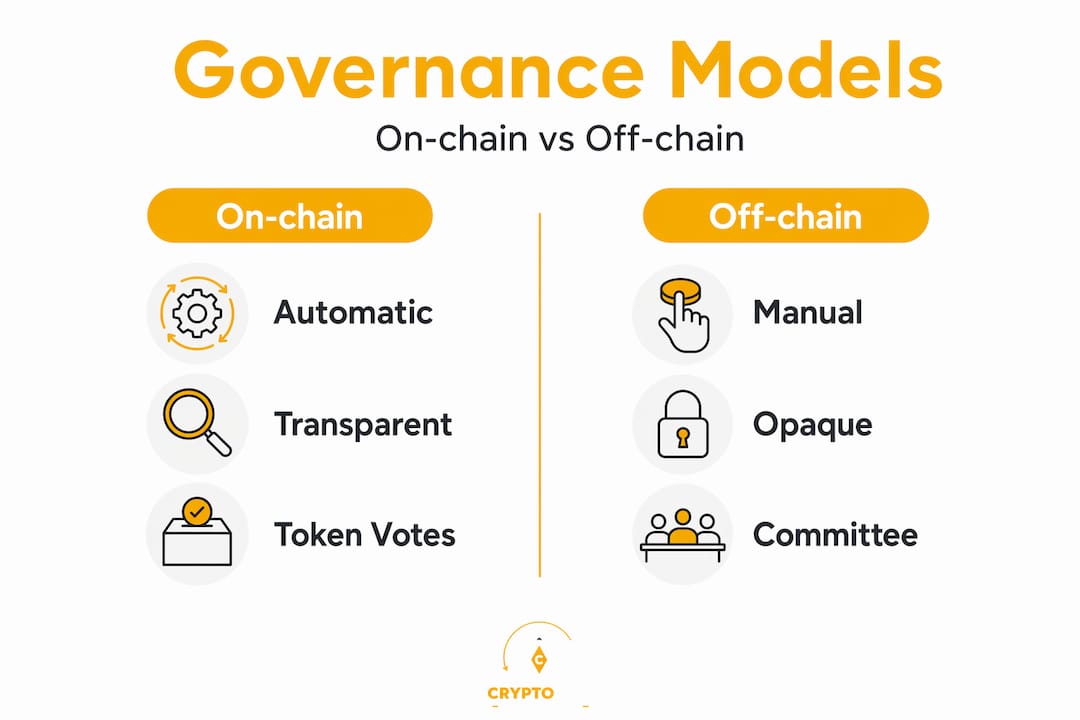
Governance operates across two distinct modes:
- On-chain governance: Protocol changes are proposed and ratified through mechanisms recorded directly on the blockchain. Ethereum on-chain governance uses token-holder votes to enact protocol upgrades, with some changes automatically executed once thresholds are met. Ethereum's formal proposals, known as Ethereum Improvement Proposals (EIPs), require substantial social and technical coordination before any change is merged, precisely because the coordination threshold is set high to preserve network security.
- Off-chain governance: Decisions are made through forums, working groups, legal entities, or regulatory filings, with outcomes then implemented by developers or administrators. Many DeFi protocols combine both: community votes signal intent off-chain, whilst on-chain execution follows once consensus is established.
Governance tokens are the mechanism through which many decentralised protocols distribute voting rights. Governance tokens enable holders to vote on upgrades, treasury allocations, and fee structures, with voting power that may be proportional to holdings and delegatable to other participants. This is a critical distinction for regulatory purposes: holding a governance token does not confer equity, dividends, or ownership rights in the legal sense.
| Feature | On-chain governance | Off-chain governance |
|---|---|---|
| Execution | Automatic upon threshold | Manual implementation |
| Transparency | Fully auditable on-chain | Dependent on disclosure |
| Participation | Permissionless, token-gated | Forum, committee, or board |
| Regulatory visibility | High | Variable |
| Capture risk | Token concentration | Insider control |
Pro Tip: When structuring a VASP application, map your protocol's governance mechanisms explicitly to your compliance framework. Regulators do not assume that on-chain voting substitutes for board-level accountability.
Regulatory frameworks shaping governance requirements
Understanding crypto governance in a compliance context requires engaging with the specific regulatory instruments that impose governance obligations. These are not aspirational standards. They are enforceable mandates.

In the UAE, the relevant framework draws on five regulators. VARA's Regulations and associated Rulebooks require VASPs to maintain documented governance structures, including senior management accountability, conflicts of interest policies, and clear lines of authority over virtual asset activities. The DFSA Rulebooks (GEN, COBS, and AML) impose equivalent requirements on firms operating in the DIFC, including fit-and-proper assessments and internal audit obligations. The FSRA Virtual Asset Framework within ADGM adds custody-specific governance controls. Across all UAE regulators, Federal AML Law (Decree-Law No. 20 of 2018 and its amendments) mandates that governance structures actively support AML/CFT compliance, including the Travel Rule obligations under FATF Recommendation 16.
At the US federal level, the SEC's March 2026 interpretive guidance on crypto asset classification under federal securities laws has direct governance implications. The guidance clarifies the application of the Howey test to crypto assets and treats issuer involvement, governance promises, and the economic realities of token distribution as material factors in determining whether a token constitutes a security. The SEC's token classification analysis now considers governance structure as a substantive input, not merely a label.
Key governance-related regulatory requirements for compliant VASPs include:
- Board-level accountability: Boards must approve governance frameworks, risk appetites, and material changes to operational structures.
- Capital and prudential standards: Regulators including VARA and the DFSA require firms to maintain minimum capital buffers, with governance obligations to monitor and report capital adequacy.
- Segregation of client assets: Governance controls must enforce the separation of client assets from proprietary holdings, with documented custodial arrangements.
- AML/CFT integration: Governance frameworks must embed AML/CFT obligations operationally, not merely at the policy level. This includes transaction monitoring, sanctions screening, and Travel Rule data transmission.
- Audit and reporting: Internal and external audit requirements apply, with governance frameworks obligated to produce evidence of control effectiveness.
Statistic callout: The SEC's 2026 framework explicitly references issuer participation and transactional context as determinants of securities classification, meaning governance structure choices at the protocol design stage carry direct legal consequence.
Best practices for crypto treasury governance
Crypto asset treasury governance is where protocol-level principles meet institutional-grade operational controls. Stripe's 2026 guidance on crypto treasury management identifies internal controls enforced by cryptographic systems, audit trails, and legal team coordination as non-negotiable governance measures for regulated entities. The following framework reflects those standards aligned with VARA and DFSA expectations.
-
Establish segregation of duties. No single individual should have unilateral authority to initiate, approve, and execute a virtual asset transaction. Multi-approval workflows, requiring sign-off from at least two authorised officers, should be encoded into both policy and technical architecture.
-
Implement multisignature or MPC wallets. Private key management is the single largest operational risk in crypto asset management. Multisignature wallets require multiple keyholders to authorise transactions. Multi-party computation (MPC) wallets distribute key shards across parties without ever reconstituting the full key. Both architectures reduce single points of failure and support governance audit trails.
-
Define an authorised asset policy. The governance framework must specify which assets may be held, on which exchanges or custodians, and under what allocation limits. Unauthorised assets or counterparties should require board-level approval before inclusion.
-
Maintain an audit trail reconciled with blockchain records. Every transaction must be reconcilable against on-chain records and custodian statements. This is not merely good practice; it is a prerequisite for regulatory examination readiness under the DFSA's COBS Rulebook and VARA's operational requirements.
-
Establish liquidity and volatility governance procedures. Governance frameworks must specify how the firm responds to material price movements, including pre-approved liquidation thresholds, fiat conversion authorities, and escalation procedures to senior management and the board.
-
Assign finance and legal oversight roles. The finance function is responsible for reconciliation and reporting. Legal and compliance functions are responsible for confirming that all activities remain within licensed parameters. These responsibilities should be documented and reviewed periodically by the board.
Pro Tip: A controls matrix that maps each governance role to specific transaction types, approval thresholds, and escalation triggers will satisfy audit requirements and demonstrate supervision readiness to regulators far more effectively than a narrative governance policy alone.
Challenges in decentralised governance models
Decentralised governance models present genuine regulatory and operational challenges that neither protocol designers nor compliance teams can afford to underestimate. Several structural features of token-based governance create risks that are now drawing direct regulatory attention.
Governance token concentration and voter apathy are among the most documented problems. In practice, many DeFi protocols see participation rates in governance votes that represent only a small fraction of eligible token holders. When a small number of large holders control the outcome of votes, the system may be formally decentralised but functionally centralised.
Key challenges practitioners encounter in decentralised governance include:
- Governance capture: Insiders, early investors, or coordinated groups can accumulate sufficient token holdings to pass or block proposals against broader community interests.
- Voter fatigue and quorum failures: Low participation undermines the legitimacy of decisions and, in some jurisdictions, may affect how regulators characterise the degree of real decentralisation.
- Token misclassification risk: Governance tokens are frequently argued to fall outside securities regulation on the basis of their voting function. However, the SEC's interpretive framework makes clear that issuer actions, marketing representations, and economic realities are assessed holistically. Governance functions alone do not determine classification.
- Off-chain coordination risks: Major protocol decisions in projects such as MakerDAO and Aave have often been shaped by off-chain forum discussions, delegate voting structures, and foundation influence before any on-chain vote occurs. This social coordination layer is less visible and harder to audit.
| Protocol | Governance model | Notable challenge |
|---|---|---|
| Uniswap | Token-based on-chain voting | Low voter participation in major proposals |
| MakerDAO | Delegated governance via MKR | Foundation influence on off-chain coordination |
| Aave | Mixed on-chain and off-chain | Concentration among large token holders |
| Ethereum | EIP process with social consensus | High coordination threshold required for changes |
For DAO legal structuring purposes, the absence of a formal legal entity does not eliminate liability. Regulators in the UAE and elsewhere are actively assessing whether DAO participants assume obligations equivalent to those of directors or partners, depending on their role in governance decisions.
Structuring compliant governance for 2026 regulations
Implementing a governance framework that satisfies regulatory expectations in 2026 requires more than drafting a policy document. It requires an architecture that maps decision authority, control mechanisms, and audit evidence to specific regulatory obligations.
-
Build a controls matrix. A controls matrix maps governance roles and decision points to specific controls, approval workflows, and audit trails. It should cover on-chain and off-chain approvals, asset custody procedures, key management, and incident response. This document is foundational to regulatory examination readiness.
-
Align governance with licensable activities. Under VARA's regulated activities framework and the DFSA's COBS Rulebook, each licensable activity carries specific governance and capital requirements. Your governance framework must be activity-specific, not generic. An exchange operator faces different governance obligations than a custody provider or an investment manager.
-
Embed board-level accountability. The board must formally approve the governance framework, review it at defined intervals, and receive regular reporting on material governance events. Regulators including VARA and the FSRA assess board composition, skills, and engagement as part of authorisation and ongoing supervision.
-
Address technology and custody controls. Governance frameworks must specify the custody model (self-custody, qualified custodian, or hybrid), the key management architecture, and the technical controls that enforce access restrictions. The DFSA's GEN Rulebook and VARA's Technology and Information Security requirements impose specific standards in this area.
-
Prepare for enforcement exposure. VARA's penalty framework and the DFSA's enforcement powers include the ability to impose significant financial sanctions, suspend activities, and revoke licences for governance failures. A well-documented governance framework is your primary evidence of good faith compliance in any enforcement proceeding.
-
Engage legal counsel on compliance reporting. Material governance changes, incidents, and regulatory submissions require legal review. Governance frameworks should specify when legal counsel must be engaged and how compliance reporting to regulators is prepared, reviewed, and filed.
The VARA licensing framework and the ADGM regulatory regime both require applicants to demonstrate governance readiness before authorisation is granted. Preparing that evidence begins at the framework design stage, not at the point of application.
My perspective on where crypto governance is heading
I have worked with founders and compliance officers who treat governance as a box-ticking exercise, something to assemble quickly before submitting a licence application. That approach consistently produces frameworks that fail on examination, not because the documents are poorly written, but because the controls are not operational.
What I have observed across VARA, DFSA, and FSRA applications is that regulators are not primarily reading governance policies. They are assessing whether the firm's actual decision-making processes reflect those policies. The gap between a written framework and a lived control environment is where enforcement risk concentrates.
The tension between decentralisation ideals and regulatory realities is real, but it is not irresolvable. Protocols that are genuinely decentralised with no identifiable issuer or controlling party occupy a different regulatory position from those that maintain a foundation, a grants programme, or ongoing developer control. The 2026 SEC framework makes this distinction explicit, and UAE regulators are applying equivalent logic.
My view is that institutional credibility in this space is built through governance transparency. That means board minutes that reflect real deliberation, audit trails that are maintained consistently rather than reconstructed before examinations, and governance frameworks for UAE compliance that are reviewed and updated as the regulatory environment evolves. Firms that invest in this infrastructure attract better institutional counterparties, pass regulatory examinations more efficiently, and are better positioned when enforcement action is taken against less disciplined competitors.
— CRYPTOVERSE
How Cryptoverselawyers can support your governance framework
Designing a governance framework that satisfies VARA, SCA, DFSA, FSRA, and global regulators requires more than general compliance knowledge. It requires specialists who understand both the regulatory instruments and the technical architecture of digital asset operations.

Cryptoverselawyers is a Dubai-based law firm advising exclusively on virtual assets, blockchain, and fintech regulation. The firm's team guides clients through the full spectrum of VARA licensing and compliance, from governance framework design and AML/CFT policy development to VASP licence applications and ongoing supervisory engagement. For firms operating across multiple jurisdictions, Cryptoverselawyers provides structured advice on digital asset regulatory compliance aligned with MiCA, MAS, FCA, and FATF standards. Contact Cryptoverselawyers to discuss your governance requirements and licensing objectives.
FAQ
What is crypto asset governance?
Crypto asset governance refers to the frameworks, controls, and decision-making structures that govern how digital assets are managed, how protocols evolve, and how regulated entities meet their regulatory obligations. It operates across protocol, organisational, and regulatory compliance dimensions.
How do governance tokens work in decentralised protocols?
Governance tokens grant voting rights on protocol decisions such as upgrades, treasury use, and fee structures. They do not constitute equity or entitle holders to dividends, and their regulatory classification depends on issuer conduct and economic context, not merely their voting function.
What governance requirements does VARA impose on VASPs?
VARA requires VASPs to maintain documented governance structures with board-level accountability, segregation of client assets, capital adequacy monitoring, AML/CFT integration, and audit readiness. These requirements are set out in VARA's Regulations and activity-specific Rulebooks and are assessed during the licensing process and ongoing supervision.
Does decentralised governance eliminate regulatory obligations?
No. Decentralised governance alone does not mitigate regulatory risk. Regulators assess issuer involvement, governance structure, marketing representations, and the economic realities of token distribution. Firms that maintain ongoing control through foundations, grants, or development activity remain subject to regulatory obligations regardless of their governance model.
What is the difference between on-chain and off-chain governance?
On-chain governance records proposals and votes directly on the blockchain and may execute changes automatically once thresholds are met. Off-chain governance operates through forums, committees, or legal entities, with outcomes implemented separately. Most protocols combine both, and each carries distinct audit, transparency, and regulatory implications.