

TL;DR:
- UAE's crypto licensing involves federal and free zone authorities with distinct scope and requirements.
- The 2026 update bans privacy coins and algorithmic stablecoins, impacting existing and future firms.
- Proper planning, precise activity classification, and early legal guidance are essential for successful licensing.
Even experienced virtual asset service providers enter the UAE expecting a clear, single licensing pathway — and are surprised to discover that no such pathway exists. The UAE operates a layered regulatory architecture where federal authority, free zone jurisdiction, and activity-specific rules interact in ways that can catch even seasoned compliance teams off guard. With the Capital Markets Authority issuing CMA Decision No. 4/R.M/2026, the landscape has shifted further. This guide cuts through that complexity and gives crypto startups and established VASPs a practical framework for understanding, planning, and achieving licensing readiness in 2026.
Key Takeaways
| Point | Details |
|---|---|
| No universal licence | Each UAE zone has its own crypto licensing rules, and federal approval is often required for full coverage. |
| Activity determines compliance | The type of services you offer—and the tokens you handle—dictate your licence and capital requirements. |
| 2026 introduced new bans | Privacy tokens and algorithmic stablecoins are now prohibited under CMA rules. |
| Preparation is crucial | Early, tailored preparation shortens timelines and avoids costly rework in the licensing process. |
Understanding the UAE crypto licensing landscape in 2026
The UAE does not operate a single unified crypto regulator. Instead, licensing authority is distributed across federal and free zone bodies, each with a distinct statutory remit, scope of permitted activities, and applicable capital requirements.
The three principal licensing authorities relevant to most VASPs are:
- Federal CMA (Capital Markets Authority): Governs virtual asset activities on the UAE mainland under federal law. As of 2026, it has issued a new framework establishing eight licensed activity categories.
- ADGM (Abu Dhabi Global Market): A financial free zone in Abu Dhabi, regulated by the Financial Services Regulatory Authority (FSRA). ADGM issues Financial Services Permissions (FSPs) for virtual asset activities, but these permissions are confined to ADGM's jurisdiction.
- DIFC (Dubai International Financial Centre): Dubai's financial free zone, regulated by the Dubai Financial Services Authority (DFSA). It has its own crypto token regime applicable to businesses operating within DIFC.
A critical point that many market entrants miss: as the CMA virtual asset rules confirm, no single licence covers all UAE; free zones like ADGM and DIFC restrict activities to those zones, and federal CMA overlays additional rules for mainland operations.
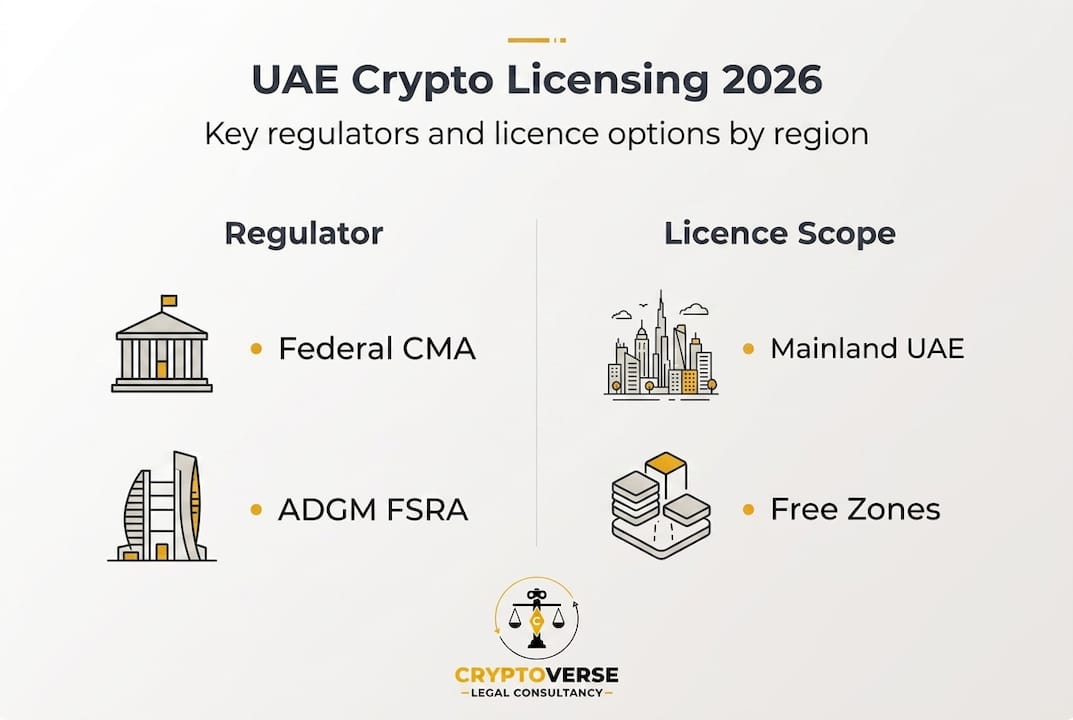
The table below provides a comparative overview of the three main licensing bodies:
| Regulator | Jurisdiction | Typical capital range | Key activities covered |
|---|---|---|---|
| Federal CMA | UAE mainland | AED 500k–AED 4M | Dealing, custody, advisory, exchange |
| ADGM FSRA | ADGM free zone | USD 250k–USD 1M | Dealing, advising, custody, MTF |
| DIFC DFSA | DIFC free zone | Varies by activity | Crypto token services, custody |
For startups, the decision of where to licence is as important as what to licence for. Free zones attract significant innovation investment and offer relatively streamlined processes, but they do not replace the need for federal compliance if you intend to serve mainland UAE clients. Reviewing the major UAE crypto regulators and the applicable blockchain legal frameworks before selecting a jurisdiction is an essential first step.
Key activities and categories: What crypto licences actually cover
Understanding which licence to apply for depends entirely on what your business actually does. Both the federal CMA and ADGM's FSRA define permitted activities with legal precision, and misclassifying your operations is one of the most common and costly application errors.
Under CMA Decision No. 4/R.M/2026, eight licensed activities are defined, with minimum capital ranging from AED 500,000 to AED 4 million depending on the activity. These include dealing in virtual assets, operating an exchange, providing custody, offering advisory services, managing portfolios, operating a transfer service, providing financing, and acting as a virtual asset fund manager.
In ADGM, the FSRA guidance sets out that ADGM licences virtual asset activities via Financial Services Permissions covering Dealing, Advising, Custody, and Multilateral Trading Facilities (MTF). Each category requires individual approval, and capital requirements apply per permission sought.
| Activity | Minimum capital (CMA) | Minimum capital (ADGM FSRA) |
|---|---|---|
| Dealing/exchange | AED 4M | USD 1M |
| Custody | AED 2M | USD 500k |
| Advisory | AED 500k | USD 250k |
| Portfolio management | AED 1M | USD 500k |
To map your business model to the correct licence category, follow these steps:
- List every revenue-generating activity your business performs or plans to perform.
- Match each activity to the definitions in the CMA framework or ADGM FSRA guidance.
- Identify the regulator whose jurisdiction aligns with your target customer base and physical operations.
- Confirm crypto firm capital needs against each required permission.
- Prepare a regulatory mapping document to accompany your application.
In ADGM specifically, per-token approvals are required for each virtual asset you intend to offer. This means an exchange supporting 50 tokens must obtain approval for each one individually — a significant operational consideration that affects both timelines and internal compliance workload.
Pro Tip: Many startups attempt to apply for the broadest possible licence to avoid repeat applications. In practice, UAE regulators assess applications against actual business plans. Applying for activities you cannot substantiate with capital, systems, or personnel will delay or derail approval. Review key activities explained to align your application precisely with your operational model.
What changed in 2026: New federal rules, token bans, and evolving risks
The 2026 regulatory update is the most consequential shift in UAE crypto governance in several years. Businesses operating under pre-2026 licences or planning applications based on older frameworks face real compliance exposure if they have not reviewed their positions.
The centrepiece of the 2026 update is CMA Decision No. 4/R.M/2026. Among its most significant provisions: the CMA bans privacy coins and algorithmic stablecoins, and local rules continue to evolve in line with global regulatory trends including MiCA in the EU.
Key regulatory update: CMA Decision No. 4/R.M/2026 introduces minimum capital requirements from AED 500,000 to AED 4 million, establishes eight formal activity categories, and imposes explicit prohibitions on privacy tokens and algorithmic stablecoins across all licenced entities.
For businesses holding or planning to issue stablecoins, the stablecoin restrictions now draw a clear line between compliant fiat-backed stablecoins and prohibited algorithmic designs. This mirrors similar prohibitions under MiCA in the EU, signalling alignment between UAE and international regulatory standards.
Key risks to monitor following the 2026 rule changes include:
- Token inventory review: Any exchange or broker holding privacy coins or algorithmic stablecoins must delist or restructure its offering.
- Licence scope gaps: Activities that were previously unregulated or loosely categorised now fall within the eight formal categories, meaning unlicensed operations face enforcement risk.
- Capital adequacy reassessment: Firms that met older capital thresholds may no longer satisfy 2026 minimums and must recapitalise accordingly.
- AML/CTF alignment: Updated rules tighten AML/CTF expectations, requiring policy reviews and updated customer due diligence procedures.
- Cross-border exposure: Firms serving UAE clients from offshore may now face registration or licensing obligations under the new CMA framework.
Pro Tip: If your licence was issued before 2026, do not assume it remains valid without review. Engage legal advice for new rules to assess whether your existing permissions cover your current activities under the updated definitions.
The path to licensing: Steps, timelines, and strategic pitfalls to avoid
With a clear picture of the regulatory environment, the next challenge is executing the application process without costly delays. UAE crypto licensing is thorough, and regulators expect well-prepared, complete submissions.

The ADGM FSRA process is illustrative: the ADGM application overview confirms that ADGM typically takes 3 to 6 months for virtual asset licensing, with minimum capital reaching USD 1 million for dealing activities. CMA mainland applications follow a comparable timeline depending on application quality and responsiveness.
The main steps from pre-application to approval are as follows:
- Pre-application preparation: Define your business model, target jurisdiction, and licensed activity scope. Ensure capital is available and auditable.
- Corporate structuring: Establish the correct legal entity in the chosen jurisdiction. For free zones, this typically means incorporating within ADGM or DIFC.
- Documentation assembly: Prepare business plans, AML/CTF policies, risk frameworks, ownership structure charts, and key personnel CVs.
- Regulator engagement: Some regulators offer pre-application meetings. Use this opportunity to confirm your classification and flag complex structural elements.
- Formal application submission: File with complete documentation. Incomplete submissions are the single biggest cause of delays.
- Regulatory review and queries: Respond to regulator queries promptly and accurately. This phase can last several weeks depending on complexity.
- Approval and licence issuance: Upon satisfaction of conditions, the licence and any relevant permissions are issued.
Common mistakes to avoid during the licensing process:
- Underestimating capital requirements and applying before funds are secured
- Submitting generic AML/CTF frameworks not tailored to the UAE regulatory environment
- Misclassifying business activities and applying for the wrong licence category
- Failing to account for per-token approval requirements in ADGM
- Ignoring board and senior management fit-and-proper requirements
For specific tactics that accelerate the process, review UAE licensing shortcuts and confirm you are meeting capital thresholds well before submission.
Pro Tip: Internal decision-making delays, such as board approvals and investor sign-offs on capital allocation, regularly add four to eight weeks to an application timeline. Begin the internal process well before you submit externally.
A hard-won perspective: Why shortcuts and 'one-size' licensing fail in the UAE
In practice, we see a consistent pattern among firms that encounter licensing difficulties in the UAE. They begin with a search for the fastest, cheapest, or broadest licence available. The logic is understandable: reduce cost, maximise coverage, and launch quickly. The outcome is almost always the opposite of what was intended.
The UAE's regulatory bodies are sophisticated. They scrutinise applications against actual business plans, system capabilities, and personnel competencies. A firm applying for a custody licence without a demonstrable custody model, or seeking dealing permissions without verifiable capital, will not obtain approval. It will receive queries, rejections, or conditional approvals that still require the missing elements.
We have advised firms that pursued shortcut strategies elsewhere and arrived at our office facing relicensing obligations, enforcement inquiries, or operational restrictions. The time and cost involved in resolving those positions far exceeded what a properly structured application would have cost from the outset.
The firms that launch successfully and sustain compliance are those that match their licence scope precisely to their actual operations. They invest in proper documentation, qualified compliance personnel, and tailored AML/CTF frameworks. They engage early with regulators rather than waiting for queries. Understanding when to seek legal advice is not a question of budget: it is a question of risk management.
Get expert guidance for your UAE crypto licence in 2026
Navigating UAE crypto licensing requires more than reading the rules. It requires knowing how regulators interpret them, what documentation passes scrutiny, and how to structure your application for first-time approval.
At CRYPTOVERSE Legal Consultancy, we have guided startups and established VASPs through licensing across all five UAE regulators. Whether you are pursuing a VARA licensing guide for Dubai or need SCA VASP support for mainland federal compliance, our team builds regulator-ready applications from the ground up. For firms that need to move efficiently, our crypto licensing fast-track tips service identifies the fastest compliant path without compromising quality. Contact us to arrange a licensing assessment and determine your most direct route to approval.
Frequently asked questions
What is the minimum capital required for a crypto licence in the UAE in 2026?
Minimum capital ranges from AED 500,000 to AED 4 million under CMA rules, and from USD 250,000 to USD 1 million in ADGM, depending on the licenced activity.
Does a single UAE crypto licence cover the entire country?
No. Licences granted by free zones such as ADGM or DIFC are limited to those zones; a federal CMA licence is required for UAE-wide mainland activities.
Are any tokens banned in the UAE in 2026?
Yes. The CMA has banned privacy tokens and algorithmic stablecoins under the 2026 framework, and all licenced entities must comply.
How long does it take to get a crypto licence in ADGM?
The process typically takes 3 to 6 months from application to approval, depending on application completeness and business complexity.
Recommended
- UAE crypto licensing tips 2026: navigate approvals fast - Cryptoverse Legal Consultancy
- UAE Blockchain Legal Frameworks 2026: Navigate Licensing - Cryptoverse Legal Consultancy
- Why crypto businesses need legal advice in the UAE 2026 - Cryptoverse Legal Consultancy
- Unlock the advantages of UAE crypto law for your business