

TL;DR:
- Compliance officers in UAE VASPs face high-stakes, technically complex AML/CTF responsibilities.
- Blockchain analytics tools are essential for tracing suspicious transactions and managing DeFi risks.
- Regular testing through quarterly risk assessments ensures adaptive and effective compliance frameworks.
The role of a compliance officer at a virtual asset service provider (VASP) in the UAE is frequently mischaracterised as an administrative function focused on completing checklists and filing periodic reports. In practice, it is one of the most technically demanding and high-stakes positions in the financial services sector. Regulatory failures in this space carry consequences that range from substantial fines and licence revocations to reputational damage that can permanently close a business. This article sets out the statutory mandate, core AML/CTF duties, emerging analytical tools, and framework-testing responsibilities that define the compliance officer's role under UAE virtual asset regulations.
Key Takeaways
| Point | Details |
|---|---|
| Beyond tick-box compliance | Compliance officers must interpret and enforce detailed AML/CTF policies, not just standard checklists. |
| Quarterly risk reviews are vital | Regular business risk assessments ensure frameworks respond to emerging threats and regulatory shifts. |
| Tech enables and complicates compliance | Blockchain analytics is essential for detecting illicit activity but introduces new challenges, especially in DeFi. |
| Proactivity wins in enforcement | 24/7 readiness, immediate escalation, and strategic partnerships set apart the most effective compliance teams. |
Understanding the compliance officer's mandate in virtual assets
The UAE has established one of the most structured and actively enforced regulatory environments for virtual assets in the world. Compliance officers working within licensed VASPs operate under obligations imposed by multiple regulators, including the Virtual Assets Regulatory Authority (VARA), the Securities and Commodities Authority (SCA), the Dubai Financial Services Authority (DFSA), the Financial Services Regulatory Authority (FSRA), and the Central Bank of the UAE (CBUAE). Understanding which regulator governs your entity and what that regulator specifically demands is the starting point for any effective compliance programme.
The statutory remit of a compliance officer in a UAE VASP is not limited to monitoring transactions. It encompasses the full lifecycle of the firm's AML/CTF posture. Those working in compliance for platform operators will quickly recognise that the role involves significant policy authorship, cross-departmental coordination, and direct accountability to both senior management and regulators.
Core statutory responsibilities typically include the following:
- Policy development and implementation: Drafting AML/CTF policies aligned with UAE Federal Decree-Law No. 20 of 2018, its executive regulations, and FATF Recommendations.
- Customer due diligence (CDD) oversight: Ensuring that know-your-customer (KYC) procedures are properly designed, consistently applied, and updated in response to risk assessments.
- Suspicious transaction reporting: Managing the submission of suspicious transaction reports (STRs) to the UAE Financial Intelligence Unit (FIU) via the IEMS platform, within legally required timeframes.
- Business risk assessment (BRA): Conducting and documenting structured assessments of the firm's exposure to financial crime risk. Critically, quarterly BRA reviews are mandatory under UAE requirements, not simply a best practice recommendation.
- Training and culture: Ensuring that all relevant staff understand their AML/CTF obligations and that compliance culture is embedded across the organisation.
- Regulatory liaison: Acting as the primary point of contact for regulator-initiated inquiries, audits, and inspections.
For those operating as brokers, additional specific conduct obligations apply, particularly around order handling and client asset segregation, which intersect with AML obligations. Early-stage businesses may benefit from regulatory compliance advisory services that help map these obligations against their actual operational model before the compliance framework is finalised.
The accountability dimension is equally important. Compliance officers must be prepared to demonstrate to regulators, at any point, that policies are not only in place but actively functioning and regularly reviewed. A well-drafted policy that sits unimplemented is itself a regulatory risk.
AML/CTF frameworks: Core duties for compliance officers
Having defined the mandate, the next focal point is what thorough AML/CTF work looks like in practice. The UAE's virtual asset sector requires compliance officers to go considerably further than their counterparts in traditional finance, because the speed, pseudonymity, and cross-border nature of virtual asset transactions create genuinely distinct risk vectors.
A structured AML/CTF approach should follow this operational sequence:
- Risk assessment: Conduct a thorough mapping of the firm's products, customer base, geographic reach, and transaction channels to identify where financial crime risk concentrates. This forms the foundation of your risk appetite statement and informs resource allocation.
- KYC and CDD procedures: Implement tiered due diligence based on customer risk classification. Standard due diligence applies to lower-risk customers, while enhanced due diligence (EDD) is triggered by higher-risk profiles, including politically exposed persons (PEPs), high-value transaction counterparties, and customers from higher-risk jurisdictions.
- Transaction monitoring: Deploy rule-based and, where possible, machine-learning-enhanced monitoring systems that flag anomalous activity in real time. Monitoring rules should be calibrated to the firm's specific risk profile and updated regularly.
- Internal reporting: Establish a clear escalation pathway from front-line staff to the compliance officer, with documented timelines for assessing and acting on internal suspicious activity reports (SARs).
- Regulatory reporting: File STRs with the UAE FIU through the IEMS platform when suspicion is established. Tipping off a customer about an STR filing is a criminal offence under UAE law.
- Record-keeping: Maintain all customer and transaction records for a minimum of five years, accessible to regulators on request.
Regarding EDD for high-risk wallets and addresses, compliance officers must be prepared to act immediately when blockchain analytics or monitoring systems identify suspicious activity. This includes 24/7 readiness to respond to IEMS FIU requests and the authority to execute immediate account freezes where circumstances demand it.

Pro Tip: Compliance officers should maintain a pre-approved account freeze protocol, agreed in advance with senior management and legal counsel, so that action can be taken within minutes of a regulatory request rather than hours. Delay in executing a freeze can itself constitute a regulatory breach.
Common pitfalls in this space include relying exclusively on rule-based transaction monitoring without periodic recalibration, failing to document the rationale for not filing an STR when suspicion arises, and treating EDD as a one-time exercise rather than an ongoing process. Effective AML/CTF risk management requires that each of these risks is systematically addressed within the firm's operational framework.
Emerging tools and strategies: Blockchain analytics and DeFi challenges
Building on robust AML/CTF practices, technology becomes a key enabler and, simultaneously, a source of new regulatory complexity. The use of blockchain analytics has become a foundational requirement for VASPs operating under UAE regulation, not an optional enhancement.
Blockchain analytics platforms such as Chainalysis, Elliptic, and TRM Labs enable compliance teams to trace the provenance and destination of virtual assets at the wallet and transaction level. This matters because financial criminals have developed increasingly sophisticated techniques to obscure the trail of illicit funds. Key risk indicators that analytics tools are specifically designed to detect include:
- Mixers and tumblers: Services that deliberately blend virtual asset transactions to break traceability.
- Peel chains: A structuring technique where funds are transferred through a rapid sequence of wallets in diminishing amounts to avoid detection.
- Privacy coins: Assets such as Monero that use cryptographic methods to render transaction details largely invisible on-chain.
- Layering through DeFi protocols: Using decentralised exchanges, liquidity pools, and cross-chain bridges to move funds across multiple blockchains, creating jurisdictional ambiguity.
The guidance on blockchain analytics for mixers, peel chains, and DeFi makes clear that compliance officers must have both the tools and the expertise to interpret outputs from these systems accurately. A false positive rate that triggers excessive account freezes can be as damaging commercially as a failure to detect genuine risk.
| Factor | Centralised exchange (CEX) | Decentralised protocol (DeFi) |
|---|---|---|
| KYC applicability | Mandatory at onboarding | Limited or absent |
| Transaction traceability | Moderate, with analytics | High on-chain, but complex |
| Regulatory touch point | Clear licensing entity | Often no identifiable entity |
| Compliance officer jurisdiction | Well-defined | Legally ambiguous |
| STR filing mechanism | Established via IEMS | Uncertain in DeFi context |
The DeFi landscape presents particular challenges for compliance officers because there is frequently no central legal entity against which AML obligations can be formally imposed. Regulators are actively working to address this, and staying current with web3 compliance trends is essential for any compliance officer operating near or within DeFi infrastructure.
Forensics and compliance expertise is increasingly intersecting with blockchain analytics, particularly in cases involving litigation support, regulatory investigations, and incident response. Compliance officers should understand how forensic evidence standards apply to blockchain data, particularly if regulatory enforcement or court proceedings may arise from a case.
The blockchain legal support dimension is also relevant here. When analytics outputs generate regulatory questions, having legal advisors who understand both the technology and the regulatory framework is materially different from relying on general financial crime counsel.
Pro Tip: When vetting blockchain analytics vendors, request a live demonstration using publicly known high-risk addresses before committing to a contract. Evaluate their coverage of the specific blockchains your business uses, their update frequency for risk classifications, and their capacity to produce regulator-ready reports.
Testing frameworks in practice: Business risk assessments, incident management, and real-world scenarios
With emerging tools and regulatory advancements understood, a compliance officer's focus shifts towards practical framework testing and response. A well-designed policy framework that has never been tested under real or simulated conditions provides limited assurance.
The quarterly business risk assessment is the primary mechanism through which VASPs demonstrate that their risk management is dynamic rather than static. Quarterly BRA reviews are mandatory, and 24/7 readiness for IEMS FIU requests is a parallel standing obligation, not one that activates only during business hours.
A structured BRA process includes the following steps:
- Gather updated data: Pull transaction volume data, customer risk tier distributions, and any new product or geographic exposures since the last assessment.
- Reassess inherent risk: Evaluate whether the firm's underlying risk profile has changed due to market developments, new regulatory guidance, or changes in the customer base.
- Review control effectiveness: Test whether existing controls are functioning as intended. This includes sampling transaction monitoring alerts, reviewing KYC file quality, and assessing staff training completion rates.
- Document residual risk: Record the risk that remains after controls are applied, and confirm this sits within the firm's approved risk appetite.
- Report to senior management: Present findings formally, with action items and timelines for any identified gaps.
"The expectation is not merely that a business risk assessment exists, but that it demonstrably influences operational decisions and control enhancements on an ongoing basis." This is the standard to which UAE regulators hold licensed VASPs.
| Scenario | Without a robust framework | With a robust framework |
|---|---|---|
| FIU request received at 02:00 | Delay; no clear escalation path | Immediate response; designated on-call officer acts |
| Suspicious transaction identified | Alert goes unreviewed for 48 hours | Escalated within four hours; STR filed or closed with rationale |
| Account freeze required | Legal and operational confusion | Pre-approved protocol executed within minutes |
| Quarterly BRA deadline | Rushed, superficial documentation | Structured, evidence-based assessment completed on schedule |
For those managing safe custody of virtual assets, incident management also encompasses scenarios involving unauthorised access, key management failures, or counterparty default, each of which carries AML implications if asset movements occur without proper authorisation.
Digital forensics in compliance plays a growing role in post-incident analysis. When a suspicious activity event has occurred, forensic analysis of on-chain data, system logs, and communication records can materially support regulatory reporting and any subsequent enforcement proceedings.
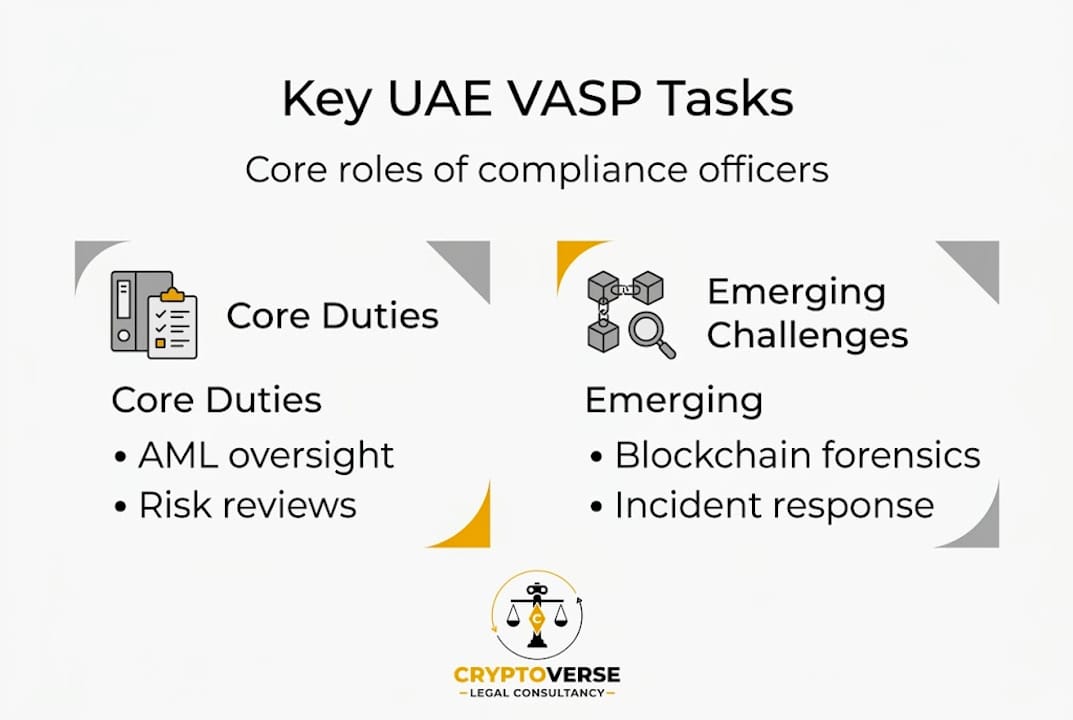
Real-world incident walk-throughs, conducted as tabletop exercises at least annually, allow compliance teams to validate their escalation chains, test their documentation practices, and identify gaps before a regulator does.
A fresh perspective: Why effective compliance is a competitive edge, not just a regulatory burden
There is a persistent tendency in some VASP boardrooms to treat the compliance function as a cost centre, a necessary overhead that exists to satisfy regulators rather than to create value. This framing is both operationally dangerous and commercially short-sighted.
The most effective compliance officers are not those who simply implement policy documentation. They are those who shape organisational culture, create operational clarity, and build the institutional credibility that attracts institutional counterparties and serious investors. In the virtual asset sector, regulatory readiness is a direct factor in deal-making. Institutional liquidity providers, banking partners, and fund managers conduct compliance due diligence before entering into relationships with VASPs. A firm that can demonstrate mature, tested frameworks is genuinely differentiated from one that cannot.
The agility argument is equally compelling. Virtual asset markets evolve faster than any regulatory framework can track. Compliance officers who have built dynamic, regularly tested systems adapt to new regulatory requirements faster and at lower cost than those who rely on static documentation. In a sector where regulators are actively refining their expectations, agility and preparedness are measurable competitive advantages. Treating compliance as an investment in operational resilience, rather than a regulatory tax, is the orientation that separates firms that scale sustainably from those that face enforcement action at the point of growth.
How expert support unlocks compliance success
Translating regulatory obligations into functioning operational workflows is where many VASP compliance teams encounter practical difficulty. Policy drafting is one skill; implementation across business lines, technology systems, and third-party relationships is another.

CRYPTOVERSE Legal Consultancy works directly with compliance officers and in-house legal teams to bridge this gap. Our advisors understand VARA regulations and licensing requirements in operational detail, having guided clients through full compliance programme design from initial risk framework to regulator-ready documentation. Whether you are building an AML/CTF framework from the ground up or strengthening an existing one, our digital asset legal consultancy services are structured to support your specific operational context. Reach out to discuss how our team can support your compliance programme.
Frequently asked questions
What are the primary responsibilities of a compliance officer at a virtual asset service provider under UAE law?
Compliance officers oversee AML/CTF frameworks, conduct quarterly risk assessments, respond to FIU requests, and execute account freezes when required by law or regulation.
How do compliance officers use blockchain analytics for regulatory compliance?
They identify suspicious activity via blockchain analytics, focusing on high-risk wallet behaviour such as mixers, DeFi channels, and peel chains to trace and report illicit fund flows.
Why are quarterly business risk assessments mandatory for VASPs in the UAE?
Quarterly BRAs are mandatory to ensure that risk management adapts promptly to new threats and regulatory changes, maintaining continuous and demonstrable compliance.
What are the key challenges facing compliance officers today in the virtual asset sector?
Complex DeFi structures, privacy tools such as mixers and privacy coins, and rapid technological innovation make it genuinely difficult to detect and manage emerging risks, demanding consistent upskilling and dynamic framework management.
Recommended
- Essential web3 legal risks list for VASP compliance
- Regulatory Compliance for Virtual Asset Platform Operators in the UAE - Cryptoverse Legal Consultancy
- Why crypto legal consultants are vital for VASP success
- Regulatory Compliance for Virtual Asset Brokers in the UAE - Cryptoverse Legal Consultancy