

Many crypto startups assume that regulatory legal support is reserved for large, well-funded exchanges. That assumption is costly. Global crypto compliance now spans frameworks as varied as MiCA in the EU, SEC and CFTC oversight in the US, and the FATF Travel Rule, which applies to virtually every virtual asset service provider (VASP) regardless of size. Whether you are launching a token, building a custody solution, or operating a peer-to-peer exchange, the regulatory obligations are real and the consequences of getting them wrong are severe. This guide explains precisely how crypto legal consultants help firms navigate licensing, compliance, and operational readiness across the UAE and beyond.
Key Takeaways
| Point | Details |
|---|---|
| Specialist guidance essential | Crypto legal consultants steer VASPs and startups safely through regulatory complexity worldwide. |
| Compliance prevents losses | Expert support reduces risks of licence denial, fines, or shutdown – especially in multi-jurisdiction settings. |
| Clear selection criteria | Look for demonstrable crypto sector experience and cross-border regulatory awareness in your consultant. |
| Proactive overreactive | Bringing legal advisors in early saves time, money, and ensures smooth regulatory interactions. |
What do crypto legal consultants do?
Crypto legal consultants are not general solicitors who occasionally handle a blockchain matter. They are specialists whose entire practice is built around virtual asset regulation, digital asset markets, and the evolving statutory frameworks that govern them. The distinction matters enormously in practice.
A general commercial lawyer can draft a contract or advise on corporate structure. A crypto legal consultant does that and much more. Their core services typically include:
- Regulatory analysis: Identifying which licences, registrations, or exemptions apply to your specific business model and jurisdiction.
- Licence selection and application support: Preparing documentation, policies, and governance frameworks that meet regulator expectations from day one.
- AML/CTF policy drafting: Designing anti-money laundering and counter-terrorist financing programmes aligned with FATF standards and local law.
- Ongoing compliance monitoring: Tracking regulatory updates and advising on necessary adjustments before enforcement action becomes a risk.
- Cross-border harmonisation: Ensuring that operations in multiple jurisdictions do not create conflicting obligations or regulatory gaps.
Consultants advising on MiCA, SEC/CFTC, and FATF compliance must maintain current knowledge across all three simultaneously, because a firm operating in the EU and the UAE faces obligations under both regimes at once. Understanding the EU crypto regulation framework and the detailed requirements of the MiCA 2025 compliance guide is foundational to advising any crypto asset service provider (CASP) operating across borders.
Key areas of regulatory focus for VASPs
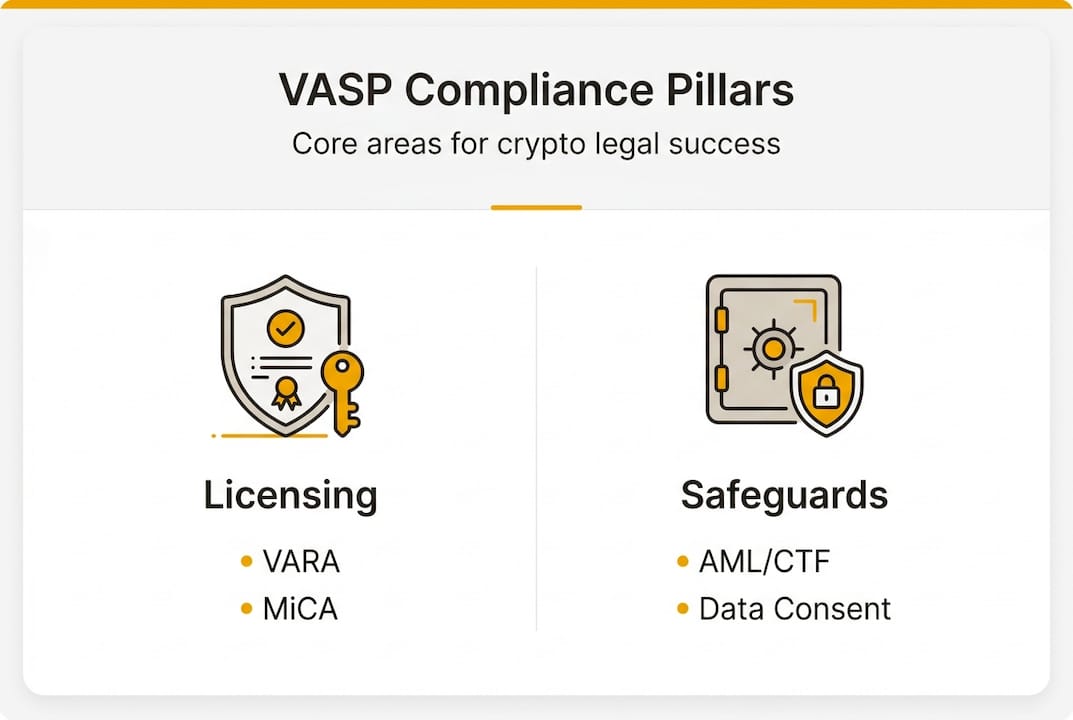
VASPs face regulatory obligations across several distinct pillars. Understanding each one helps you appreciate where specialist legal input adds the most strategic value.

The table below compares three major frameworks that crypto legal consultants routinely navigate:
| Framework | Jurisdiction | Key requirements | Enforcement body |
|---|---|---|---|
| MiCA | European Union | CASP authorisation, whitepaper disclosure, AML/CTF | National Competent Authorities |
| SEC/CFTC | United States | Securities/commodities classification, registration | SEC and CFTC |
| FATF Travel Rule | Global | Originator/beneficiary data sharing for transfers | National FIUs |
Consultants harmonise compliance across these frameworks, ensuring that a firm's policies satisfy multiple regulators without creating internal contradictions. The key risk areas they help manage include:
- Licensing gaps: Operating without the correct licence in a given jurisdiction, even inadvertently, can trigger enforcement action and reputational damage.
- AML/CTF deficiencies: Weak know-your-customer (KYC) procedures and inadequate transaction monitoring are among the most common grounds for regulatory sanction.
- Travel Rule non-compliance: Failing to transmit originator and beneficiary data with virtual asset transfers breaches FATF standards in most regulated markets.
- Investor protection failures: Inadequate disclosures or unsuitable product offerings can attract securities regulation scrutiny.
Understanding MiCA's transitional phase is particularly important for firms already operating in the EU, as grandfathering provisions have strict deadlines. Similarly, robust crypto AML and KYC rules form the backbone of any credible compliance programme, regardless of jurisdiction.
Common compliance challenges in the UAE and abroad
Even well-resourced firms encounter significant compliance obstacles. The following are the most recurrent challenges that crypto legal consultants help resolve:
- Inconsistent application standards: Different regulators, including VARA, DFSA, and FSRA in the UAE, apply different documentation and governance standards. A submission that satisfies one may fall short of another.
- Rapidly evolving guidance: Regulatory frameworks in the UAE and globally are updated frequently. Firms that rely on outdated templates or prior approvals risk non-compliance without realising it.
- Enforcement risk from regulatory gaps: Gaps between when a firm begins operating and when it obtains a licence create exposure. Regulators increasingly scrutinise the period before formal approval.
- Multi-jurisdictional conflicts: A policy that satisfies FATF standards may still conflict with local data protection law or specific national AML requirements.
- Inadequate internal governance: Many startups lack the compliance officer infrastructure that regulators expect, making external legal support essential during the early stages.
Legal consultants are essential for cross-border compliance precisely because they anticipate these issues before they become enforcement problems. The impact of MiCA on tokenisation is one area where early legal input has prevented costly restructuring for firms that initially overlooked the regulation's scope.
Regulatory note: In 2026, VARA in Dubai has continued to refine its enforcement posture, with increased scrutiny on firms operating without a valid licence or with incomplete AML frameworks. Non-compliance can result in licence refusal, financial penalties, and public censure.
Pro Tip: Before submitting any licence application, commission a pre-application regulatory gap analysis. This identifies deficiencies in your governance, AML policies, and corporate structure before the regulator does, significantly improving your approval prospects.
Case studies: How expert legal advice prevents pitfalls
The difference between firms that obtain licences efficiently and those that face repeated rejections often comes down to one factor: the quality of legal guidance engaged from the outset.
The table below illustrates contrasting outcomes:
| Scenario | Without legal consultant | With legal consultant |
|---|---|---|
| VASP licence application (UAE) | Incomplete documentation, 18-month delay | Regulator-ready submission, approval within standard timeline |
| EU CASP registration (MiCA) | Rejected due to AML policy gaps | Approved with tailored compliance framework |
| Cross-border expansion | Conflicting obligations, enforcement notice | Harmonised multi-jurisdiction compliance structure |
| Token issuance | Securities classification risk, trading suspended | Pre-issuance legal opinion, compliant launch |
Scenario A: A UAE-based crypto exchange engaged a specialist consultant prior to applying for a VARA licence. The consultant identified that the firm's proposed custody model did not meet VARA's segregation requirements. After restructuring, the application was submitted and approved without a request for further information.
Scenario B: A European crypto startup attempted to register under MiCA without specialist advice. The firm's AML/CTF policy was drafted using a generic template that did not address the specific Travel Rule obligations applicable to its transfer volumes. The application was rejected, and the firm required six additional months of remediation before resubmitting.
Legal consultants' guidance is vital for cross-border compliance under frameworks like MiCA, FATF, and SEC/CFTC. Firms building DeFi protocols face additional complexity, and understanding DeFi tax and MiCA protocol compliance is increasingly non-negotiable for protocol developers targeting regulated markets.
Pro Tip: When selecting a legal consultant, verify that they have direct experience with your specific product type, whether that is an exchange, a stablecoin, a tokenised fund, or a DeFi protocol. Regulatory requirements differ materially between product categories.
How to choose the right crypto legal consultant
Selecting the right adviser is as important as deciding to seek advice at all. A consultant without genuine virtual asset regulation experience can create a false sense of security while leaving material compliance gaps unaddressed.
Key qualities to look for include:
- Proven crypto regulation experience: The adviser should have a demonstrable track record of successful VASP licence applications and regulatory engagements, not just general financial services work.
- Current jurisdictional knowledge: Regulatory frameworks change rapidly. Your consultant must be actively monitoring updates across the jurisdictions relevant to your operations.
- Multi-regulator familiarity: In the UAE alone, VARA, SCA, DFSA, FSRA, and CBUAE each have distinct statutory remits. An adviser who knows only one is insufficient for most multi-product businesses.
- Transparent fee structures: Regulatory engagements can be lengthy. Ensure you understand the billing model, whether fixed-fee, retainer, or hourly, before committing.
- Ongoing support commitment: Compliance is not a one-time exercise. Your adviser should offer continuous monitoring and policy update services, not just application support.
- Genuine blockchain literacy: An adviser who does not understand how a smart contract or a liquidity pool functions cannot accurately assess the regulatory risk it creates.
Specialised legal advisors streamline compliance for VASPs and startups in ways that general practitioners simply cannot replicate. If you are evaluating options, reviewing the scope of crypto legal expertise in the UAE provides a useful benchmark for what a qualified specialist should offer.
Avoid the common mistake of engaging a general corporate lawyer who has handled one or two blockchain transactions. The regulatory complexity of virtual asset markets in 2026 demands dedicated expertise, not peripheral familiarity.
Ready to secure your crypto venture? Legal experts can help
Navigating VASP licensing, AML frameworks, and cross-border regulatory obligations is not something most crypto businesses can manage effectively without specialist support. The regulatory environment across the UAE and globally is too detailed, too fast-moving, and too consequential to approach without expert guidance.
CRYPTOVERSE Legal Consultancy works exclusively in virtual assets, blockchain, and fintech regulation. Our team advises across all five UAE crypto regulators and supports clients in over 30 jurisdictions worldwide. Whether you need to understand VARA regulations and licensing in Dubai, access specialist digital asset legal advice, or clarify your obligations under VARA regulated activities, we provide regulator-ready legal solutions from pre-application through to full approval and ongoing compliance. Contact our team to arrange an initial consultation and establish a clear path to compliant operations.
Frequently asked questions
What is a crypto legal consultant?
A crypto legal consultant is a lawyer or adviser who specialises in helping companies comply with virtual asset regulations, obtain licences, and address cross-border crypto compliance under frameworks such as MiCA, SEC/CFTC, and the FATF Travel Rule.
When does a crypto business need a legal consultant?
A crypto business needs specialist legal advice when planning to operate in regulated markets, apply for a VASP licence, or build AML/CTF programmes that satisfy regulatory licensing requirements across one or more jurisdictions.
What is the difference between a general lawyer and a crypto legal consultant?
A general lawyer typically lacks the specific virtual asset regulation knowledge required for VASP licensing and compliance. A crypto legal consultant has specialist expertise in MiCA, SEC/CFTC, and FATF frameworks and understands the technical architecture of digital asset products.
Do legal consultants assist with international crypto expansion?
Yes. Specialists advise on cross-border regulatory harmonisation and help firms establish compliant operations across multiple countries, managing conflicting obligations and jurisdiction-specific requirements simultaneously.
Recommended
- Cayman Islands VASP and Crypto License | CIMA Approval 2025
- About us - Cryptoverse Legal Consultancy
- Dubai's Sponsored VASP Regime Explained | Cryptoverse Lawyers
- BVI VASP License: Requirements, Costs & Timeline |Cryptoverse Lawyers
- Virtual CISO Services: Enhancing Security Compliance - Heights Consulting Group