

TL;DR:
- The UAE offers a complex, multi-jurisdictional framework for virtual asset businesses requiring precise structuring.
- Choosing the correct license and regulatory authority early prevents costly delays and enforcement actions.
- Engaging specialized legal advice enhances licensing success and ensures ongoing compliance in a rapidly evolving environment.
The UAE has positioned itself as one of the world's most deliberate and well-regulated destinations for virtual asset businesses, attracting founders, exchanges, and institutional players from every corner of the globe. Yet the regulatory landscape is layered across multiple authorities, jurisdictions, and licensing pathways, and choosing the wrong structure at the outset can result in costly delays, enforcement action, or outright rejection. This guide walks you through the entity options, regulatory bodies, licensing steps, and compliance obligations that every crypto entrepreneur and investor in the UAE needs to understand before committing capital or resources.
Key Takeaways
| Point | Details |
|---|---|
| Choose the right entity | Selecting a suitable legal structure in the UAE is fundamental for compliance and growth. |
| Licensing matters | You must secure the proper VARA or SCA licences based on your location and activity. |
| Follow correct steps | Start with trade name reservation and documentation to avoid delays or rejection. |
| Stay proactive with compliance | Regularly review regulatory updates to keep your business operational and protected. |
Overview of crypto business structures in the UAE
Now that we've established the importance of proper structuring, let's review the key frameworks available to virtual asset businesses operating in the UAE.
The UAE does not have a single, unified crypto regulator. Instead, the regulatory landscape is divided along geographical and jurisdictional lines. Your choice of entity type and location determines which regulator you answer to, what licence you need, and what compliance obligations apply.
Mainland versus free zone: the core distinction
Businesses incorporated on the mainland fall under the Dubai Department of Economy and Tourism (DET) for commercial licensing purposes. Free zones, including the Dubai Multi Commodities Centre (DMCC) and the Dubai World Trade Centre (DWTC), offer distinct advantages, most notably 100% foreign ownership without the need for a local sponsor, and dedicated crypto regulatory frameworks.
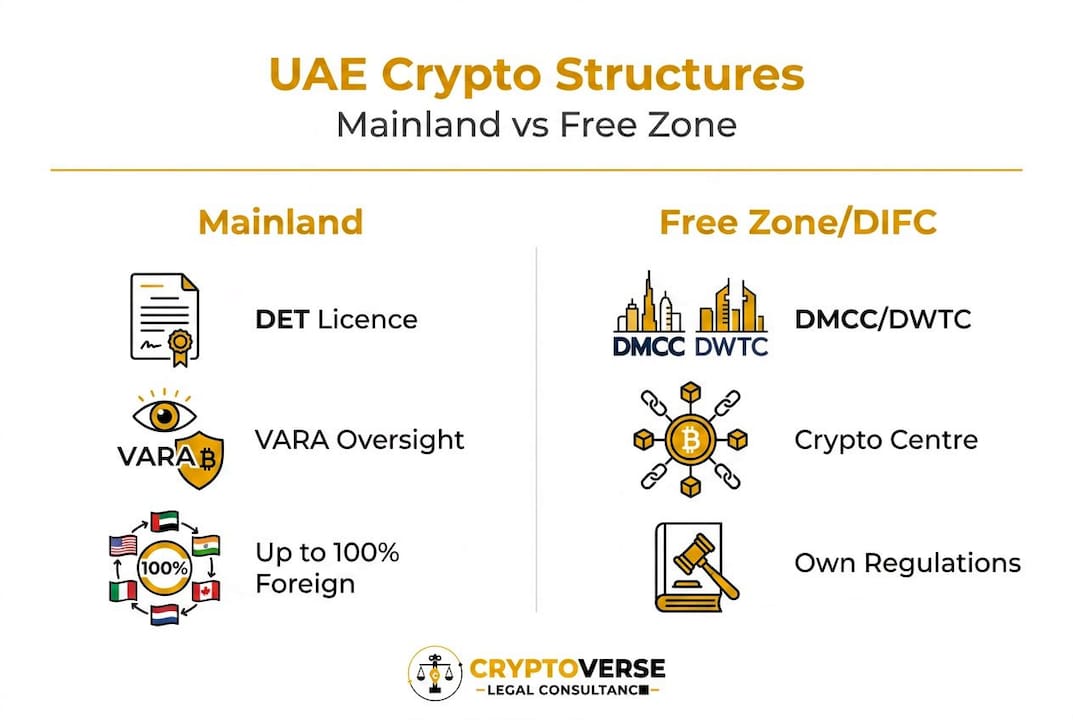
The Virtual Assets Regulatory Authority (VARA) is the primary regulator for virtual asset service providers (VASPs) operating in Dubai, with the critical exception of the Dubai International Financial Centre (DIFC). Businesses within the DIFC fall under the jurisdiction of the Dubai Financial Services Authority (DFSA). The Abu Dhabi Global Market (ADGM) is regulated by the Financial Services Regulatory Authority (FSRA), and the Securities and Commodities Authority (SCA) retains oversight over certain token offerings and crypto-related activities at the federal level.
Understanding VARA regulations is essential for any business targeting the Dubai market outside of the DIFC. VARA issues licences for regulated virtual asset activities including exchange services, broker-dealer operations, custody, lending, and investment management.
Comparison: mainland vs free zone vs DIFC
| Feature | Mainland (DET) | Free Zone (DMCC/DWTC) | DIFC |
|---|---|---|---|
| Foreign ownership | Up to 100% (post-2021 reforms) | 100% permitted | 100% permitted |
| Regulatory body | VARA | VARA (for VA activities) | DFSA |
| Local market access | Unrestricted | Restricted to zone or abroad | Restricted to DIFC or abroad |
| Crypto licence pathway | VARA licence required | VARA or zone-specific | DFSA Digital Asset Framework |
| Office requirement | Physical office mandatory | Flexi-desk or physical | Physical office required |
| Setup speed | Moderate | Faster in most cases | Moderate to slower |
The advantages of the UAE's crypto law framework for foreign investors are substantial, but they only materialise when the correct structure is chosen from the outset. Misidentifying your regulatory jurisdiction can result in operating without the proper licence, which carries severe penalties under VARA's enforcement regime.
You should also note that the DMCC's crypto centre and the DWTC's Virtual Assets and Related Activities (VARA) regulated zone have specific approval processes layered on top of standard free zone incorporation. The overview of crypto regulations in the UAE covers the full picture across all five regulatory bodies.
Step-by-step process to structure your crypto business
With a grasp on legal structures and regulatory zones, here is a step-by-step breakdown for starting your crypto business in the UAE.
Step 1: Define your activity and target jurisdiction
Before you reserve a name or draft any documents, determine precisely what regulated activities your business will conduct. VARA distinguishes between advisory services, exchange services, custody, broker-dealer activities, lending, and investment management. Each carries a different licence category and compliance burden. Your activity scope also determines whether you need a VARA licence, a DFSA authorisation, or an FSRA licence.
Step 2: Reserve your trade name
Trade name reservation is the formal first step for both mainland and free zone entities. Names must comply with UAE naming conventions, must not imply regulatory endorsement, and must be reserved through the relevant authority (DET for mainland, the relevant free zone authority for zone entities).
Step 3: Prepare and notarise the Memorandum of Association (MOA)
The MOA defines your company's legal structure, shareholding, and permitted activities. For crypto businesses, the permitted activities clause must precisely reflect the virtual asset services you intend to offer, as any mismatch between your MOA and your licence application will cause delays.
Step 4: Obtain the initial commercial licence
This step is handled by DET or the relevant free zone authority. The initial licence confirms your entity's legal existence and commercial activity. It is a prerequisite for the VARA licensing process.
Step 5: Submit VARA's Initial Disclosure Questionnaire (IDQ)
VARA's IDQ is the gateway to the full licensing process. It captures information about your business model, technology infrastructure, AML/CFT (Anti-Money Laundering and Counter-Financing of Terrorism) framework, key personnel, and financial projections. VARA uses the IDQ to assess whether your application is suitable to proceed to the Minimum Viable Product (MVP) or full VASP licence stage.
| Stage | Key documents required |
|---|---|
| Trade name reservation | Passport copies, proposed name, activity description |
| MOA preparation | Shareholder details, activity scope, share capital structure |
| Initial licence | MOA, registered office address, fee payment |
| VARA IDQ submission | Business plan, AML policy, technology overview, UBO disclosures |
| Full VARA licence | Audited financials, compliance manuals, governance framework, key personnel CVs |
Pro Tip: Engaging a specialist legal adviser before the IDQ submission significantly reduces back-and-forth with VARA. The IDQ is not a simple form; it is a substantive regulatory document that shapes your entire licensing trajectory.
A practical scenario worth noting: a DMCC-incorporated entity that intends to offer crypto exchange services must obtain both the DMCC crypto trading licence and a full VARA VASP licence for exchange services. These are parallel processes with overlapping documentation requirements, so coordinating them simultaneously is far more efficient than treating them as sequential.
The crypto business licence guide provides detailed documentation checklists, and if you are considering a proprietary trading structure, guidance on setting up a trading firm in the UAE is also available.
Licensing and regulatory compliance for virtual assets
Once you have your business setup in order, staying compliant with the right licences and regulations is essential for continued operation and investor confidence.

The five regulatory authorities you must know
The UAE's regulatory landscape for virtual assets spans five key bodies:
- VARA (Virtual Assets Regulatory Authority): Governs VASPs in Dubai, excluding the DIFC. Issues licences for exchange, custody, broker-dealer, advisory, lending, and investment management activities.
- SCA (Securities and Commodities Authority): Federal authority with oversight over token offerings that qualify as securities, and certain other crypto-related activities at the national level.
- DFSA (Dubai Financial Services Authority): Regulates crypto activities within the DIFC under its Digital Assets Framework, which covers crypto tokens, investment tokens, and utility tokens.
- FSRA (Financial Services Regulatory Authority): Governs virtual asset activities within the ADGM, including digital securities and virtual asset spot trading.
- CBUAE (Central Bank of the UAE): Oversees payment token services, including stablecoins and digital payment instruments used within the UAE financial system.
As VARA covers Dubai excluding the DIFC, businesses that straddle both jurisdictions, for example, an entity with entities in both the DIFC and mainland Dubai, must maintain separate compliance frameworks for each regulator. This is a common source of confusion and one that frequently leads to regulatory overlap issues if not addressed during the structuring phase.
Core compliance obligations for VASPs
Once licensed, your ongoing Dubai crypto compliance obligations typically include:
- Maintaining a Board-approved AML/CFT policy aligned with FATF Recommendations and UAE Federal AML Law (Federal Decree-Law No. 20 of 2018)
- Conducting Customer Due Diligence (CDD) and Enhanced Due Diligence (EDD) for high-risk clients
- Filing Suspicious Activity Reports (SARs) with the UAE Financial Intelligence Unit (FIU) via the goAML platform
- Adhering to VARA's Market Conduct Rulebook and applicable activity-specific rulebooks
- Appointing a compliant Money Laundering Reporting Officer (MLRO) and a Compliance Officer
- Maintaining adequate capital reserves as stipulated by VARA's prudential requirements
Regulatory warning: VARA has the authority to impose fines, suspend licences, and mandate business wind-downs for non-compliance. Late submissions, inadequate AML records, and failure to notify VARA of material changes to your business model are among the most frequently cited enforcement triggers. Compliance is not a one-time exercise; it is a continuous operational function.
Pro Tip: Schedule quarterly internal compliance audits and set calendar reminders for all regulatory filing deadlines at the start of each financial year. VARA's regulatory calendar and reporting windows are predictable, and missing them is entirely avoidable with a structured internal governance process.
Common mistakes and how to futureproof your business
Understanding errors others have made makes it considerably easier to plan for sustained success in a regulatory environment that continues to evolve rapidly.
Costly mistakes that derail crypto businesses in the UAE
As entity structure and regulatory framework are decisive for both legal compliance and commercial flexibility, errors made at the structuring stage tend to have compounding consequences. The most common include:
- Selecting the wrong jurisdiction: Setting up in the DIFC when VARA licensing is required, or incorporating in a free zone that does not have a pathway for the specific virtual asset activity you intend to operate.
- Underestimating the IDQ: Treating the VARA IDQ as a basic questionnaire rather than a detailed regulatory submission. Incomplete or inconsistent answers trigger extended review periods and requests for additional information.
- Inadequate capitalisation: Failing to meet VARA's minimum capital requirements for the relevant activity category. This is a hard stop; the licence will not be issued without adequate capital evidence.
- Missing UBO disclosures: Ultimate Beneficial Ownership (UBO) disclosure requirements are strictly enforced. Incomplete or inaccurate ownership structures are one of the primary reasons applications are delayed or rejected.
- Ignoring ongoing compliance costs: Budgeting only for setup and initial licensing without accounting for the recurring cost of compliance operations, including MLRO salary, audit fees, goAML subscriptions, and annual VARA fees.
- Cross-authority misunderstanding: Assuming that a DFSA authorisation covers mainland Dubai activities, or that a VARA licence extends to ADGM. Each regulator has a clearly defined statutory remit.
Building a futureproof corporate structure
The legal advantages of the UAE's framework are most fully realised by businesses that build flexibility into their corporate structure from day one. This means:
- Establishing a multi-entity structure where a UAE holding company controls operational subsidiaries in relevant jurisdictions
- Designing your AML/CFT framework to meet FATF standards, which makes it portable across jurisdictions including MiCA (EU), MAS (Singapore), and FCA (UK)
- Maintaining governance documentation that can be updated incrementally as VARA issues new rulebooks or amends existing ones
- Engaging a specialist to monitor regulatory developments and translate them into concrete compliance actions before deadlines arise
Pro Tip: When drafting your corporate structure, include provisions for adding new regulated activities or new entity types without requiring a full restructuring. VARA's activity categories may expand, and businesses that can add activities by amendment rather than by refiling are at a meaningful commercial advantage.
The risk of regulatory stagnation
Crypto regulation in the UAE moves quickly. VARA issued its full suite of rulebooks in 2023 and has continued to refine them. The SCA has been updating its framework for token offerings. The CBUAE issued its Payment Token Services Regulation in 2024. Businesses that treat compliance as a static exercise will find themselves out of step with current requirements within twelve to eighteen months of setup.
A candid perspective on structuring crypto businesses in the UAE
From our experience advising VASPs, exchanges, tokenisation platforms, and investment funds across the UAE, one pattern appears consistently: entrepreneurs who rely on generic incorporation checklists encounter the most expensive problems. The UAE's crypto regulatory framework is detailed and technical. A small distinction, such as whether your token qualifies as a virtual asset or a digital security under the SCA's classification framework, can determine which regulator you must approach, what capital you must hold, and what investor protections you must offer.
Business structures in the UAE are not merely administrative formalities. They directly affect your ability to open a corporate bank account, attract institutional investors, and onboard payment partners. Banks in the UAE conduct their own due diligence on the regulatory status of crypto businesses, and a VARA licence from a well-structured entity carries considerably more weight than an equivalent structure that appears ad hoc or poorly documented.
Understanding why legal advice matters is not just a question of risk mitigation. It is a question of commercial viability. Founders who invest in specialist legal counsel at the structuring stage consistently progress through VARA's licensing process faster, with fewer information requests and a stronger compliance posture from the outset. Given that VARA licensing timelines can range from several months to over a year depending on application quality, the time saved by a well-prepared initial submission translates directly into earlier market entry and earlier revenue.
The uncomfortable reality is that generic guidance, no matter how well-intentioned, cannot substitute for jurisdiction-specific, activity-specific, and structure-specific legal advice. The UAE's crypto framework rewards those who engage with its technical detail, and penalises those who do not.
Expert support for structuring your crypto business
For those looking to put their plans into action with confidence, expert guidance is essential. At CRYPTOVERSE Legal Consultancy, we work with crypto startups, established VASPs, investment funds, and institutional clients to structure compliant, regulator-ready businesses across all UAE jurisdictions.
Our team advises on the full range of VARA compliance services, from IDQ submission to full VASP licence approval, and covers every regulated activity under VARA's framework. We also provide digital asset legal consulting across SCA, DFSA, and FSRA jurisdictions, and can structure multi-authority businesses where your operations span more than one UAE regulatory zone. If you need clarity on the full scope of regulated activities under VARA, our team can map your business model to the appropriate licence category and build the compliance framework to support it.
Frequently asked questions
Who regulates crypto businesses in Dubai and the UAE?
VARA regulates most of Dubai (excluding the DIFC), while the SCA holds federal oversight over token offerings, the DFSA governs activities within the DIFC, and the FSRA covers the ADGM in Abu Dhabi.
What is the first step to starting a crypto business in the UAE?
The process begins with trade name reservation and preparation of a Memorandum of Association, followed by obtaining an initial commercial licence before submitting VARA's Initial Disclosure Questionnaire.
Can foreign investors own 100% of a UAE crypto company?
Yes, free zones such as DMCC and DWTC permit 100% foreign ownership, and mainland reforms since 2021 have also expanded foreign ownership rights in many commercial sectors.
What are the main compliance pitfalls for crypto entrepreneurs in the UAE?
The most significant risks include selecting an incompatible entity structure, missing regulatory filing deadlines, and misunderstanding authority overlap, all of which confirm that entity structure and regulatory framework are decisive factors for both legal compliance and long-term commercial flexibility.
Recommended
- Unlock the advantages of UAE crypto law for your business
- Why crypto businesses need legal advice in the UAE 2026 - Cryptoverse Legal Consultancy
- Crypto Regulations in UAE - VARA, DFSA, FSRA, SCA & CBUAE Explained
- Regulatory Compliance for Virtual Asset Brokers in the UAE - Cryptoverse Legal Consultancy