

TL;DR:
- UAE virtual asset regulations are layered, strict, and require precise compliance strategies.
- Obtaining a license involves establishing a UAE entity, meeting capital and AML standards, and navigating multiple regulators.
- Ongoing AML and compliance obligations are rigorous, with heavy penalties for violations and no GCC passporting.
Regulatory missteps in the UAE's virtual asset market can result in multi-million dirham penalties and permanent market exclusion, consequences that are entirely avoidable with the right preparation. The UAE has positioned itself as a global digital assets hub, but the regulatory framework governing virtual asset service providers (VASPs) is layered, fast-moving, and unforgiving of gaps. Whether you are a crypto startup approaching your first licence application or an established business eyeing GCC expansion, understanding the precise compliance obligations across regulators is not optional. This guide sets out a structured, step-by-step approach to regulatory compliance in the UAE and beyond.
Key Takeaways
| Point | Details |
|---|---|
| Know your regulator | Identify whether CMA or VARA applies before launching crypto services in the UAE. |
| Capital and controls | Secure the right entity, capital, and compliance infrastructure for your chosen licence. |
| Implement AML early | Robust customer checks and risk reporting must be in place from day one to avoid fines. |
| GCC expansion is tricky | No unified licence means each market—Oman, Saudi Arabia, Bahrain—requires a unique strategy. |
| Compliance is ongoing | Regular risk assessments, audits, and expert support help future-proof your crypto business. |
Understanding the UAE crypto regulatory framework
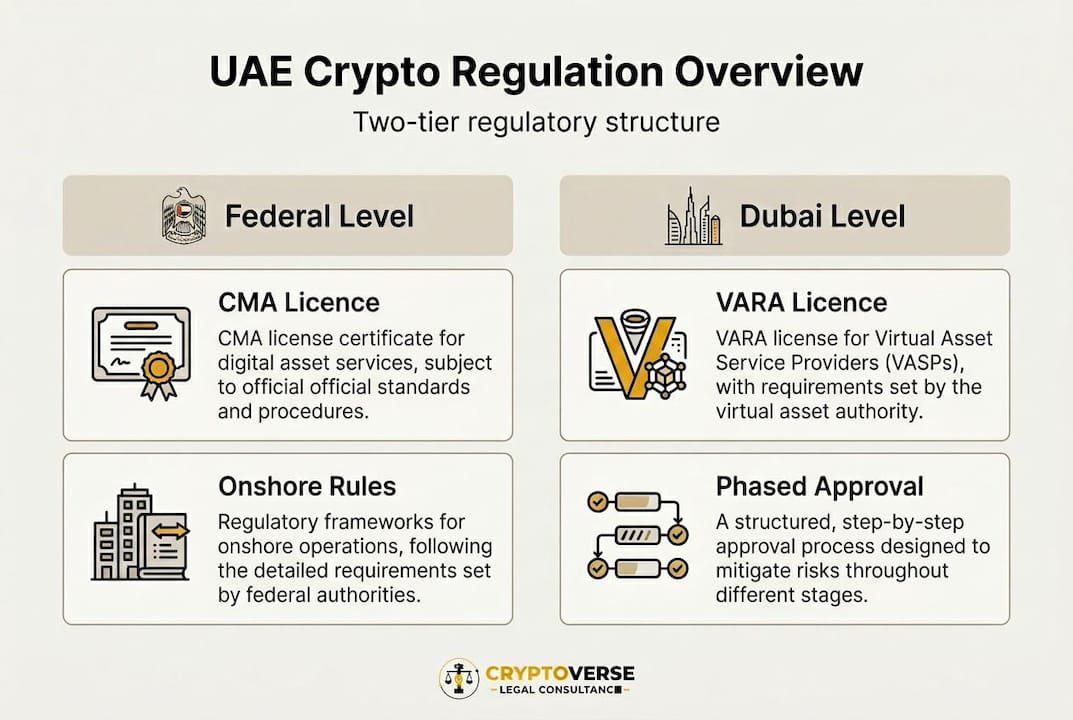
The UAE's virtual asset regulatory architecture operates across two distinct tiers: federal oversight and emirate-level supervision. Getting this distinction wrong from the outset is one of the most common and costly errors a VASP applicant can make.
At the federal level, CMA Decision No. 4/R.M/2026 issued in February 2026 establishes the statutory framework for onshore crypto operations. It identifies eight regulated virtual asset activities, sets minimum capital thresholds, and mandates that any business conducting these activities outside a financial free zone must obtain a CMA licence. In parallel, VARA's licensing system applies exclusively within Dubai's non-financial free zones and operates under a phased approval model requiring a UAE-registered legal entity and a demonstrable local presence.
The table below summarises the key differences between CMA (federal) and VARA (Dubai) regulation:
| Feature | CMA (Federal) | VARA (Dubai) |
|---|---|---|
| Jurisdiction | Onshore UAE (excluding DIFC, ADGM) | Dubai (non-financial free zones) |
| Governing instrument | CMA Decision No. 4/R.M/2026 | VARA Rulebook (May 2025) |
| Licencing model | Single-stage licence | Phased: Provisional, MVP, FMP |
| Local entity required | Yes | Yes |
| Prohibited instruments | Privacy tokens, algorithmic tokens | Privacy tokens, algorithmic tokens |
| Minimum capital | Activity-specific (from AED 1M) | Activity-specific (from AED 1M) |
Businesses operating within the Dubai International Financial Centre (DIFC) or Abu Dhabi Global Market (ADGM) fall under the DFSA and FSRA respectively. Each regulator has its own rulebook, fee structure, and supervisory expectations, so confirming the correct regulatory perimeter before any application is essential. For a broader overview of UAE VASP compliance obligations, it is worth reviewing all five UAE regulators' scope before making a corporate structuring decision.
Key prohibitions applicable under federal rules include:
- Privacy coins and privacy tokens (e.g. Monero, Zcash)
- Algorithmic tokens without sufficient reserve backing
- Privacy-enabling devices and tools designed to obfuscate transaction trails
- Operating without a licence beyond the 90-day transition period granted to existing market participants
Pro Tip: Before submitting any application, confirm which regulator has jurisdiction over your proposed operating model, entity location, and target customer base. Applying to the wrong regulator wastes capital and time.
Essential requirements for VASP licensing in the UAE
Securing a VASP licence in the UAE demands more than completing an online form. Regulators assess applicants across governance, financial soundness, technology infrastructure, and compliance readiness simultaneously.
The following prerequisites apply whether you are applying under the CMA framework or through the VARA licensing process:
- UAE legal entity: You must incorporate a company under UAE law, whether onshore (LLC) or within an applicable free zone.
- Detailed business plan: Including revenue model, product scope, target market, and risk appetite.
- Appointed Responsible Officers: At minimum, a Chief Executive Officer and a Money Laundering Reporting Officer (MLRO) who meet fit-and-proper criteria.
- Physical premises: Demonstrable UAE office space. Virtual addresses are not acceptable.
- AML/CTF framework: A documented compliance programme including policies, procedures, and controls.
- Technology and custody architecture: Evidence of secure systems, particularly for custody or exchange activities.
Capital requirements vary significantly by activity. The table below reflects CMA-level thresholds published in CMA Decision No. 4/R.M/2026:
| Activity | Minimum capital (AED) |
|---|---|
| Exchange services | 2,000,000 |
| Principal dealing | 4,000,000 |
| Transfer services | 1,000,000 |
| Custody services | 2,000,000 |
| Investment management | 2,000,000 |
VARA operates a phased licensing model with three stages. The Provisional stage allows initial assessment and pre-market-entry preparation. The Minimum Viable Product (MVP) stage permits limited live operations under regulatory supervision. The Full Market Product (FMP) stage grants full commercial authorisation. Paid-up capital and the crypto firm capital requirements must be met and evidenced at each stage transition.
Pro Tip: Engaging a regulatory adviser before the Provisional application stage consistently reduces approval timelines. Regulators flag incomplete or inconsistent documentation quickly, and resubmissions cause significant delays.
Meeting AML and compliance obligations under UAE law
Once licensed, the real compliance work begins. AML/CTF obligations are not a one-time exercise. They are ongoing, audited regularly, and enforced with escalating severity.

The UAE's AML/CFT regime is FATF-aligned, meaning it applies the Travel Rule to transactions exceeding USD 1,000, mandates Know Your Customer (KYC) verification for all clients, requires Suspicious Activity Reports (SARs), and enforces quarterly risk assessments across the business. These are not aspirational standards. They are enforceable legal obligations.
The compliance implementation checklist below covers the core steps:
- Customer due diligence (CDD): Verify identity for all clients at onboarding. Apply enhanced due diligence (EDD) for high-risk customers, politically exposed persons (PEPs), and non-standard jurisdictions.
- Transaction monitoring: Deploy automated systems to flag unusual transaction patterns, high-velocity trading, or structuring behaviours.
- Travel Rule compliance: Collect and transmit originator and beneficiary information for qualifying transfers.
- Source of funds verification: Document and retain evidence of wealth origin for any client presenting meaningful transaction volumes.
- SAR filing: Report to the UAE Financial Intelligence Unit (FIU) via the goAML portal when suspicious activity is identified.
- Quarterly risk assessments: Conduct and document formal risk reviews tied to your customer base, geography, and product changes.
Accurate and timely regulatory reporting is not simply a compliance obligation; it is a primary safeguard for your licence, your leadership team, and your investors.
Common pitfalls that trigger regulatory intervention include failure to screen against updated sanctions lists, inadequate controls for unhosted wallets, and accepting transactions from mixing services or tumbling protocols. Reviewing virtual asset custody rules is particularly important for custody providers, where specific safeguarding obligations apply.
It is also critical to understand that executive liability under UAE law extends personal criminal exposure to directors and compliance officers, not only to the corporate entity itself.
Expanding across the GCC: Cross-border compliance and pitfalls
A UAE VASP licence is a strong foundation, but it does not automatically open doors across the Gulf Cooperation Council. GCC states are at markedly different stages of regulatory development, and the differences are consequential for any cross-border expansion plan.
The landscape, as confirmed by regional regulatory analysis, is fragmented. Only Oman has moved towards a licensing demand comparable to the UAE, while Saudi Arabia, Bahrain, and Qatar are at earlier or less clearly defined stages. There is no unified GCC VASP passporting mechanism. Each market requires its own regulatory assessment and, in most cases, a separate local entity.
Key cross-border considerations by jurisdiction:
| Country | Regulatory status | Key watchpoints |
|---|---|---|
| Oman | Licensing framework advancing | Capital Markets Authority oversight |
| Saudi Arabia | SAMA and CMA active, evolving rules | Shariah compliance layer, marketing limits |
| Bahrain | CBB sandbox and licensing available | Limited product scope currently permitted |
| Qatar | Restricted market, limited VASP activity | High entry bar, conservative approach |
Practical steps before expanding into any GCC market:
- Review local AML/CTF requirements and whether they differ materially from UAE standards
- Assess marketing and solicitation rules, as some jurisdictions restrict outreach to retail clients
- Confirm sanctions screening obligations, including local designations beyond OFAC and UN lists
- Identify whether a local banking relationship is required for operational settlement
- Evaluate whether the activity you intend to offer is permitted under the local framework
For a detailed view of crypto regulations in Dubai and how they interact with GCC entry considerations, cross-referencing both frameworks before any market entry decision is strongly advised.
Pro Tip: Do not assume that operational processes meeting UAE standards will automatically satisfy GCC regulators. Local AML frameworks, reporting timelines, and permitted product scopes vary enough to require jurisdiction-specific legal review.
Expert perspective: Why most startups underestimate UAE crypto compliance
With only 39 VARA licences issued and a very small number at federal CMA level, the data makes clear that the majority of applicants either fail or never complete the process. This is rarely because their product is inadequate. It is almost always because compliance infrastructure is treated as secondary to commercial priorities.
The most common failures we observe are consistent: underestimating ongoing risk review obligations, failing to integrate know-your-transaction (KYT) monitoring before going live, and submitting AML frameworks that are technically present but operationally hollow. Regulators review the substance of compliance, not just its documentation.
There is a wider lesson here. Investment in compliance technology and qualified compliance officers is frequently characterised as overhead. In practice, the cost of a regulatory fine, a licence suspension, or executive liability exposure vastly exceeds the cost of proactive compliance investment. Businesses that review common crypto licence rejection reasons often discover they were preparing for the wrong risks entirely.
Pro Tip: Treat compliance as a commercial enabler. A clean regulatory record accelerates partnerships, investor due diligence, and market entry into additional jurisdictions.
How Cryptoverse Lawyers can help you stay compliant
Navigating the UAE's multi-regulator crypto environment whilst managing business growth demands precise, up-to-date legal support. CRYPTOVERSE Legal Consultancy provides exactly that.

Our team advises across VARA regulations and licensing, SCA VASP licensing, and the full spectrum of UAE and GCC regulatory frameworks. From pre-application readiness assessments to AML/CTF policy design, phased licence progression, and cross-border expansion strategy, we provide structured support at every stage. Our digital asset legal support services are tailored to founders, established VASPs, and institutions entering the market for the first time. Book a compliance assessment consultation to understand exactly where your business stands and what steps are required to achieve and maintain full regulatory authorisation.
Frequently asked questions
What are the main steps to obtain a VASP licence in the UAE?
You must form a UAE legal entity, prepare full compliance documentation, appoint a Money Laundering Reporting Officer, and meet activity-based capital requirements before submitting your application to VARA or the CMA.
How strict are AML/CTF requirements for crypto firms in the UAE?
AML/CTF obligations are strictly enforced, with fines reaching AED 100 million and executive imprisonment for serious failures; businesses must conduct KYC, monitor transactions, and submit regular risk assessments without exception.
Can a UAE VASP passport its licence to other GCC countries?
No. There is no GCC passporting system for virtual asset firms; each jurisdiction maintains its own regulatory requirements, and a UAE licence does not grant market access elsewhere in the Gulf.
What are the penalties for non-compliance with UAE crypto regulation?
Penalties include fines ranging from AED 100,000 to AED 100 million, revocation of licence, and executive imprisonment of up to 10 years for serious AML/CTF failures.
Does the UAE prohibit any types of tokens or activities?
Yes. Privacy tokens, algorithmic tokens and privacy-enabling devices are prohibited under CMA federal rules, and operating without a valid licence beyond the 90-day transition period is also unlawful.
Recommended
- Crypto Regulations in UAE - VARA, DFSA, FSRA, SCA & CBUAE Explained
- Unlock the advantages of UAE crypto law for your business
- Why crypto businesses need legal advice in the UAE 2026 - Cryptoverse Legal Consultancy
- Regulatory Compliance for Virtual Asset Brokers in the UAE - Cryptoverse Legal Consultancy