

TL;DR:
- The UAE's crypto regulatory framework involves five distinct authorities, each covering specific regions and activities.
- Structuring a crypto business correctly from the start aligns with the appropriate regulator, reducing compliance risks and costs.
- Multi-entity and offshore structures are common to optimize operational flexibility, asset protection, and regulatory compliance.
Many founders arrive in Dubai convinced there is one correct structure for a UAE crypto business. There is not. The UAE operates a multi-regulator framework covering five distinct authorities, each with its own statutory remit, licensing conditions, and enforcement powers. Choosing the wrong structure, or selecting a regulator whose scope does not match your actual business activities, creates compliance gaps that can cost millions in fines or force a complete restructure. This article maps the UAE's regulatory landscape, details the principal structuring options available to virtual asset service providers (VASPs), and outlines exactly what licensing and compliance require in practice.
Key Takeaways
| Point | Details |
|---|---|
| Regulatory complexity | UAE's multi-regulator ecosystem means structuring should fit both jurisdiction and business activity. |
| Structure matters | Choosing the right free zone, foundation, or DAO model impacts setup speed, cost, and asset protection. |
| Compliance essentials | Licensing demands capital, local directors, strict AML/KYC, and staged approval—failing these risks heavy penalties. |
| Multi-jurisdiction strategy | International groups must align entity structure and token design to avoid costly regulatory overlap. |
| Expert support | Specialist legal guidance ensures your structuring and compliance strategies are fit for scale and future proof. |
Understanding the multi-regulator crypto landscape in the UAE
The UAE is unusual globally in that it does not rely on a single financial regulator for virtual assets. Instead, jurisdiction is divided by geography, activity type, and entity classification. Understanding which body has authority over your operations is the foundational step in any structuring exercise.
The five principal regulators are:
- VARA (Virtual Assets Regulatory Authority): Governs all virtual asset activities in Dubai, excluding the Dubai International Financial Centre (DIFC). VARA is the most active issuer of full VASP licences in the UAE and covers exchanges, brokers, custody providers, and advisory services.
- FSRA (Financial Services Regulatory Authority): Regulates virtual asset businesses operating within Abu Dhabi Global Market (ADGM). The FSRA framework is common-law based and is particularly suited to institutional operators and investment managers.
- DFSA (Dubai Financial Services Authority): Has jurisdiction over crypto firms operating within the DIFC. The DFSA's regime covers investment token activities and crypto token services for qualifying operators.
- SCA/CMA (Securities and Commodities Authority): Governs onshore UAE entities that are not located in a financial free zone. The SCA issued its first VASP licence in 2025 and is increasingly relevant for firms seeking nationwide reach without a free zone establishment.
- CBUAE (Central Bank of the UAE): Oversees payment tokens, including dirham-pegged stablecoins and stored-value instruments. Any business issuing or operating a payment token must engage the CBUAE regardless of where it is incorporated.
For practical purposes, this means your choice of regulator is not simply a commercial preference. It is determined by where your entity is incorporated, what activities you intend to conduct, and which customers you serve. A firm operating an exchange for retail users in Dubai mainland, for instance, falls squarely within VARA's remit. An institutional fund manager in ADGM reports to the FSRA. These are not interchangeable.
Understanding Dubai crypto compliance obligations specific to your activity class is essential before any entity formation decision is made. The practical implications of misalignment are severe.
Non-compliance with UAE virtual asset regulations carries fines from AED 1M to 4M or more, profit disgorgement orders, and potential criminal referral for individuals. Regulators have demonstrated willingness to enforce these powers, and remediation costs typically far exceed the original licensing investment.
Each regulator also publishes its own rulebooks, prudential requirements, and conduct standards. Compliance is not a one-time event; it requires continuous monitoring of regulatory updates and prompt adaptation of internal policies.
Choosing the optimal corporate structure: free zones, foundations, and DAOs
With the regulatory map established, the next decision is which corporate structure best fits your business model, target market, and growth plans. The UAE offers several distinct options, and each carries specific advantages, limitations, and regulatory alignment.

| Structure | Primary regulator | Best suited for | Approximate setup cost |
|---|---|---|---|
| DMCC free zone company | VARA | Proprietary trading, crypto services | AED 20,000 to 50,000 |
| ADGM SPV or fund | FSRA | Institutional, investment management | USD 10,000 to 30,000 |
| DIFC company | DFSA | Investment tokens, regulated services | USD 15,000 to 40,000 |
| RAK DAO entity | VARA/unregulated | DAOs, Web3 projects, low-cost setup | AED 15,000 to 25,000 |
| Onshore LLC | SCA | Nationwide operations, local clients | AED 15,000 to 35,000 |
| Foundation structure | Variable | Asset protection, multi-jurisdiction | AED 30,000 to 80,000 |
DMCC (Dubai Multi Commodities Centre) hosts over 700 crypto firms and remains the UAE's largest free zone cluster for virtual asset businesses. DMCC suits proprietary trading firms and crypto service providers who need a fast, cost-effective establishment with access to Dubai's ecosystem. Importantly, firms conducting only proprietary trading within DMCC may obtain a No Objection Certificate (NOC) rather than a full VARA licence, which significantly reduces cost and timeline.
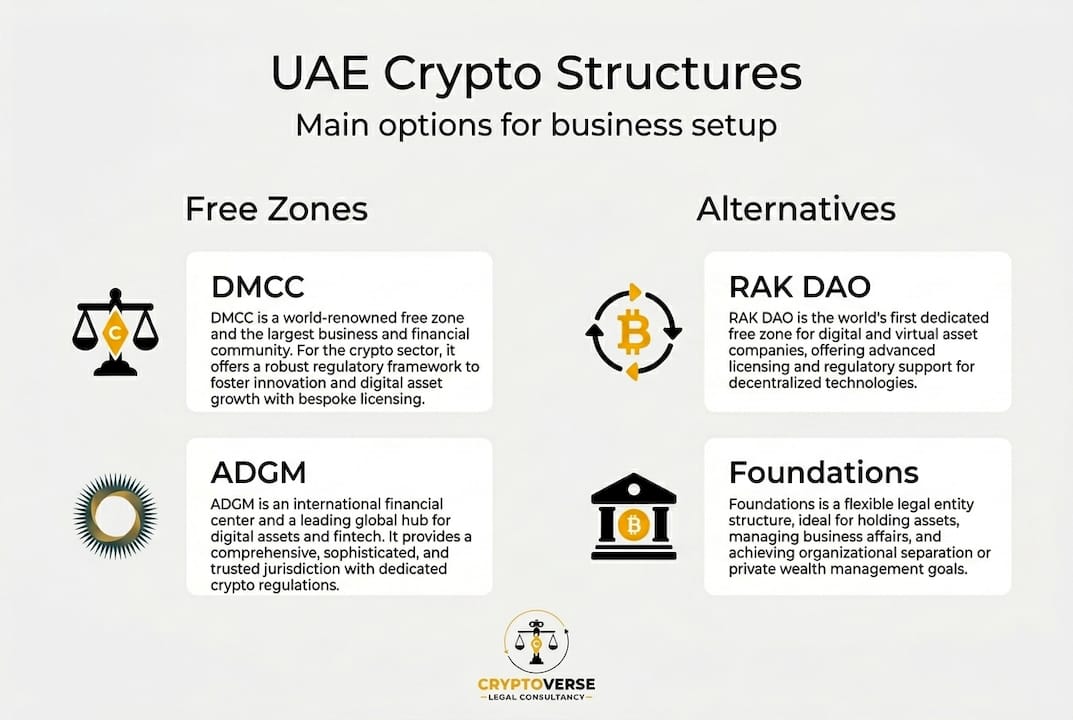
ADGM and DIFC cater to institutional operators. Both are common-law jurisdictions with English-language legal systems, making them the preferred choice for hedge funds, asset managers, and firms seeking to attract international institutional capital. The FSRA and DFSA frameworks are rigorous but well-recognised by counterparties in London, New York, and Singapore.
RAK DAO is a newer and increasingly popular option for decentralised autonomous organisation (DAO) structures, Web3 protocols, and early-stage projects that require a legal wrapper without the full overhead of a regulated entity. Setup costs are low and timelines are short, making it attractive for crypto founders who need a recognised legal domicile while their business model matures.
For complex multi-jurisdictional groups, foundation structures provide an additional layer of asset protection. A common configuration pairs a UAE foundation at the top of the group with operating subsidiaries in Seychelles or AIFC (Astana International Financial Centre). This separates asset ownership from operational risk and provides flexibility for tax planning across borders.
Multi-entity setups combining a UAE operating company (opco) with an offshore holding company (holdco) in BVI or Cayman Islands are also common among international groups. The offshore holdco holds intellectual property, token reserves, or equity stakes, while the UAE opco holds the licence and conducts regulated activity.
Pro Tip: Align your corporate structure with your token design from day one. If you intend to issue a utility token, governance token, or payment token, the classification of that token directly affects which regulator has oversight and which entity type is appropriate. Retrofitting a structure after a token launch is costly and often requires regulatory notification or fresh applications.
Licensing, compliance, and timelines: what UAE authorities require
Understanding the structural options is only part of the picture. Founders must also understand what the licensing process actually demands in terms of capital, personnel, documentation, and time.
The capital requirements alone vary significantly by licence type and activity:
| Licence type | Minimum capital requirement | Application fee | Annual fee |
|---|---|---|---|
| VARA exchange (full) | AED 4,000,000 | AED 40,000 to 300,000 | AED 100,000 to 700,000 |
| VARA broker dealer | AED 2,000,000 | AED 40,000 to 150,000 | AED 100,000 to 400,000 |
| VARA custody | AED 1,000,000 | AED 40,000 to 100,000 | AED 100,000 to 300,000 |
| FSRA crypto licence | USD 250,000 to 2,000,000 | USD 10,000 to 50,000 | USD 10,000 to 40,000 |
Beyond capital, licensing requirements include appointment of UAE-resident directors, a Money Laundering Reporting Officer (MLRO), a compliance officer, and a Chief Information Security Officer (CISO) for entities managing custody or exchange functions. Each of these individuals must pass fit-and-proper assessments, which involve background checks, professional experience verification, and often in-person interviews with the regulator.
The VARA process follows four defined stages. Understanding these in advance allows firms to plan resource allocation accurately:
- IDQ (Initial Disclosure Questionnaire): Submission of a preliminary questionnaire covering business model, ownership structure, and intended activities. VARA uses this to assess eligibility before formal engagement.
- In-principle approval: Following a successful IDQ, VARA issues in-principle approval subject to the firm completing all outstanding requirements. This stage involves detailed review of AML/KYC policies, governance documents, and technology infrastructure.
- MVP (Minimum Viable Product) licence: The firm receives a restricted licence to begin limited commercial operations. This stage allows regulators to assess real-world compliance before full authorisation.
- Full licence: Granted upon satisfactory completion of the MVP period and all outstanding conditions. Firms with a full licence can operate without commercial restrictions.
For a detailed breakdown of each stage, including documentation checklists and regulator expectations, refer to VARA licensing steps and guidance on who to hire for a VARA licence to ensure your team composition meets regulatory standards.
The SCA's first VASP licence case established important precedent. The SCA required a detailed business plan, evidence of sufficient capital, comprehensive AML/KYC policies, and CVs for all senior management. This confirms that onshore applications are substantive processes, not administrative formalities.
Technology requirements are increasingly demanding. Regulators expect cybersecurity audit reports, multi-signature custody protocols, incident response procedures, and penetration testing results for any firm handling client assets. These are not optional disclosures; they are conditions of licence approval.
Navigating multi-jurisdictional challenges and edge case structuring
Many of the firms seeking UAE licences are not operating exclusively within the UAE. They serve international clients, hold assets across multiple jurisdictions, or operate subsidiary entities in markets ranging from Singapore to Nigeria. This cross-border complexity creates layered structuring challenges that require careful advance planning.
The UAE's regulatory benchmarks are instructive for understanding the pace of this market. VARA has issued over 70 full licences and more than 200 provisional licences as of 2025. DMCC hosts 700 or more crypto-related firms. ADGM has over 40 licensed entities operating under the FSRA framework. These numbers confirm the UAE as a serious, established jurisdiction rather than an emerging regulatory experiment.
Licensing timelines differ substantially between jurisdictions. UAE licences typically take three to nine months from initial submission to full approval. Offshore jurisdictions such as BVI, Cayman, and Seychelles can achieve equivalent approvals in two to four months, though those licences carry less reputational weight with institutional counterparties. The trade-off between speed and credibility is a genuine structuring consideration.
Choosing your regulatory home based purely on cost or speed almost always creates downstream problems. Selecting the correct regulator per activity and target market is the most effective way to reduce regulatory overlap, avoid dual-licensing costs, and protect the business from enforcement risk.
The key principles for multi-jurisdictional structuring are:
- Separate activities by entity: Where a group conducts both retail exchange and proprietary trading, separate legal entities prevent regulatory bleed-through and protect the licensed entity from the risk profile of the unlicensed one.
- Match token design to entity: If your group issues a governance token from an offshore entity but the token is traded on a UAE-licenced exchange, both entities may face regulatory scrutiny. Token classification must be analysed before issuance, not after.
- Plan for FATF travel rule compliance: Firms with cross-border transactions must implement Virtual Asset Service Provider (VASP) identification protocols consistent with FATF Recommendation 16. This has direct implications for technology architecture and correspondent VASP relationships.
- Consider substance requirements: UAE free zones increasingly require genuine operational substance, including staff, office space, and local management. Nominee arrangements that lack real substance expose the entity to regulatory and tax risk.
Pro Tip: For groups considering expansion into markets regulated under MiCA (EU) or MAS (Singapore), structuring the UAE entity as an intermediate holding layer can simplify future passporting and cross-border licensing applications. However, this only works if the UAE entity has genuine substance and is not treated purely as a brass-plate vehicle.
For firms operating AI-driven trading systems, VARA has begun issuing specific guidance on algorithmic and automated trading activities, which introduces additional compliance obligations that must be factored into both the entity structure and the technology audit process.
A fresh perspective on structuring for crypto in the UAE
The most consistent mistake we observe among founders is prioritising speed and cost over regulatory fit. A RAK DAO entity set up in three weeks with minimal capital may seem efficient at the outset. But if the business model evolves to include retail client asset management, that entity will need to be restructured entirely, often at a cost five times greater than the original setup.
Regulatory fit is not a compliance formality. It is a commercial foundation. Firms that align their corporate structure, token design, and business model with the correct regulator from the start tend to raise capital more easily, attract institutional partners more quickly, and avoid the enforcement actions that have disrupted several prominent UAE-market entrants in recent years.
The second persistent error is centralising too many functions within a single entity. Multi-entity group structures exist for sound commercial and regulatory reasons. Separating IP ownership, capital holding, and operational activity protects individual entities from cross-contamination risk and allows the group to respond to regulatory change in one market without disrupting the whole.
Understanding who needs a VARA licence and at what stage of business development is a question we recommend founders answer before incorporating. Building compliance in from day one is categorically less expensive than retrofitting it under regulatory pressure.
Expert guidance for structuring and compliance in the UAE
Navigating the UAE's multi-regulator environment requires more than a checklist. It requires legal counsel that understands both the regulatory frameworks and the commercial realities of running a virtual asset business.
CRYPTOVERSE Legal Consultancy provides end-to-end support for crypto firms seeking to establish, licence, and operate in the UAE. Our team advises on VARA regulations and licensing, structures multi-entity groups for institutional and retail operators, and prepares regulator-ready compliance frameworks from AML/KYC policy design to technology audit preparation. We also advise on digital asset legal matters across 30 or more jurisdictions and support firms navigating SCA VASP licensing as the onshore UAE framework matures. Contact our Dubai office to begin a structured licensing assessment.
Frequently asked questions
Which regulator should I approach for a UAE crypto licence?
Your choice depends on activity and location: VARA for Dubai (excluding DIFC), FSRA for ADGM, DFSA for DIFC, and SCA/CMA for onshore UAE entities, with the CBUAE covering payment token operations.
What is the minimum capital for a UAE crypto licence?
Most licences require AED 1M to 4M in minimum capital; for example, a VARA exchange licence requires at least AED 4M in share capital at the point of full authorisation.
How long does it take to secure a UAE crypto licence?
The process typically takes three to nine months in the UAE depending on the regulator and licence type, compared to two to four months for equivalent offshore jurisdictions.
What are the consequences of non-compliance in the UAE?
Non-compliance can result in fines from AED 1M to 4M or more, profit disgorgement orders, and criminal referral for responsible individuals within the firm.
Can I use offshore entities for UAE crypto business structuring?
Yes. Many firms combine a UAE operating company with an offshore holding structure in BVI or Cayman Islands to optimise capital efficiency, intellectual property ownership, and operational flexibility across borders.