

TL;DR:
- Custody solutions provide secure storage, management, and control of cryptographic keys for digital assets, essential for institutional compliance and risk mitigation.
- Regulatory frameworks like VARA, DFSA, and FSRA mandate custody as a non-negotiable requirement, emphasizing segregation, controls, and auditability to prevent asset loss and legal violations.
Custody solutions are defined as the secure storage, management, and control of cryptographic keys that govern ownership and transfer of digital assets. For institutional participants, understanding why custody solutions are important is not a theoretical exercise. It is a fiduciary and regulatory obligation. The collapse of FTX in 2022 demonstrated with precision what happens when assets are commingled, controls are absent, and custody is treated as an afterthought. For exchanges, investment funds, family offices, and virtual asset service providers operating under frameworks such as VARA, DFSA, FSRA, and the UAE Federal AML Law (Decree-Law No. 20 of 2018), professional custody is a condition of authorisation, not a product feature.
Custodians currently manage roughly 50% of global assets, representing approximately $300 trillion in value. This figure signals that regulators and institutional markets have long treated custody as a structural requirement. Digital assets are now being held to the same standard, and operators who fail to meet it face licence revocation, enforcement action, and permanent asset loss.
Why custody solutions are important: the core risks they address
The risks that professional custody mitigates fall into three categories: security threats, operational failures, and compliance exposure. Each carries the potential for irreversible loss.
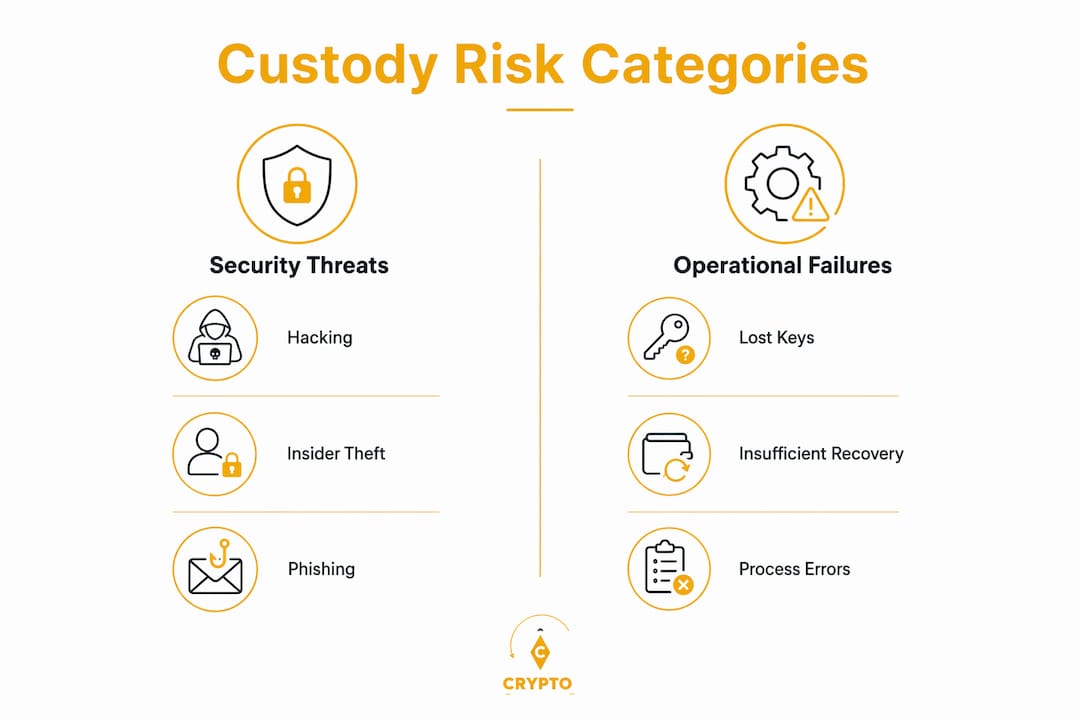
Security threats include external hacking, insider theft, and phishing attacks targeting private key holders. These are not hypothetical. Illicit crypto activity reached at least $154 billion in 2025, a 162% increase year-over-year. That figure represents the aggregate exposure facing any operator without institutional-grade custody controls in place.

Operational failures are equally damaging. Approximately 20% of Bitcoin's supply is permanently inaccessible due to lost keys and poor custody practices. For an institution managing client assets, a single key management failure can trigger regulatory investigation, civil liability, and reputational collapse.
Compliance exposure arises when custody arrangements cannot demonstrate segregation of client assets, audit trails, or AML/CFT controls. Under VARA's Custody Services Rulebook, DFSA COBS requirements, and the FSRA Virtual Asset Framework, operators must maintain documented custody policies that satisfy prudential and governance standards.
The specific risks that custody solutions address include:
- Key loss and inaccessibility: Without recovery protocols, lost credentials result in permanent asset forfeiture.
- Counterparty insolvency: Depositing assets on exchanges creates unacceptable counterparty risk, as institutional exposure to exchange failures demonstrates.
- Unauthorised transactions: Absence of multi-signature controls and role-based access allows single points of failure.
- Illicit activity facilitation: Without custody-level transaction monitoring, operators breach AML/CFT obligations under FATF standards and UAE Federal AML Law.
- Concentration risk: Unmonitored custody positions allow risk exposure to drift beyond board-approved thresholds.
Pro Tip: When assessing custody providers, request their disaster recovery documentation and key recovery procedures before reviewing fee structures. Recovery architecture is the most operationally critical element of any custody arrangement.
How regulatory frameworks shape the importance of custody solutions
Regulatory mandates across the UAE and major international jurisdictions have made professional custody a non-negotiable element of virtual asset service provision. The importance of custody solutions is codified in law, not merely recommended in guidance.
The UAE's five crypto regulators each impose distinct custody-related obligations:
- VARA requires licensed custodians to maintain segregated client asset accounts, implement multi-signature controls, and submit to periodic audits under the Custody Services Rulebook. Governance requirements include board-level oversight of custody policies and documented incident response procedures.
- DFSA mandates compliance with COBS and AML Rulebook provisions requiring client asset segregation, reconciliation procedures, and appointment of a senior manager responsible for custody oversight within DIFC-authorised firms.
- FSRA applies its Virtual Asset Framework to custody activities within ADGM, requiring capital adequacy buffers, operational resilience standards, and AML/CFT controls aligned with FATF Recommendation 16 (the Travel Rule).
- CBUAE has issued Circular 2/2024 and Circular 15/2021 establishing expectations for payment service providers and financial institutions engaging with virtual assets, including requirements for secure storage and client asset protection.
- SCA applies its Virtual Asset Regulations to custody arrangements outside the financial free zones, requiring governance frameworks and AML compliance consistent with Federal AML Law.
"Professional custody is a mandatory fiduciary and regulatory obligation for institutional asset managers, not a retail philosophy." — CVJ.AI, 2026
Beyond the UAE, MiCA (EU) Article 70 requires crypto-asset service providers to hold client assets with qualified custodians. MAS in Singapore imposes similar requirements under the Payment Services Act. The FCA in the UK requires CASS-compliant custody arrangements for authorised firms. These converging frameworks confirm that the role of custody solutions in regulatory compliance is universal, not jurisdiction-specific.
For AML/CFT purposes, custody infrastructure must support transaction monitoring, sanctions screening, and Travel Rule data transmission. Operators who cannot demonstrate custody-level controls during a VARA or DFSA supervisory review face enforcement action under the penalty frameworks of each regulator, which include fines, licence suspension, and public censure.
What custody solution models exist and how do they compare?
The benefits of custody solutions vary materially depending on the model selected. Choosing the wrong model for your risk profile and operational volume creates both security gaps and regulatory deficiencies.
| Custody model | Security profile | Regulatory suitability | Operational complexity |
|---|---|---|---|
| Self-custody (hardware wallet) | High for individuals; inadequate for institutions | Not suitable for licensed VASPs | Low |
| Third-party qualified custodian | Institutional grade | Fully suitable; meets VARA, DFSA, FSRA standards | Medium |
| Hybrid (self + third-party) | High with proper controls | Suitable with documented governance | High |
| Exchange-held custody | Low; counterparty risk | Not acceptable for client asset segregation | Low |
Cold storage (offline key storage) eliminates remote attack vectors but introduces operational latency. It is appropriate for long-term holdings and reserve assets. Hot wallets (online) support real-time transaction execution but require compensating controls including multi-signature authorisation, IP whitelisting, and transaction velocity limits.
Institutional-grade custody providers such as those operating under VARA's Custody Services Rulebook offer:
- Multi-signature approval workflows requiring two or more authorised signatories per transaction
- Role-based access control separating initiation, approval, and settlement functions
- Automated audit trails meeting DFSA and FSRA recordkeeping requirements
- Disaster recovery and business continuity plans tested at least annually
- Integration with AML compliance frameworks for real-time transaction screening
Custody infrastructure must also integrate multi-layer approvals, policy enforcement, and audit trails as stablecoin adoption accelerates. This is not optional architecture. It is a governance requirement for any operator issuing or managing stablecoins under VARA's Stablecoin Issuance Rulebook or MiCA Title IV.
Pro Tip: For operators managing assets across multiple chains or jurisdictions, a master custody arrangement with a single qualified custodian provides consolidated reporting and reduces the risk of governance gaps between siloed custody accounts.
How do custody solutions support operational governance and long-term asset protection?
Custody solutions function as operational governance frameworks, not merely storage mechanisms. The advantages of custody solutions in this context extend to risk monitoring, fiduciary accountability, and lifecycle management.
Recovery protocols represent the most critical and most frequently overlooked element of custody design. If a key holder leaves the organisation, is incapacitated, or loses access credentials, the absence of a documented recovery path results in permanent asset loss. This is not a theoretical risk. It is a documented cause of the 20% of Bitcoin supply that is permanently inaccessible. Every custody arrangement must include a tested, audited recovery procedure covering personnel changes, device failure, and multi-party key reconstruction.
Lifecycle management is equally material. Custody infrastructure must support key rotation, asset migration between custody providers, and protocol upgrades without interrupting operational continuity. Operators who treat custody as a static arrangement rather than an actively managed system accumulate technical debt that creates regulatory and security vulnerabilities over time.
The governance benefits of professional custody include:
| Governance function | Custody mechanism | Regulatory relevance |
|---|---|---|
| Segregation of client assets | Separate wallet addresses per client | VARA, DFSA COBS, FSRA |
| Transaction authorisation | Multi-signature approval workflows | Board governance requirements |
| Audit and recordkeeping | Automated immutable audit trails | AML Law, FATF standards |
| Risk monitoring | Real-time concentration and liquidity dashboards | Prudential capital standards |
| Incident response | Documented recovery and escalation procedures | VARA, DFSA operational resilience |
Fragmented custody reporting creates blind spots that lead to negative operational alpha. Consolidated master custody, as offered by qualified custodians operating under regulated frameworks, enables real-time monitoring of concentration risk and liquidity positions. This directly supports the board-level risk oversight that VARA, DFSA, and FSRA expect from licensed operators.
Custody solutions also prevent costly operational errors and monitor risk exposure during periods of market volatility. For family offices and investment funds managing digital asset portfolios, this function is equivalent to the fiduciary safeguards applied to traditional asset classes under established custodial frameworks. Understanding legal challenges in crypto custody is a prerequisite for any operator designing a custody governance framework that will withstand regulatory scrutiny.
Why professional custody is indispensable in 2026: our view
At Cryptoverselawyers, we have advised on custody structuring across VARA, DFSA, FSRA, and multiple international frameworks. The pattern we observe consistently is that operators underestimate custody until they face a supervisory review or an operational incident. By that point, the cost of remediation is multiples of what proper custody design would have required at the outset.
The most consequential shift we are seeing in 2026 is regulators moving from principles-based guidance to prescriptive technical standards. VARA's Custody Services Rulebook now specifies approval workflow architecture, not just outcomes. DFSA is increasing its scrutiny of client asset reconciliation procedures during routine supervision. This means that custody arrangements designed to satisfy 2023 standards are already non-compliant in several material respects.
We also observe that institutional clients entering digital assets from traditional finance consistently underestimate the operational complexity of custody in a multi-chain environment. A custody arrangement that works for Bitcoin and Ethereum does not automatically extend to tokenised real-world assets, stablecoins, or DeFi protocol interactions. Each asset class introduces distinct key management, transaction authorisation, and audit trail requirements.
The phrase "not your keys, not your coins" captures a retail truth. For institutions, the correct framing is: without a regulated, audited, and operationally resilient custody arrangement, you do not have a compliant business. Custody is not overhead. It is the legal and operational foundation on which every other function of a virtual asset service provider depends.
— CRYPTOVERSE
How Cryptoverselawyers can help you structure compliant custody solutions
Cryptoverselawyers advises virtual asset service providers, investment funds, and institutional operators on custody compliance across the UAE's five regulatory frameworks and over 30 international jurisdictions. Whether you are applying for a VARA custody licence, designing a governance framework to satisfy DFSA COBS requirements, or structuring a hybrid custody model for a tokenised asset fund, our team provides regulator-ready legal solutions grounded in technical understanding of custody architecture.

Our services cover custody policy drafting, AML/CFT integration, board governance frameworks, and prudential capital modelling aligned with VARA, FSRA, and DFSA standards. We also advise on VARA licensing and compliance for operators requiring full custody authorisation in Dubai. If your custody arrangement has not been reviewed against current regulatory standards, the risk of non-compliance is material. Contact Cryptoverselawyers to commission a custody compliance assessment before your next supervisory review.
FAQ
What are custody solutions in digital assets?
Custody solutions are systems and services that secure the cryptographic private keys controlling ownership and transfer of digital assets. They range from self-managed hardware wallets to institutional-grade qualified custodians offering multi-signature controls, audit trails, and regulatory compliance infrastructure.
Why are custody solutions important for regulated VASPs?
Regulated virtual asset service providers must maintain segregated client assets, documented governance controls, and AML/CFT-compliant transaction monitoring. Custody solutions provide the technical and operational infrastructure required to satisfy these obligations under VARA, DFSA, FSRA, and equivalent international frameworks.
What is the difference between hot and cold custody?
Cold custody stores private keys offline, eliminating remote attack vectors but introducing transaction latency. Hot custody maintains online connectivity for real-time settlement but requires compensating controls including multi-signature authorisation and continuous monitoring. Most institutional operators use a combination of both.
How much of Bitcoin has been lost due to poor custody?
Approximately 20% of Bitcoin's total supply is permanently inaccessible due to lost keys and inadequate custody practices. This figure illustrates the irreversible financial consequence of treating custody as a secondary concern rather than a primary governance obligation.
What regulatory instruments govern custody in the UAE?
Custody in the UAE is governed by VARA's Custody Services Rulebook, DFSA COBS and AML Rulebooks, the FSRA Virtual Asset Framework, CBUAE Circular 2/2024, and the Federal AML Law (Decree-Law No. 20 of 2018 and its amendments). Each framework imposes distinct obligations on segregation, governance, capital adequacy, and AML/CFT compliance.