

TL;DR:
- AML and CTF regulations are now essential for Web3 projects to access markets and avoid shutdowns.
- Regulators treat AML failures as existential threats, making compliance a critical operational requirement.
Anti-money laundering (AML) and counter-terrorism financing (CTF) regulations define the legal boundary between a viable Web3 project and one that regulators will shut down. For compliance officers and decision-makers in blockchain and decentralised finance, understanding why AML/CTF for Web3 matters is no longer optional. Regulatory bodies including FATF, the FCA, VARA, and the EU's incoming AMLA have made AML compliance the primary condition for market access. AML-related fines exceeded $900 million in the first half of 2025 alone. That figure signals a structural shift: AML is now the kill-switch that determines whether a project operates or fails.
Why AML/CTF for Web3 is now a regulatory kill-switch
The enforcement environment in 2026 is categorically different from prior years. Regulators have moved beyond token classification debates. Their primary focus is now AML/CTF compliance, and the consequences of failure are immediate and operational.
The global standard-setter is the Financial Action Task Force (FATF), whose Recommendation 15 requires all Virtual Asset Service Providers (VASPs) to implement AML/CTF controls equivalent to those in traditional finance. The EU's Anti-Money Laundering Authority (AMLA) extends this mandate across member states with direct supervisory powers. In the UK, the FCA requires crypto firms to register and demonstrate AML controls before conducting any regulated activity. In the UAE, VARA's Rulebooks and the Federal AML Law (Decree-Law No. 20 of 2018 and its amendments) impose specific AML/CTF obligations on all licensed virtual asset activities, with CBUAE Circular 2/2024 adding further prudential expectations.
The regulatory frameworks that matter most for Web3 projects in 2026 include:
- FATF Recommendation 15 and the Travel Rule: Requires VASPs to collect and transmit originator and beneficiary data on transfers above threshold amounts.
- EU AMLA and MiCA: Establishes direct supervisory authority and harmonised AML rules across EU member states.
- FCA Registration Regime: Mandates AML systems and controls as a prerequisite for UK market access.
- VARA Rulebooks (UAE): Imposes AML/CTF obligations aligned with Federal AML Law and FATF standards across all licensed virtual asset activities.
- DFSA AML Rulebook: Governs firms operating in the DIFC under conduct-of-business and AML standards.
- MAS Notice PSN02 (Singapore): Requires digital payment token service providers to implement comprehensive AML/CTF programmes.
Non-compliance with AML standards does not merely attract fines. Banking partners and centralised exchanges de-risk non-compliant projects automatically, rendering them operationally insolvent. A project that cannot access banking rails or list on regulated exchanges cannot function as a business.
The enforcement trajectory is clear. Regulators treat AML failures as existential threats to market integrity, not administrative oversights. Compliance officers must treat AML/CTF obligations with the same urgency as capital adequacy requirements.
What unique challenges do Web3 technologies pose for AML/CTF compliance?
Web3 introduces structural features that complicate AML/CTF implementation in ways that traditional financial controls were not designed to address. Compliance professionals must understand these challenges precisely to design controls that actually work.
-
Pseudonymity and identity verification gaps. Blockchain addresses do not inherently link to legal identities. Pseudonymity and transaction speed allow illicit actors to move funds rapidly across wallets without triggering conventional identity checks. KYC processes must be applied at the point of onboarding and reinforced through ongoing Know Your Transaction (KYT) monitoring.
-
Cross-chain transactions and speed. Assets can move across multiple blockchains within seconds. Traditional batch-based monitoring systems cannot track cross-chain flows in real time. Compliance programmes require blockchain analytics tools capable of following assets across chains and flagging suspicious patterns as they occur.
-
Decentralisation and control point identification. Regulators do not accept decentralisation as a defence. Regulators look through decentralisation to identify the individuals or entities that control a protocol, its smart contracts, or its governance mechanisms. DeFi founders and DAO administrators carry AML obligations whether or not they consider their project "decentralised."
-
Fragmented global regulation. 75% of assessed jurisdictions remain partially or non-compliant with FATF Recommendation 15 as of 2025. This fragmentation creates regulatory arbitrage opportunities that illicit actors exploit. Projects operating across multiple jurisdictions face inconsistent obligations and must map their compliance requirements jurisdiction by jurisdiction.
-
Fragmented compliance infrastructure. Compliance systems that lack integration between KYC, transaction monitoring, and blockchain analytics impede effective AML response. A siloed approach produces blind spots. Effective AML/CTF in Web3 requires a unified compliance stack where each component shares data with the others.
Pro Tip: When assessing your AML programme's coverage, map every user touchpoint, including wallet connections, token swaps, and governance votes, against your KYC and KYT controls. Any touchpoint without a corresponding control is a regulatory exposure.
For DeFi-specific compliance considerations, the DeFi legal compliance guide published by Cryptoverselawyers sets out how AML/CTF obligations apply to decentralised protocols in practice.
Why AML/CTF compliance is critical for institutional adoption and operational risk
AML/CTF compliance is a commercial prerequisite, not merely a legal obligation. Institutional investors, banking partners, and regulated exchanges all conduct AML due diligence before committing capital or infrastructure to a Web3 project.

Institutional investors require robust AML frameworks as a condition for investment and partnership. A project without a documented AML programme, a designated compliance officer, and evidence of ongoing monitoring will not pass institutional due diligence. This applies equally to venture capital funds, family offices, and regulated financial institutions entering Web3.
The operational risks of non-compliance extend beyond fines:
- Banking access. Payment service providers and correspondent banks terminate relationships with projects that cannot demonstrate AML controls. Loss of banking access is frequently fatal to a project's treasury operations.
- Exchange listings. Smart contract audits and AML/KYT infrastructure are now mandatory entry requirements for centralised exchange listings. Projects that cannot evidence these controls are delisted or refused listing outright.
- Reputational exposure. A single enforcement action or adverse press coverage linking a project to illicit finance can destroy user trust and investor confidence permanently.
- Licence revocation. Under VARA's enforcement framework and the DFSA's conduct rules, AML failures can result in licence suspension or revocation, not just financial penalties.
A common and dangerous misconception is that decentralisation exempts a project from AML responsibilities. It does not. Regulators apply AML obligations to the entities that control, deploy, or profit from a protocol. Founders who rely on decentralisation as a compliance shield face the highest enforcement risk.
Pro Tip: Commission an independent AML gap analysis before approaching institutional investors or applying for a VASP licence. Regulators and investors both treat proactive compliance investment as evidence of governance maturity.
Professionalised AML frameworks are the single most effective signal of institutional readiness. Projects that build compliance into their architecture from inception attract capital faster and face fewer regulatory obstacles at scale. For a broader view of how AML obligations interact with virtual asset regulation in the UAE, Cryptoverselawyers has published detailed guidance covering VARA and Federal AML Law requirements.
How to implement AML/CTF governance and technology frameworks in Web3
Effective AML/CTF compliance in Web3 requires both governance structures and technology controls working in concert. Neither alone is sufficient.
Governance and board-level oversight
Strong compliance programmes require board-level oversight, adequate capital modelling, segregation of client assets, and continuous monitoring provisions. The board must formally approve the AML/CTF policy, designate a Money Laundering Reporting Officer (MLRO), and receive regular compliance reporting. Under VARA's Compliance and Risk Management Rulebook, these governance requirements are explicit conditions of licence maintenance.
Technology controls
The technology stack for AML/CTF in Web3 must cover three layers:
| Control Layer | Function | Examples |
|---|---|---|
| KYC and identity verification | Onboarding due diligence and ongoing customer monitoring | Document verification, biometric checks, PEP and sanctions screening |
| KYT and transaction monitoring | Real-time flagging of suspicious on-chain activity | Wallet risk scoring, transaction pattern analysis, mixer detection |
| Blockchain analytics | Cross-chain asset tracing and counterparty due diligence | Address clustering, entity attribution, darknet exposure analysis |
Effective AML detection relies on continuous transaction monitoring and risk scoring, not periodic reviews. Batch-based monitoring is inadequate for blockchain environments where illicit actors can layer funds across dozens of wallets within minutes.
FATF Travel Rule implementation
FATF's 2025 update intensifies expectations on Travel Rule implementation and cross-border compliance for VASPs. The Travel Rule requires VASPs to collect and transmit originator and beneficiary information for transfers above the applicable threshold. Regulatory frameworks increasingly require Travel Rule data-sharing to enable suspicious transaction detection and counterparty due diligence. Projects must integrate Travel Rule messaging protocols into their transfer infrastructure and establish counterparty VASP verification procedures.
For guidance on AML policy formulation aligned with FATF standards, specialist AML policy advisers can assist in drafting documentation that meets both regulatory and institutional expectations.
Suspicious activity reporting and recordkeeping
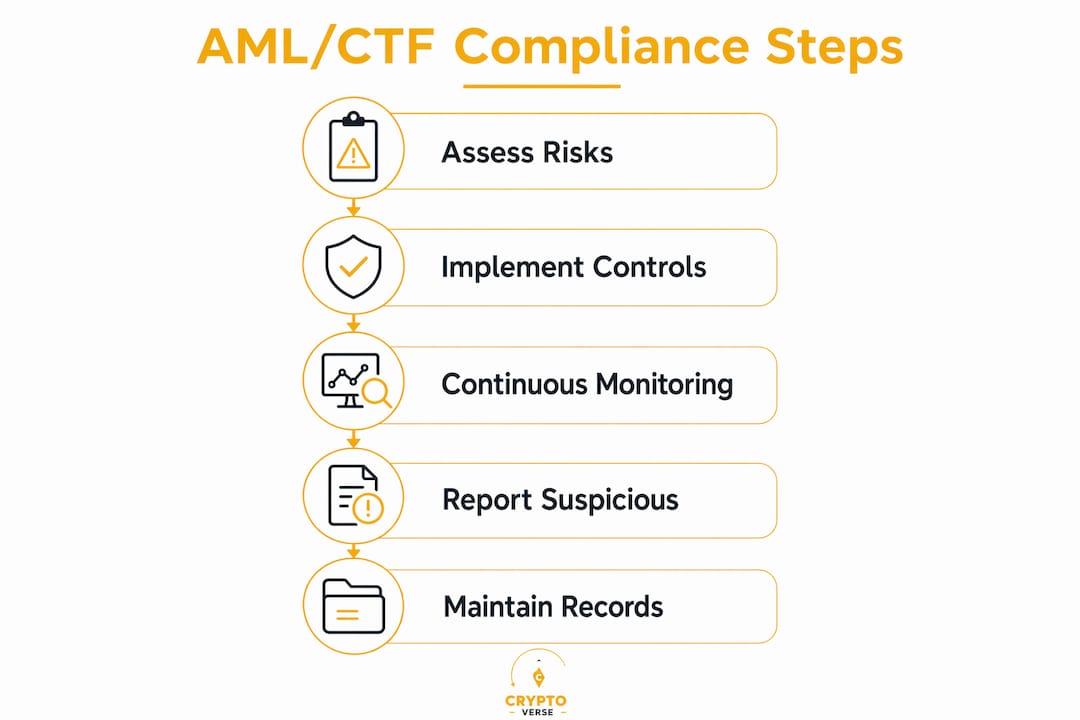
VASPs must file Suspicious Activity Reports (SARs) or Suspicious Transaction Reports (STRs) with the relevant Financial Intelligence Unit (FIU) when transactions meet the reporting threshold. Under UAE Federal AML Law and VARA's AML obligations, recordkeeping requirements extend to five years for customer due diligence records and transaction data. Compliance officers must build audit trails that can withstand regulatory examination.
For multi-jurisdiction projects, the cross-border compliance guide published by Cryptoverselawyers addresses how to manage inconsistent AML obligations across different regulatory regimes without creating gaps in coverage.
The compliance posture that actually protects Web3 projects
Working with Web3 founders and compliance teams across the UAE, EU, and UK, the pattern is consistent: projects that treat AML/CTF as a legal formality to be completed at the point of licence application are the ones that face enforcement action. Projects that embed compliance into their product architecture from day one are the ones that scale.
The most common mistake is treating AML/CTF as a documentation exercise. Regulators do not assess compliance by reviewing policy documents alone. VARA, the FCA, and the DFSA all conduct operational reviews that test whether controls actually function. A policy that says "we screen all wallets" means nothing if the screening tool is not integrated into the onboarding flow.
The second mistake is assuming that a compliance programme built for one jurisdiction transfers automatically to another. FATF Recommendation 15 sets the floor, but each regulator adds jurisdiction-specific requirements. The FCA's registration regime has different evidential standards from VARA's VASP licensing process. Multi-jurisdiction projects need jurisdiction-specific compliance mapping, not a single generic policy.
The future of AML/CTF in Web3 will be shaped by on-chain compliance infrastructure. Regulators are beginning to explore requirements for compliance logic embedded directly in smart contracts. Projects that build modular, upgradeable compliance architecture now will be positioned to adapt. Those that rely on off-chain controls bolted onto non-compliant protocols will face structural remediation costs that are far greater than the cost of building correctly from the start.
— CRYPTOVERSE
How Cryptoverselawyers supports AML/CTF compliance for Web3 projects
Cryptoverselawyers advises Web3 founders, VASPs, and institutional clients on AML/CTF compliance across the UAE, EU, UK, and more than 30 additional jurisdictions. The firm's crypto-native lawyers draft AML/CTF policies aligned with FATF standards and UAE Federal AML Law, design governance frameworks that satisfy VARA and DFSA requirements, and guide clients through VASP licensing from pre-application to full approval.

For projects operating in or entering the UAE market, Cryptoverselawyers provides dedicated advisory on VARA licensing and regulations, covering AML/CTF policy design, MLRO appointment, compliance infrastructure review, and regulator engagement. The firm also advises on Web3 and DeFi legal compliance, including AML/CTF frameworks for decentralised protocols and token issuers. For compliance officers seeking a structured starting point, the 2026 AML compliance guide sets out the practical steps required to build a regulator-ready AML programme.
FAQ
What is AML/CTF and why does it apply to Web3?
AML (anti-money laundering) and CTF (counter-terrorism financing) are regulatory frameworks that require financial service providers to detect and prevent illicit fund flows. They apply to Web3 projects because FATF Recommendation 15 classifies VASPs as obligated entities subject to the same AML/CTF standards as banks and payment firms.
Does decentralisation exempt a DeFi project from AML obligations?
No. Regulators identify the individuals or entities that control a protocol and apply AML obligations to them directly. VARA, the FCA, and FATF all treat decentralisation as a structural feature, not a regulatory exemption.
What is the FATF Travel Rule and how does it affect VASPs?
The FATF Travel Rule requires VASPs to collect and transmit originator and beneficiary information for virtual asset transfers above the applicable threshold. FATF's 2025 update has expanded Travel Rule compliance expectations globally, making implementation a licence condition in most major jurisdictions.
What happens if a Web3 project fails AML/CTF compliance?
Non-compliant projects face fines, licence suspension or revocation, and de-risking by banking and exchange partners. AML-related fines exceeded $900 million in H1 2025, and banking partners terminate relationships with projects that cannot evidence AML controls, which renders those projects operationally non-viable.
What technology does an effective Web3 AML programme require?
An effective programme requires integrated KYC identity verification, real-time KYT transaction monitoring, and blockchain analytics for cross-chain asset tracing. Fragmented systems that do not share data between these layers produce blind spots that regulators and illicit actors both exploit.