

TL;DR:
- Blockchain technology alone does not ensure the safety of cryptocurrency transactions, especially since confirmed on-chain transfers are irreversible. Crypto escrow, which involves a neutral party or smart contract holding funds until conditions are met, addresses this risk and requires clear legal and regulatory understanding. Proper governance, compliance, and detailed contractual terms are essential to mitigate operational and regulatory risks in crypto escrow arrangements.
Blockchain technology does not, by itself, make cryptocurrency transactions safe. Once a transfer is confirmed on-chain, it cannot be reversed. This is the fundamental risk that crypto escrow directly addresses. Understanding what is crypto escrow matters enormously for founders, compliance officers, and institutional investors who routinely transact in digital assets. This guide covers the core mechanics, applicable regulatory frameworks across UAE and international jurisdictions, technology and custody controls, AML/CFT obligations, and governance best practices that any party to a crypto escrow arrangement needs to understand before committing funds.
What is crypto escrow: definition and workflow
At its core, crypto escrow holds cryptocurrency by a neutral party or smart contract until agreed trade conditions are fulfilled, then releases funds accordingly. The crypto escrow definition is not materially different from traditional escrow. The substantive distinction lies in the asset class and the irreversibility of the underlying settlement rail.
The standard workflow for a crypto escrow arrangement follows five stages:
- Agreement. Both parties document the escrow terms, specifying release conditions, dispute procedures, and the escrow agent or contract address.
- Deposit. The buyer or payor deposits cryptocurrency into the escrow account, wallet, or smart contract address.
- Delivery. The seller or service provider fulfils their contractual obligation, whether delivering goods, completing a service, or transferring title.
- Verification. The buyer confirms delivery, or an independent verification mechanism confirms that conditions are met.
- Release or arbitration. Funds are released to the seller, returned to the buyer, or escalated to a dispute resolution process.
Because crypto transfers cannot be reversed once confirmed on the blockchain, escrow shifts risk from trusting the counterparty to enforcing clearly measurable release conditions. This distinction is what makes escrow structurally necessary for high-value and cross-border crypto transactions.
Comparing escrow models
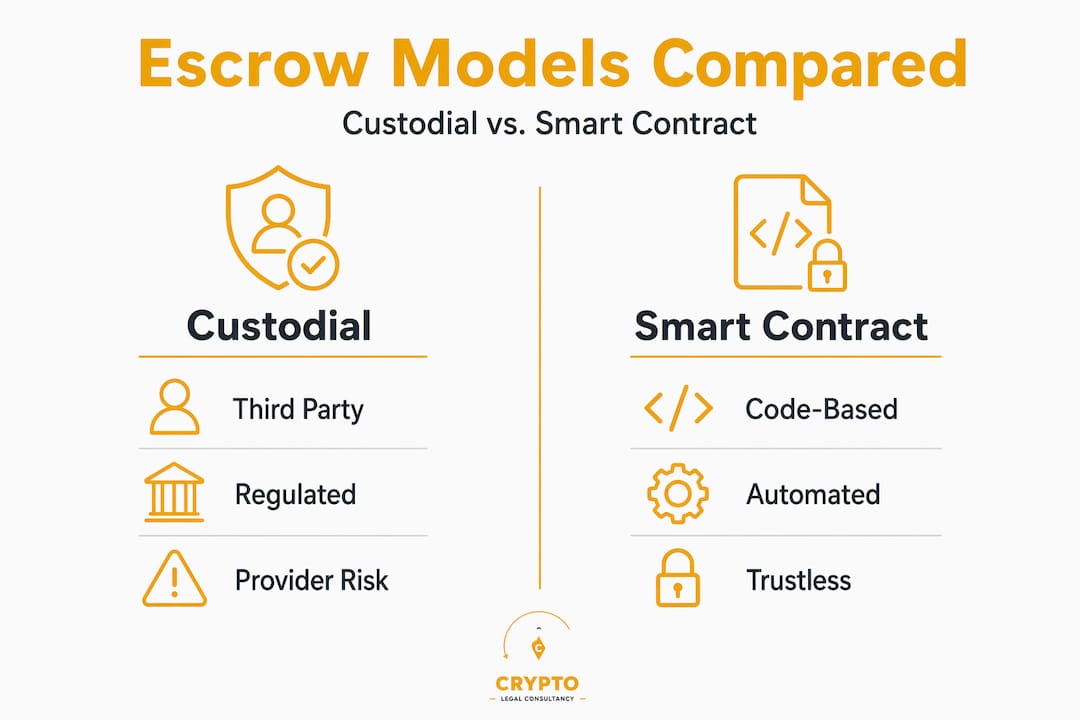
Three principal escrow models exist in practice, each carrying different regulatory, operational, and technical implications:
| Model | Mechanism | Trust assumption | Regulatory exposure |
|---|---|---|---|
| Custodial escrow | A licensed third party holds the assets | Trust in the custodian | High: requires licensing, AML/KYC obligations |
| Multi-signature escrow | Multiple private key holders must approve release | Trust distributed across signatories | Moderate: governance and key management obligations |
| Smart contract escrow | On-chain code enforces and releases funds automatically | Trust in the contract code | Moderate to high: code audit and upgrade controls required |
Pro Tip: Before selecting an escrow model, map the regulatory classification first. A custodial escrow provider in the UAE will almost certainly require a VARA, DFSA, or FSRA licence. Choosing the wrong model without legal advice can create unlicensed activity exposure.
Programmable escrow platforms take the smart contract model further, automating payouts via API and webhooks, supporting stablecoins such as USDC and USDT, and managing milestone-based releases without requiring parties to manage raw wallets directly. This approach is increasingly relevant for SaaS platforms, freelance marketplaces, and cross-border trade finance applications.
Regulatory mandates for crypto escrow services
The regulatory classification of a crypto escrow service provider depends on the jurisdiction, the asset type held, and the nature of the custody arrangement. In the UAE, five regulators exercise authority over virtual asset activities, and escrow arrangements will frequently fall within the statutory remit of one or more of them.
Key regulatory frameworks applicable to escrow services for cryptocurrency in the UAE include:
- VARA (Virtual Assets Regulatory Authority): Governs virtual asset service providers in Dubai. Custody of virtual assets, including assets held in an escrow capacity, is a licensable activity under VARA, subject to the VARA Custody Rulebook and the Compliance and Risk Management Rulebook.
- DFSA: Regulates activities within the Dubai International Financial Centre. Firms holding client virtual assets must comply with the DFSA Rulebook modules on client assets (COBS) and AML.
- FSRA: The Financial Services Regulatory Authority in Abu Dhabi Global Market applies its Virtual Asset Framework to custodians and escrow-like arrangements.
- CBUAE: CBUAE Circular 15/2021 and Circular 2/2024 impose payment system and licensing obligations on entities that may hold or transfer digital assets on behalf of third parties.
- UAE Federal AML Law (Decree-Law No. 20 of 2018 and amendments): Applies to all designated non-financial businesses and professions, including virtual asset service providers.
Capital and prudential standards vary by regulatory body, but escrow providers should generally maintain adequate liquidity reserves relative to total assets under escrow. Board-level governance expectations are explicit: VARA, DFSA, and FSRA each require appointed compliance officers, segregation of client assets from proprietary assets, and documented custody policies.
Pro Tip: If your business model involves holding digital assets on behalf of others, even temporarily as part of a payment workflow, obtain a formal legal opinion on whether that activity constitutes regulated custody under the applicable framework before going live.
Technology and custody controls
The technology model underpinning a crypto escrow arrangement is not merely an operational choice. It directly determines the regulatory obligations, security risks, and governance requirements that apply.
Custodial wallet arrangements
A custodial escrow provider holds private keys on behalf of both parties. This creates a clear fiduciary-like relationship and the full weight of custody regulation applies. Key management must follow documented procedures including hardware security module (HSM) storage, access controls, and key recovery protocols.
Multi-signature wallet escrow
Multi-sig escrow requires careful key distribution across parties. A typical 2-of-3 arrangement allocates one key to the buyer, one to the seller, and one to the escrow agent. Dispute escalation procedures must be documented operationally, specifying who holds signing authority and under what circumstances.

Multi-sig and timelocks provide complementary security layers: multi-sig requires multiple approvals before funds move, while timelocks prevent release before a specified time period elapses, reducing the risk of premature or coerced releases.
Smart contract escrow
Smart contract escrow locks funds on-chain, releasing them only when pre-programmed conditions are verified. Due diligence on smart contract escrow focuses on:
- The contract state machine: which states are valid, and what transitions are possible
- Unlock and dispute logic: how disputes are triggered, who can invoke them, and what evidence is required
- Admin privileges: whether any address can override automated rules, and whether upgrade functions exist
- Code audit requirements: independent audit of the contract before deployment is non-negotiable for commercial use
Pro Tip: For any smart contract escrow arrangement holding material value, require a published audit report from a recognised security firm as a condition of the escrow agreement. Unaudited contracts have no place in regulated or high-value transactions.
AML/CFT obligations and enforcement exposure
Crypto escrow providers are not passive conduits. They hold, control, or influence the release of digital assets, which means AML/CFT obligations attach directly. This applies whether the escrow is custodial, multi-sig, or smart-contract based, provided a legal person is involved in the arrangement.
Core AML/CFT obligations applicable to escrow operations include:
- Customer due diligence (CDD): Verify the identity of both the depositor and the beneficiary before accepting funds into escrow. Enhanced due diligence applies to politically exposed persons (PEPs) and high-risk jurisdictions.
- Transaction monitoring: Screen all deposits and proposed releases against sanctions lists (UN, OFAC, EU, UAE Executive Office) and monitor for unusual patterns.
- Travel rule compliance: Under FATF Recommendation 16 and its implementation in UAE regulations, virtual asset transfers above the threshold require transmission of originator and beneficiary information. Escrow providers must confirm their counterparty VASPs are compliant.
- Suspicious activity reporting: Any transaction that raises a red flag must be reported to the UAE Financial Intelligence Unit (goAML platform) without tipping off the customer.
"Ambiguous conditions lead to disputes; objective verification milestones are essential for smooth escrow operation. The same principle applies to AML triggers: if the release condition is unclear, the compliance team cannot determine whether funds should be released or held pending further review."
The UAE's enforcement posture on virtual asset AML has tightened materially. VARA, the DFSA, and the UAE's national AML supervisory bodies have demonstrated willingness to impose licence suspension and financial penalties on non-compliant VASPs. An escrow provider that fails to implement a documented AML/CFT framework aligned with Federal AML Law No. 20 of 2018 is carrying significant regulatory risk.
Pro Tip: Design escrow release workflows so that every release event generates a compliance log entry. This supports both internal monitoring and regulator-facing audit trails.
Governance, capital adequacy, and structuring
For parties structuring a crypto escrow transaction, whether as a provider or as a user, governance and contractual clarity are as important as the technology choice.
Board-level governance responsibilities
Boards of escrow service providers should have formal policies covering:
- Segregation of client assets from proprietary holdings
- Appointment of a qualified compliance officer with direct board access
- Documented incident response procedures for key compromise, smart contract exploit, or counterparty insolvency
- Periodic prudential review of capital reserves relative to total escrow exposure
Escrow agreement quality
High-quality escrow agreements specify objective milestones, required evidence for delivery confirmation, and defined trigger points for arbitration. Vague language such as "satisfactory completion" is not sufficient. The agreement should state exactly what evidence the escrow agent or contract will accept as proof of fulfilment.
Practical structuring considerations
| Structuring consideration | Key guidance |
|---|---|
| Crypto-to-fiat conversion | Real estate closings often require conversion to fiat before settlement; coordinate conversion timing and document the workflow |
| Dispute resolution | Specify the arbitration seat, governing law, and arbitral body in the escrow agreement |
| Stablecoin choice | USDC and USDT are most widely supported; confirm the escrow platform supports the specific asset before execution |
| Regulatory classification | Obtain legal advice on whether the arrangement triggers custody licensing in the relevant jurisdiction |
For real estate transactions in particular, crypto and fiat settlement bifurcate at the closing stage, requiring coordination between the blockchain settlement layer and traditional escrow agents handling title documents and regulatory filings. This dual-track structure demands careful documentation and timing alignment.
Pro Tip: In cross-border transactions, identify the governing law and dispute resolution jurisdiction at the outset. A crypto escrow agreement silent on jurisdiction creates an enforcement gap that is genuinely difficult to remedy after a dispute arises.
Expert perspective on crypto escrow and regulatory readiness
In my experience advising virtual asset businesses across the UAE and internationally, the most consistent failure point in crypto escrow arrangements is not the technology. It is the escrow agreement itself.
Clients frequently arrive with smart contracts that are technically sound but with release conditions so ambiguous that no compliance officer could confidently authorise a release without legal review. When you are dealing with an irreversible settlement rail, that ambiguity is not a minor drafting issue. It is a material operational risk.
I have also observed a persistent misconception that smart contract escrow removes regulatory exposure entirely. It does not. The moment a legal entity controls an admin key, manages a dispute process, or collects fees for the service, regulatory custody and AML obligations apply. The trustless label is a technical descriptor, not a legal classification.
What I genuinely believe is underappreciated is the enforcement trajectory. Regulators in the UAE, the EU, and Singapore are moving simultaneously toward requiring escrow-adjacent activities to be licensed, documented, and audited. Businesses that have structured these arrangements informally are accumulating regulatory risk with each transaction. The prudent position is to seek a formal legal opinion now, while licence applications remain relatively straightforward, rather than after a regulator has made contact.
The future convergence of programmable escrow technology, on-chain identity, and regulatory reporting standards will likely produce a generation of natively compliant escrow platforms. Until that infrastructure matures, the gap between technical capability and regulatory expectation must be managed through sound legal structuring and proactive governance.
— CRYPTOVERSE
How Cryptoverselawyers can support your crypto escrow needs
Whether you are structuring a single high-value crypto transaction or building a platform that processes escrow at scale, the regulatory obligations are real and the penalties for non-compliance are significant.

Cryptoverselawyers provides specialist legal support across the full crypto escrow lifecycle. The firm advises on VARA licencing and compliance for custody and escrow activities, drafts AML/CFT frameworks aligned with UAE Federal AML Law and FATF standards, and reviews smart contract escrow arrangements for regulatory and governance risk. For clients managing crypto exchange disputes or requiring escrow structuring for cross-border transactions, the team brings both legal expertise and blockchain-native understanding to every engagement. Contact Cryptoverselawyers for a bespoke consultation tailored to your escrow structure, jurisdiction, and regulatory exposure.
FAQ
What is a crypto escrow service?
A crypto escrow service holds cryptocurrency by a neutral party or smart contract until agreed conditions are met, then releases the funds to the appropriate party. It protects both buyers and sellers in transactions where trust cannot be assumed.
How does crypto escrow work in practice?
The buyer deposits funds into an escrow wallet or smart contract, the seller delivers the agreed goods or services, and the escrow mechanism releases funds upon verified fulfilment. Disputes trigger a defined arbitration or review process rather than an irreversible transfer.
Is crypto escrow regulated in the UAE?
Yes. Depending on the model and jurisdiction, escrow custody activities may fall under VARA, DFSA, FSRA, or CBUAE oversight, requiring a licence, AML/CFT programme, and segregated client asset controls.
What are the main benefits of crypto escrow?
The primary benefits include protection against counterparty default, enforcement of contract conditions without requiring trust in the other party, and a structured dispute resolution pathway. These apply equally to individual traders and institutional parties.
What makes a crypto escrow agreement legally sound?
A legally sound escrow agreement specifies objective, measurable release conditions, required evidence for fulfilment, the governing law, and the arbitration procedure. Ambiguous conditions are the leading cause of escrow disputes and should be avoided through precise drafting.