

TL;DR:
- Web3 licensing in the UAE involves multiple regulators depending on activity and jurisdiction.
- Capital requirements vary significantly from AED 20,000 to AED 1.5 million based on the activity.
- Ongoing compliance includes regular reconciliation, licence renewal, and adapting to evolving regulations.
Many firms entering the UAE's virtual asset market assume a single "crypto licence" covers all activities across all jurisdictions. That assumption is incorrect and costly. Web3 legal compliance in the UAE operates across at least five distinct regulatory authorities, each with its own statutory remit, asset classification framework, capital requirements, and approval process. The activity you conduct, the zone you operate in, and the clients you serve all determine which regulator you answer to. This guide sets out the full regulatory picture, from licensing mechanics and capital thresholds to ongoing prudential requirements and multi-regulator strategies.
Key Takeaways
| Point | Details |
|---|---|
| Multiple licences needed | Web3 companies often require approval from several UAE regulators, not just one. |
| Capital and fees vary | Minimum capital and licensing fees shift widely by business activity and chosen regulator. |
| Rules differ by zone | Each UAE regulatory zone brings unique requirements and banned asset categories. |
| Ongoing compliance is critical | Monthly reconciliation, reporting and regulatory updates are integral to UAE Web3 legal compliance. |
| Strategic planning matters | Selecting the right regulatory path is key to successful Web3 operation in the UAE. |
Understanding Web3 legal compliance in the UAE
Web3 legal compliance in the UAE is not a single checkbox exercise. It is a structured legal process that varies significantly depending on whether you operate in a free zone, on the federal mainland, or within a specific financial centre. The UAE has deliberately created a layered regulatory architecture to attract global virtual asset service providers (VASPs) whilst maintaining rigorous oversight aligned with Financial Action Task Force (FATF) standards.
As confirmed by the VARA Virtual Assets Rulebook, Web3 legal compliance in the UAE involves obtaining licences from multiple regulators depending on jurisdiction and activity. The five principal regulators are:
- VARA (Virtual Assets Regulatory Authority): Governs virtual asset activities on Dubai mainland, excluding the Dubai International Financial Centre (DIFC). VARA is the most active issuer of VASP licences in the UAE and maintains a detailed VARA regulator profile that sets out its full statutory scope.
- FSRA (Financial Services Regulatory Authority): The regulator within the Abu Dhabi Global Market (ADGM) free zone, covering institutional-grade virtual asset activities under a firm-specific approval model.
- DFSA (Dubai Financial Services Authority): Regulates virtual asset activities within the DIFC free zone in Dubai, operating under its own investment token and crypto token framework.
- CMA (Capital Markets Authority, formerly SCA): The federal regulator for the mainland UAE, covering capital market activities involving virtual assets outside of free zones. Understanding the role of the SCA in the UAE's regulatory structure is essential for any entity targeting federal markets.
- CBUAE (Central Bank of the UAE): Regulates payment tokens, including dirham-pegged stablecoins and stored-value payment instruments used in retail or wholesale settlement.
| Regulator | Jurisdiction | Key activities covered | Typical fee range |
|---|---|---|---|
| VARA | Dubai mainland (excl. DIFC) | Exchange, custody, advisory, broker-dealer, transfer | AED 20k to AED 700k |
| FSRA | ADGM (Abu Dhabi) | MTF, custody, investment management, advisory | AED 50k to AED 500k+ |
| DFSA | DIFC (Dubai) | Crypto token services, investment tokens | AED 30k to AED 300k+ |
| CMA | Federal mainland | Capital market intermediation | AED 20k to AED 150k |
| CBUAE | All UAE | Payment tokens, stored value | Variable |
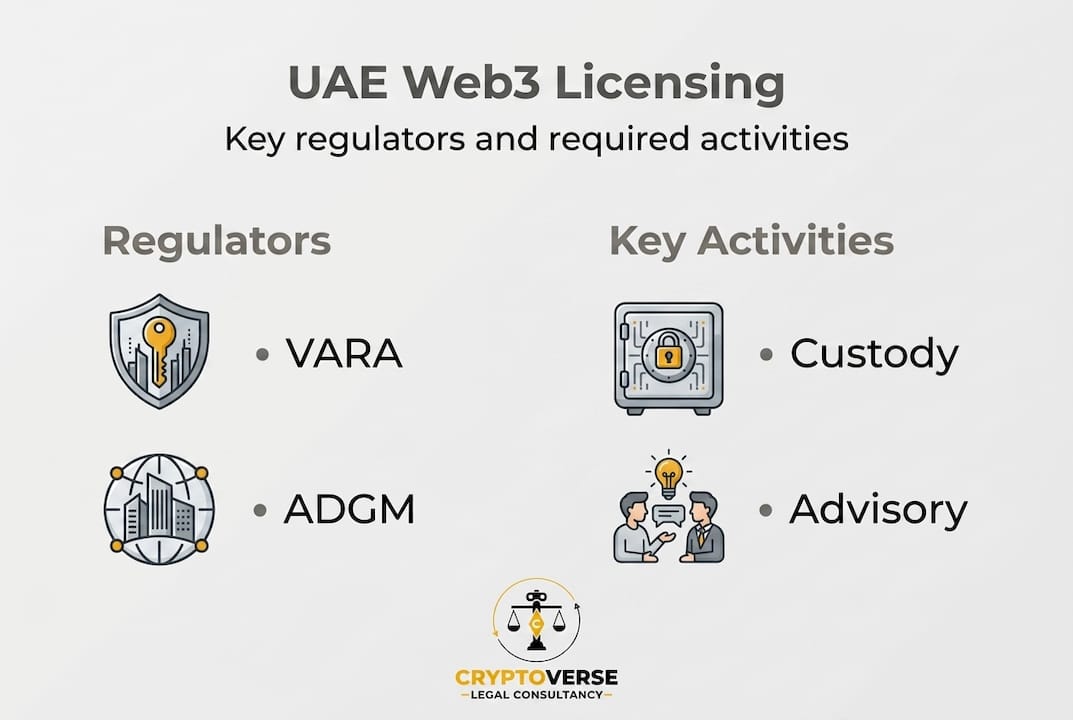
Each regulator operates independently. A VARA licence does not grant DIFC access, and an ADGM approval does not extend to Dubai mainland clients. Firms must map their intended activities to the correct regulatory authority before submitting any application.

Licensing requirements: Activities, capital, and approvals
With regulators clarified, now we break down how licensing and capital requirements are matched to specific Web3 activities. VARA structures its licensing around seven core regulated activities, each carrying distinct minimum paid-up capital thresholds. These thresholds are not arbitrary; they reflect the risk profile and operational overhead of each activity type.
According to FSRA guidance for virtual asset activities, capital requirements across UAE regulators broadly align as follows:
| Activity | Minimum paid-up capital | Notes |
|---|---|---|
| Advisory | AED 100,000 | Lowest threshold; no client asset holding |
| VA Management | AED 280,000 to AED 500,000 | Varies by AUM and discretion |
| Broker-Dealer | AED 400,000 to AED 600,000 | Depends on market-making scope |
| Transfer/Settlement | AED 500,000 | Includes settlement infrastructure costs |
| Lending/Borrowing | AED 500,000 | Subject to prudential stress testing |
| Custody | AED 600,000 and above | Requires cold/hot wallet governance framework |
| Exchange | AED 800,000 to AED 1,500,000 | Highest threshold; full order-book operations |
All capital must be held in a UAE-licensed bank, either as a trust account or secured via an approved surety bond. Monthly reconciliation is mandatory for most licence categories. Empirical data confirms that VARA has issued 70+ full licences and over 200 provisional approvals by 2025, with ADGM hosting 40+ licensed entities. Licence fees range from AED 20,000 to AED 700,000, and approval timelines run between 3 and 15 months depending on the regulator and application completeness.
Step-by-step pathway to licence acquisition:
- Define your regulated activities clearly before engaging any regulator. Advisory, exchange, custody, and broker-dealer functions each require separate approvals or endorsements within a single licence.
- Select your jurisdiction based on your target client base, preferred legal system (common law vs. civil law), and operational model (retail vs. institutional).
- Incorporate your entity in the chosen jurisdiction. Free zone and mainland incorporations follow different company law frameworks.
- Prepare your regulatory business plan, including a risk assessment, governance structure, AML/CTF (anti-money laundering/counter-terrorism financing) policy, and technology architecture documentation.
- Submit your initial application through the relevant regulator's portal, paying the initial application fee.
- Respond to regulator queries during the review period. VARA, in particular, conducts multiple rounds of review and may require in-person meetings.
- Obtain provisional approval (where applicable) and commence build-out of your compliance infrastructure.
- Complete the operational readiness review, demonstrating live systems, staffed compliance functions, and funded trust accounts.
- Receive your full licence and commence regulated activities. Details on the VARA licence application steps provide granular guidance for each stage.
Pro Tip: Do not wait for full incorporation before engaging your legal adviser. Structural decisions made at incorporation stage, such as share class design and directorship arrangements, directly affect how regulators assess your governance framework during the licence review.
Understanding the full scope of VARA regulated activities before applying avoids costly amendments to your business plan mid-process. Similarly, reviewing virtual asset broker compliance requirements early gives broker-dealer applicants a realistic view of the documentation burden ahead.
Key differences: VARA, ADGM, CMA and other UAE regulators
After explaining licensing mechanics, it is crucial to see how each regulator approaches assets and clients differently. The distinctions are not merely procedural. They reflect fundamentally different regulatory philosophies, risk appetites, and market orientations.
The ADGM FSRA requires activity-based Financial Services Permission (FSP) for VA Regulated Activities such as custody, Multilateral Trading Facility (MTF) operation, and investment management. Critically, ADGM requires firm-specific Accepted Virtual Assets (AVA) approval, meaning each asset your firm handles must be individually whitelisted by the regulator. ADGM bans privacy coins and algorithmic stablecoins outright. Capital requirements are typically calibrated to six to twelve months of operating expenditure (OPEX), making ADGM a higher-cost but institutionally credible pathway.
VARA operates differently. Rather than requiring firm-specific asset whitelisting, VARA publishes category-level bans. Privacy coins and certain algorithmic tokens are prohibited across all licence holders, but firms are not required to seek individual approval for each listed asset outside the banned categories. This gives VARA-licensed entities greater flexibility in listing new tokens, subject to their internal compliance review.
"The choice between VARA and ADGM is not simply about cost or speed. It is about which regulatory model aligns with your long-term business strategy. VARA's open-category approach suits retail-facing exchanges and token issuers. ADGM's firm-specific whitelist is better suited to institutional custodians and fund managers who want a highly defined, auditable asset universe." — CRYPTOVERSE Legal Consultancy
Key distinctions across UAE regulators:
- VARA: Dubai mainland jurisdiction; retail and institutional access; category-based asset rules; highest licence volume; accessible application process; detailed rulebook with phased implementation.
- ADGM FSRA: ADGM free zone only; primarily institutional clients; firm-specific AVA approval; bans privacy/algorithmic stablecoins; common law framework; high minimum operational standards. See the full scope of ADGM accepted virtual assets.
- DFSA: DIFC jurisdiction; investment token and crypto token framework; strong alignment with international standards; common law courts; targeted at institutional market.
- CMA: Federal mainland; capital market intermediation focus; growing virtual asset remit post-2022 legal reforms; relevant for firms serving clients across all seven Emirates outside free zones.
- CBUAE: Payment token oversight; essential for stablecoin issuers and payment service providers; coordinates with other regulators on systemic risk.
Understanding virtual asset custody compliance requirements under each regulator is particularly important for custodians, who face the highest documentation burden and most detailed operational assessments. Similarly, firms handling transfers between wallets must review VARA asset transfer rules carefully, as Travel Rule obligations and counterparty due diligence requirements vary by regulator.
Navigating harmonisation, ongoing compliance and multi-activity licences
Now we tackle the practical challenges facing firms: harmonisation, month-to-month compliance, and complex licence portfolios. Many operators assume that obtaining a licence is the endpoint. In the UAE, it is the beginning of an ongoing compliance cycle.
The VARA Virtual Assets Rulebook clarifies that multi-activity capital is not always additive. For firms holding multiple activity approvals within a single licence, capital requirements may be calculated as the highest applicable threshold rather than the sum of all activities. However, where activities carry independent overhead structures, each may require separate provisioning. Legal counsel is essential when structuring multi-activity entities to avoid undercapitalisation findings during prudential review.
The UAE's 2026 federal harmonisation initiative aims to align regulatory standards across the mainland and free zones under a unified legal framework for virtual assets. However, VARA and ADGM continue to set their own local standards in parallel. Federal convergence affects AML/CTF reporting obligations, data localisation, and licensing mutual recognition, but it does not eliminate the need for jurisdiction-specific approvals. Firms operating across zones must maintain compliance with each regulator independently.
Ongoing compliance essentials:
- Monthly reconciliation: Maintain accurate records of client asset positions, trust account balances, and operational capital. Submit reconciliation reports to your regulator within prescribed deadlines.
- Periodic licence renewal: Most UAE virtual asset licences require annual or biennial renewal, with updated governance documentation and fee payments. Track renewal windows carefully.
- Asset list review: For ADGM licensees, any new virtual asset to be offered requires AVA approval before listing. For VARA licensees, internal token assessment against the banned categories list is required before any new asset goes live.
- AML/CTF policy updates: FATF standards evolve regularly. Your AML/CTF framework must be updated to reflect any new guidance, particularly around Travel Rule implementation and beneficial ownership verification.
- Regulatory reporting: File suspicious transaction reports (STRs), periodic financial returns, and governance updates as required by your specific licence conditions.
- Staff fit and proper assessments: Senior management changes require prior regulatory notification. New controllers and compliance officers must pass fit and proper assessments before taking up their roles.
Pro Tip: Firms with licences from more than one UAE regulator frequently encounter reporting calendar conflicts. VARA and ADGM operate on different fiscal and reporting cycles. Build a unified compliance calendar from day one, mapping every reporting deadline, renewal date, and asset review trigger across all applicable regulators to avoid inadvertent breaches.
Ongoing VA platform operator compliance demands a dedicated compliance function, not simply a nominated officer. Regulators assess whether your compliance infrastructure is proportionate to the scale and complexity of your activities during periodic supervisory reviews.
Why UAE Web3 legal compliance is more strategic than procedural
The most common mistake firms make is treating UAE Web3 compliance as a documentation exercise rather than a strategic decision. After advising clients across VARA, ADGM, DFSA, CMA, and CBUAE, our consistent observation is that firms which succeed long-term do not simply chase the cheapest licence or the fastest approval. They select the regulatory environment that best fits their business model, client base, and growth trajectory.
Picking the wrong regulator creates compounding problems. A retail exchange that incorporates under ADGM for its institutional prestige will face a higher capital burden, a more restrictive asset universe, and a client acquisition challenge if its actual user base is retail. Conversely, a family office seeking to offer custody services to high-net-worth institutions may find VARA's retail-facing framework misaligned with the operational standards its institutional clients demand.
The emerging Web3 legal trends for 2026 confirm that regulators are becoming more sophisticated in assessing whether an applicant's business model genuinely fits the licence they are seeking. Compliance strategy must begin before incorporation, not after. Build your legal and compliance advisory team into your founding process, not as an afterthought before your application deadline.
Expert guidance for Web3 compliance in the UAE
For firms ready to move from understanding to action, reliable legal counsel is what bridges regulatory knowledge and practical licensing success.
CRYPTOVERSE Legal Consultancy provides end-to-end support across the UAE's full regulatory landscape. Whether you are pursuing a VARA licence for a Dubai mainland exchange, structuring an ADGM custody entity, or navigating CMA requirements for federal mainland operations, our team brings direct experience across every relevant regulator. We advise on corporate structuring, AML/CTF framework design, capital planning, and ongoing prudential compliance. Our digital asset legal consulting services cover the full lifecycle of a regulated virtual asset business, from pre-application strategy through to licence maintenance. To understand the full scope of what requires licensing, review the complete list of regulated VARA activities and speak with our team about the right pathway for your firm.
Frequently asked questions
Do I need approvals from more than one UAE regulator for Web3 activities?
Yes, depending on your business model, you may require licensing from VARA, ADGM FSRA, CMA, or others for full compliance, since Web3 compliance involves multiple regulators depending on jurisdiction and activity type.
What are the typical timelines and fees for getting a Web3 licence in the UAE?
Licence fees range from AED 20,000 to AED 700,000, with regulators taking between 3 and 15 months to issue approvals, as VARA and ADGM benchmarks confirm across 70+ full VARA licences and 40+ ADGM entities.
Are stablecoins and privacy coins allowed under ADGM or VARA?
ADGM bans privacy and algorithmic stablecoins outright under its VA Regulated Activities framework, whilst VARA applies category-level restrictions without requiring individual asset whitelisting.
How much capital is required for different Web3 activities?
Minimum capital ranges from AED 100,000 for advisory to AED 1,500,000 for exchange operations, with all amounts required to be held in UAE trust accounts as FSRA guidance confirms across regulated virtual asset activities.
Recommended
- UAE Web3 legal frameworks: 5 advantages for startups
- UAE Blockchain Legal Frameworks 2026: Navigate Licensing - Cryptoverse Legal Consultancy
- Why crypto businesses need legal advice in the UAE 2026 - Cryptoverse Legal Consultancy
- Regulatory Compliance for Virtual Asset Platform Operators in the UAE - Cryptoverse Legal Consultancy