

TL;DR:
- VARA supervises virtual asset activities across Dubai mainland and most free zones, excluding DIFC.
- Licensing involves significant costs and ongoing compliance, with a focus on activity-based regulation.
- Robust compliance and strategic treatment of VARA licenses enable Dubai crypto businesses to gain competitive advantage.
Dubai is not the regulatory vacuum that many crypto entrepreneurs assume it to be. The Virtual Assets Regulatory Authority, known as VARA, has moved well beyond its early sandbox phase and is now issuing substantial fines, reviewing compliance frameworks, and holding Virtual Asset Service Providers (VASPs) to account with real consequences. If you are structuring or operating a crypto business in Dubai, understanding VARA's statutory remit, licensing architecture, and enforcement posture is not optional. It is foundational. This guide provides that clarity, covering VARA's origins, regulatory framework, enforcement record, and forward trajectory for 2026 and beyond.
Key Takeaways
| Point | Details |
|---|---|
| VARA’s broad oversight | VARA regulates virtual assets and service providers throughout Dubai, excluding DIFC. |
| Robust licensing process | Starting a VASP under VARA requires significant capital and understanding of risk-based rules. |
| Active enforcement | VARA issues substantial penalties for non-compliance, with strict reviews and deadlines. |
| Future-proof regulation | VARA adapts to tech evolution, impacting DeFi, DAOs and next-gen crypto projects. |
What is VARA? Establishment, scope and mandate
VARA is the Virtual Assets Regulatory Authority of Dubai, established under Dubai Law No. 4 of 2022 to regulate, supervise, and oversee virtual assets and VASPs across Dubai mainland and most free zones, with one critical exclusion: the Dubai International Financial Centre (DIFC). The DIFC remains governed by its own regulator, the Dubai Financial Services Authority (DFSA). This distinction has material consequences for how you structure your entity and where you operate.
VARA's primary objectives, as set out in its founding legislation, include:
- Market integrity: Ensuring that virtual asset markets in Dubai operate fairly, transparently, and in an orderly manner.
- Investor protection: Safeguarding retail and institutional participants from fraudulent schemes, market manipulation, and inadequate disclosures.
- Innovation facilitation: Creating a regulatory environment that accommodates new business models in digital assets without stifling technological development.
- AML/CFT compliance: Aligning Dubai's virtual asset sector with Financial Action Task Force (FATF) standards and UAE Federal AML Law to prevent money laundering and terrorist financing.
Understanding VARA's coverage relative to other UAE regulators matters greatly when choosing your licensing pathway. The table below clarifies the key distinctions:
| Regulator | Jurisdiction | Scope |
|---|---|---|
| VARA | Dubai mainland and most free zones | Virtual assets and VASPs |
| DFSA | DIFC (Dubai) | Financial services including crypto tokens |
| SCA | UAE federal (outside ADGM/DIFC) | Securities and commodities |
| FSRA | Abu Dhabi Global Market (ADGM) | Financial services including digital assets |
| CBUAE | UAE federal | Payment services and stablecoins |
VARA's supervision and enforcement framework applies to any entity conducting virtual asset activities in Dubai, whether that business is incorporated in a free zone or on the mainland. If you are operating a centralised exchange, offering brokerage services, managing a virtual asset fund, or providing custody solutions, you fall within VARA's statutory perimeter.
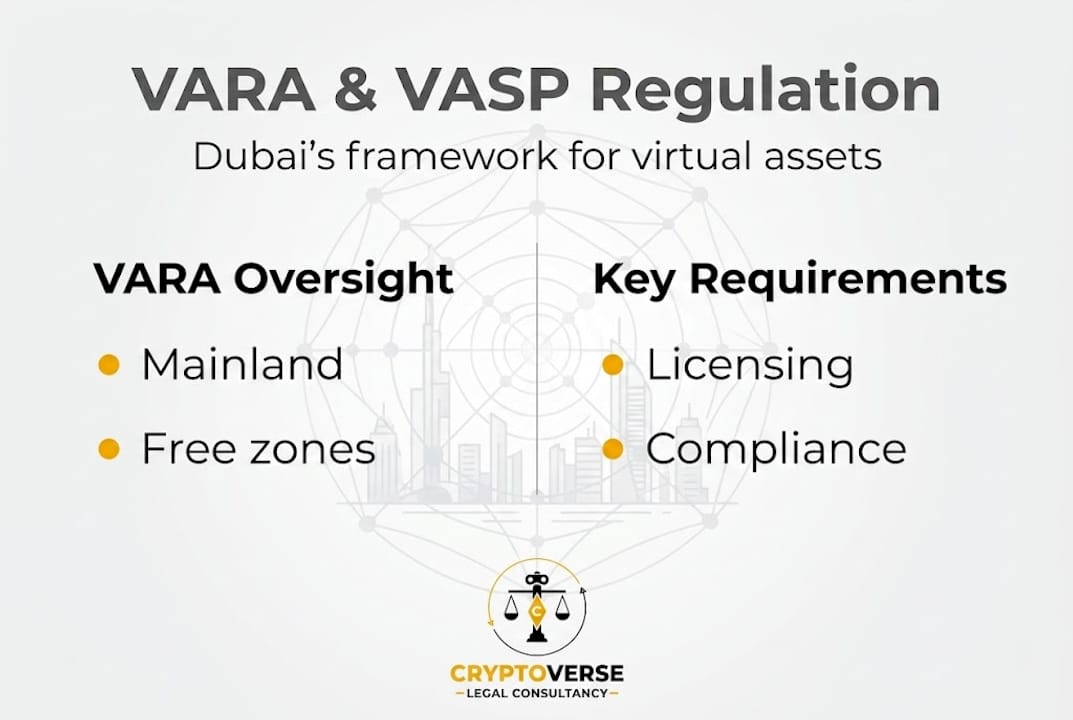
One area that frequently causes confusion is the interaction between VARA and free zone authorities such as DMCC or Dubai Silicon Oasis. VARA operates alongside these authorities, not in competition with them. A DMCC-licensed entity providing virtual asset services still requires a VARA licence for its regulated activities. Structuring your entity correctly from the outset avoids costly restructuring later.
VARA's profile as Dubai's virtual assets regulator is still evolving, but its legislative foundation is solid and its enforcement tools are extensive. The crypto regulatory landscape in Dubai now sits on firmer legal ground than at any point in the emirate's history, and founders who treat licensing as a formality do so at significant risk.
VARA's regulatory framework: How rules shape VASP licensing
VARA's VASP licensing process is built on a risk-based, activity-centric, and tech-agnostic approach. This framework, which has evolved from sandbox to enforcement following the 2025 Rulebook update, means that your obligations are determined primarily by what activities your business performs, not by the underlying technology you use to perform them.
Under VARA's activity-centric model, the following regulated activities each require specific licensing authorisation:
- Virtual Asset Issuance Services: Issuing, offering, or listing virtual assets to the public.
- Virtual Asset Custody Services: Holding or safeguarding virtual assets or private keys on behalf of clients.
- Virtual Asset Exchange Services: Operating platforms for the exchange of virtual assets for fiat or other digital assets.
- Virtual Asset Transfer Services: Facilitating transfers of virtual assets on behalf of clients.
- Virtual Asset Broker-Dealer Services: Executing orders and dealing in virtual assets as principal or agent.
- Virtual Asset Investment Management and Advisory Services: Managing portfolios of virtual assets or providing investment advice.
- Virtual Asset Lending and Borrowing Services: Operating lending or borrowing facilities for virtual assets.
Several licensing nuances deserve particular attention. Sponsored VASPs, for instance, operate under the licence of a principal VASP, which shifts a portion of compliance responsibility to the sponsoring entity. If you are considering this structure, the sponsor bears accountability for the sponsored entity's regulatory conduct. Founders often underestimate the scrutiny sponsors receive as a result.
Multi-activity applicants face capital requirements calculated at the highest threshold across all applied-for activities. You cannot aggregate lower minimums. This matters significantly when budgeting: the capital requirement alone can reach several million dirhams for complex multi-activity firms.
DeFi protocols and DAO structures present additional complexity. VARA's tech-agnostic rules mean that decentralisation does not automatically place an entity outside the regulatory perimeter. Where a DeFi platform exercises sufficient control or benefits economically from services provided to UAE-based users, VARA may require a formal application, an independent audit, or engagement through a special regulatory track. The rules for virtual asset transfers and exchanges make clear that the economic substance of the activity, rather than its technical delivery, determines regulatory classification.
The costs involved in VARA licensing are material:
| Cost item | Estimated range (AED) |
|---|---|
| Application fee | 40,000 to 100,000 |
| Minimum share capital | 250,000 to 2,000,000+ |
| Year 1 total estimated costs | 350,000 to 2,000,000+ |
| Ongoing annual compliance budget | 200,000 to 500,000+ |
Pro Tip: When planning your VARA application, budget well beyond the application fees. You will need to account for minimum share capital, professional indemnity insurance, qualified compliance officer salaries, technology infrastructure for AML monitoring, and ongoing audit costs. Applicants who model only the application fee frequently find themselves undercapitalised before reaching the approval stage.
Compliance for virtual asset platform operators extends beyond the initial application. VARA expects continuous governance, regular reporting, and proactive engagement with its supervisory teams. Approval is the beginning of the compliance journey, not the end.

Enforcement in practice: Case studies and common pitfalls
As regulatory requirements have grown more defined, so has VARA's willingness to act against those who fall short. The period spanning 2025 to 2026 has produced the clearest signal yet that Dubai's virtual asset market is not self-regulating.
Fines on 19 or more VASPs were issued for unlicensed operations and marketing activities, with penalties ranging from AED 100,000 to AED 600,000 per case. AML failures, including those involving Fuze, attracted supervisory action. BRA (Business Risk Assessment) deficiencies have triggered formal enforcement proceedings, and VARA has set a Q2 2026 deadline for outstanding BRA reviews across licensed entities.
The most common triggers for enforcement action include:
- Operating without a VARA licence: Marketing or offering virtual asset services to UAE residents without a valid licence remains the single most frequent enforcement trigger. This includes social media marketing, referral programmes, and promotional events targeting UAE-based audiences.
- Inadequate AML/CFT frameworks: VARA's AML expectations are closely aligned with FATF Recommendation 15 and UAE Federal Decree-Law No. 20 of 2018. Failure to conduct adequate customer due diligence, maintain transaction monitoring systems, or file suspicious transaction reports constitutes a serious regulatory breach.
- BRA non-compliance: The Business Risk Assessment is a structured internal process that licensed VASPs must complete and maintain. VARA has signalled that it will take enforcement action against entities that either fail to submit their BRA or submit assessments that are materially deficient.
- Misleading marketing and investor communications: Promotional materials that make unsubstantiated return projections, fail to include mandatory risk disclosures, or misrepresent licensing status are subject to immediate enforcement.
"VARA has made clear that licensing alone does not constitute compliance. Post-licensing obligations, including risk assessments, governance reporting, and AML programme maintenance, are subject to ongoing supervisory review and enforcement." — VARA enforcement communications, 2025 to 2026.
The case of Fuze illustrates how AML failures can affect entities that are otherwise operationally sophisticated. Fuze's enforcement outcome underscored that technical product quality does not mitigate regulatory exposure when compliance programmes are incomplete.
For broker compliance in Dubai, the obligations are particularly layered. Brokers must maintain clear client suitability assessments, enforce transaction limits where applicable, and ensure their marketing materials meet VARA's investor disclosure standards.
Pro Tip: Treat your ongoing risk assessments as a live, actively maintained document rather than a one-time filing exercise. VARA's supervisory team looks at the quality, currency, and internal governance of your BRA as an indicator of your overall compliance culture. An outdated or templated BRA can attract disproportionate scrutiny during routine reviews, as VARA's enforcement activity in 2025 and 2026 has demonstrated.
Future trends: VARA's shifting approach and Dubai's crypto landscape
With enforcement now clearly established, the next phase of VARA's regulatory evolution is already taking shape. For founders and compliance officers planning beyond the immediate licence application, the following developments are critical to understand.
-
Consolidation of enforcement capacity: VARA is actively building its internal supervisory infrastructure, including technology tools for transaction monitoring and cross-border information sharing with peer regulators such as the DFSA, FSRA, and international bodies. Expect supervisory reviews to become more frequent and more technically sophisticated.
-
Expanding DeFi and DAO coverage: The evolving approach to DeFi in Dubai reflects VARA's commitment to its tech-agnostic mandate. As decentralised protocols attract more UAE-based users and liquidity, VARA will increasingly scrutinise the control structures, fee extraction mechanisms, and governance arrangements of DeFi projects operating in or targeting Dubai.
-
AI trading and algorithmic systems regulation: The VARA 2026 roadmap for AI trading bots signals an emerging licensing consideration for firms deploying automated or AI-driven trading strategies. Algorithmic systems that execute virtual asset trades on behalf of clients are likely to require dedicated licensing disclosures and technical safeguards.
-
Tighter custody and segregation rules: VARA has been progressively tightening requirements around client asset segregation and custody model documentation. Custodians and exchanges that hold client assets must demonstrate robust technical and legal safeguards that meet VARA's updated standards.
-
International regulatory convergence: UAE federal DeFi compliance frameworks are becoming increasingly aligned with global standards, including MiCA (EU), MAS (Singapore), and FATF's updated virtual asset guidance. Businesses operating across jurisdictions must track how VARA's rules interact with those of other regulators.
VARA's trajectory is significant in a global context. Dubai is positioning itself as a mature, rule-of-law crypto hub rather than a permissive registration destination. This positioning is deliberate.
Key indicators of Dubai's ambition as a global crypto regulatory centre include:
- Active FATF membership and commitment to grey-list exit conditions
- Bilateral memoranda of understanding with peer regulators in Asia and Europe
- The development of a tokenisation regulatory sandbox for real-world asset (RWA) projects
- VARA's ongoing consultation processes, which invite industry input into rule evolution
The risk-based, tech-agnostic approach that VARA has adopted is not a temporary stance. It is a structural design choice that places substance and function above form and label. This has meaningful implications: a DeFi protocol that effectively operates as an exchange must be treated as one, regardless of how its marketing materials describe it.
Why VARA's nuanced presence is redefining Dubai's crypto edge
There is a persistent belief among founders approaching Dubai that regulation is a cost to be minimised and a hurdle to be cleared as quickly as possible. VARA's development over the past three years challenges that assumption in a material way.
The businesses gaining real competitive advantage in Dubai's virtual asset market are those treating VARA licences and compliance programmes as strategic assets, not administrative burdens. A robust VARA licence signals to institutional counterparties, banking partners, and overseas regulators that your business operates to a recognised international standard. That signal has commercial value that extends well beyond the UAE.
What founders frequently misunderstand is that VARA's framework, though demanding, is navigable for well-prepared applicants. The complexity is not punitive. It reflects the authority's genuine effort to build a market that can sustain long-term institutional confidence. Entrepreneurs who invest properly in compliance infrastructure before applying, rather than retrofitting it after approval, consistently report smoother supervisory relationships and faster licence progression. Compliance, in this context, is not just a legal obligation. It is a competitive differentiator.
Expert legal support for VARA licensing and compliance
Navigating VARA's licensing requirements demands more than a checklist. It requires a clear understanding of activity classifications, capital thresholds, AML programme design, and the nuances of ongoing supervisory obligations.

CRYPTOVERSE Legal Consultancy provides end-to-end advisory for VASPs at every stage of the VARA licensing process. From pre-application structuring to full compliance programme design, our team works directly with founders, investment firms, and established operators to build regulator-ready frameworks. If you are ready to move from planning to application, our VARA licensing consultants can guide you through every requirement with precision. Explore our digital asset legal services to understand how we support clients across the full virtual asset lifecycle.
Frequently asked questions
What makes VARA different from other Dubai regulators?
VARA's remit covers virtual assets across Dubai mainland and most free zones, while the DFSA only oversees financial services within DIFC, making VARA's jurisdiction considerably broader for most VASPs.
How much capital is needed for a VARA licence?
Applicants should plan for AED 350,000 to over 2 million in total Year 1 costs, excluding ongoing minimum capital requirements, which vary by activity type.
What are the main reasons VASPs get penalised by VARA?
The most common causes are unlicensed operations and marketing, inadequate AML/CFT compliance programmes, and Business Risk Assessment deficiencies, all of which have attracted fines ranging from AED 100,000 to AED 600,000.
Are DeFi and DAOs covered by VARA regulations?
Yes. VARA's tech-agnostic approach means DeFi and DAO structures may require independent audits or engagement through a specialist regulatory track, depending on their economic function and the degree of control exercised over the protocol.
How can founders best prepare for VARA licensing?
Founders should complete a thorough internal gap analysis, establish a qualified compliance function before applying, and ensure their AML programme reflects FATF standards and UAE Federal AML Law requirements. Early engagement with specialist legal advisers significantly reduces the risk of application rejection or post-approval enforcement.