

Building an anti-money laundering framework for a UAE-based virtual asset firm feels like assembling a puzzle with pieces from five different boxes. You're juggling VARA rules in Dubai, FSRA requirements in ADGM, CBUAE guidelines for mainland operations, and FATF standards looming over everything. One misstep triggers penalties reaching tens of millions of dirhams, personal liability for your management team, and potential loss of banking relationships. This guide delivers a structured approach to designing an AML/CTF program that meets UAE Federal AML Law No. 10 of 2025 and prepares your firm for the upcoming FATF mutual evaluation in 2026.
Table of Contents
- Introduction To UAE Virtual Asset AML Landscape
- Prerequisites: What You Need Before Building Your AML Framework
- Step-By-Step AML Framework Implementation For UAE VASPs
- Common Compliance Pitfalls And How To Avoid Them
- Preparing For FATF Mutual Evaluation UAE 2026
- Expected Outcomes, Success Metrics, And Enforcement Risks
- Achieve Full AML Compliance With Cryptoverse Legal Consultancy
- Frequently Asked Questions
Key Takeaways
| Point | Details |
|---|---|
| UAE AML Law No. 10 of 2025 expands VASP obligations | Virtual asset firms now face stricter customer due diligence, transaction monitoring, and reporting requirements aligned with FATF Recommendation 15. |
| Mandatory MLRO appointment centralizes responsibility | Every VASP must appoint a qualified Money Laundering Reporting Officer to oversee AML compliance and report suspicious transactions to the Financial Intelligence Unit. |
| Risk-based CDD and EDD mitigate exposure | Enhanced due diligence on PEPs, high-risk wallets, and cross-border transactions reduces regulatory risk and improves detection of illicit activity. |
| Blockchain analytics and Travel Rule compliance required | Transaction monitoring tools and counterparty data exchange protocols are non-negotiable for demonstrating effective AML controls to UAE regulators. |
| FATF 2026 evaluation demands documented policies | Operational evidence, training records, and real-world AML outcomes will be scrutinized during the upcoming mutual evaluation cycle. |
Introduction to UAE Virtual Asset AML Landscape
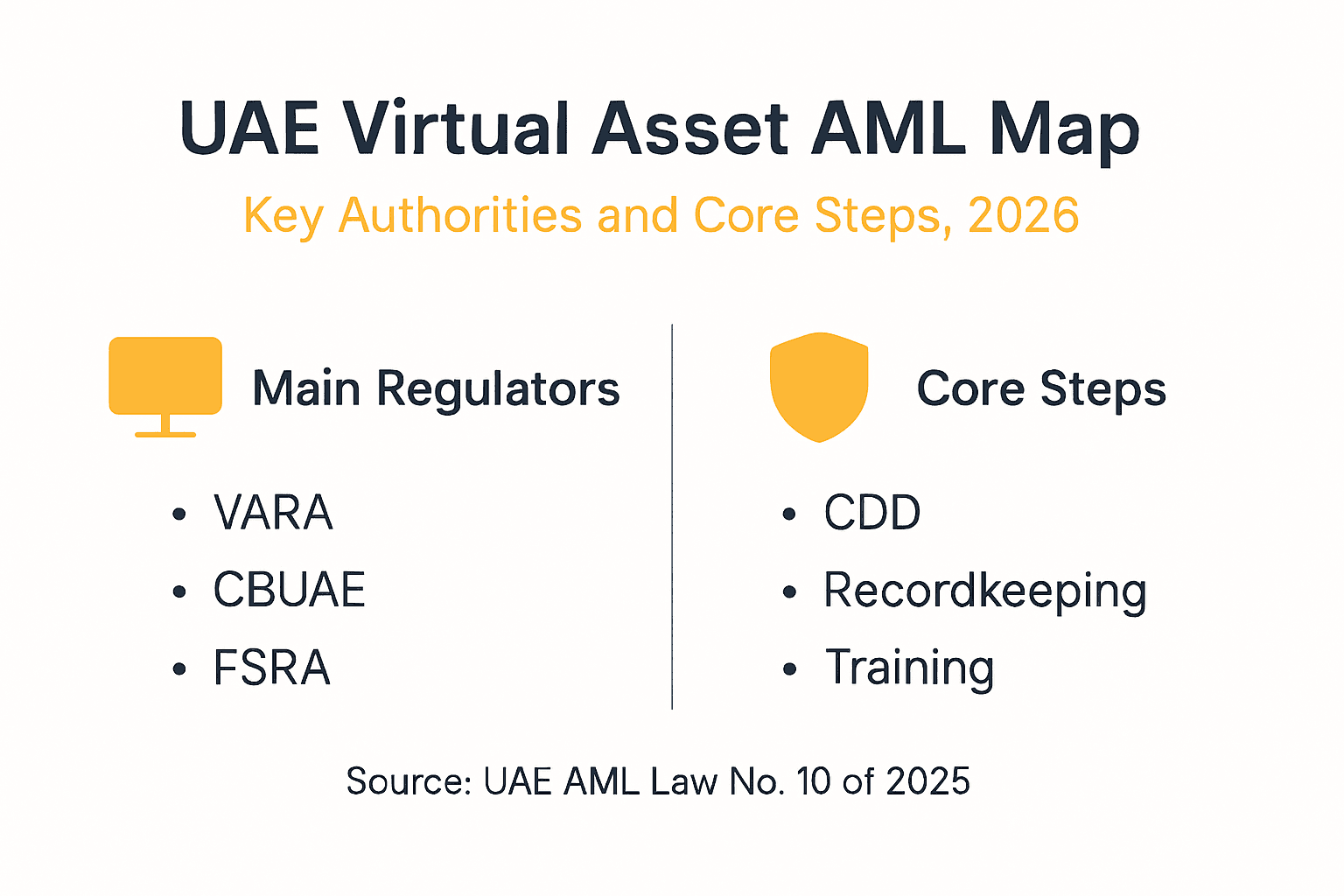
The UAE operates a complex regulatory environment where five separate authorities govern virtual asset compliance. VARA oversees Dubai's mainland crypto firms, FSRA regulates ADGM entities, DFSA controls DIFC operations, SCA manages securities-related tokens, and CBUAE sets overarching monetary policy. Each regulator publishes its own guidance, yet all reference the same federal baseline: UAE Federal Decree-Law No. 10 of 2025 significantly expands AML and CFT obligations to include virtual asset service providers (VASPs), aligning with FATF standards. This law mandates customer due diligence, beneficial ownership identification, suspicious transaction reporting, and recordkeeping for all firms handling cryptocurrencies, tokens, or blockchain-based financial services.
FATF Recommendation 15 treats virtual assets like traditional financial products for AML purposes. You must know your customer, monitor their transactions, and report red flags to the Financial Intelligence Unit. The difference? Blockchain transactions cross borders instantly, wallet addresses provide pseudonymity, and decentralized protocols challenge traditional compliance models. Understanding the UAE multi-regulator AML framework is your first step toward designing policies that satisfy both federal law and the specific regulator supervising your license.
Key authorities and their jurisdictions:
- VARA: Dubai mainland VASPs, exchange licenses, custody providers
- FSRA: ADGM-licensed firms, investment tokens, fund managers
- DFSA: DIFC entities, investment services, collective investment schemes
- SCA: Securities tokens, public offerings, regulated market operators
- CBUAE: Payment tokens, stablecoins, monetary policy oversight
Your compliance program must address the regulator governing your license while respecting federal AML law and FATF standards. This jurisdictional layering creates complexity, but it also offers strategic flexibility for firms structuring operations across multiple free zones or mainland jurisdictions.
Prerequisites: What You Need Before Building Your AML Framework
You cannot build an effective AML program without the right people, knowledge, and tools in place. Start by appointing a qualified Money Laundering Reporting Officer. This individual carries legal responsibility for your firm's AML compliance and acts as the primary contact with the Financial Intelligence Unit. Your MLRO needs deep knowledge of virtual asset risks, UAE federal law, and the specific requirements of your supervising regulator. Pair the MLRO with a compliance team equipped to handle customer screening, transaction monitoring, and suspicious activity reporting.
Your team must master UAE AML laws and FATF standards before drafting policies. UAE Federal Decree-Law No. 10 of 2025 outlines offenses, penalties, and enforcement mechanisms. FATF Recommendation 15 details virtual asset-specific controls including the Travel Rule, which requires VASPs to share originator and beneficiary information for transactions above 1,000 USD or local currency equivalent. Applying a risk-based approach with enhanced due diligence (EDD) on politically exposed persons (PEPs) and high-risk wallets is vital for effective AML in virtual assets.
Essential resources before framework design:
- Qualified MLRO with virtual asset compliance expertise
- Access to blockchain analytics platforms for transaction tracing
- Risk-based CDD and EDD guidance specific to UAE requirements
- Documented AML/CFT policies reflecting federal and FATF demands
- Regular staff training programs covering virtual asset-specific risks
Pro Tip: Invest in blockchain analytics tools early. Manual transaction monitoring fails at scale, and regulators expect real-time detection of suspicious patterns. Platforms like Chainalysis, Elliptic, and TRM Labs integrate with exchange infrastructure to flag high-risk addresses, mixer use, and sanctions violations automatically.
Understanding UAE AML legal requirements and MLRO obligations prevents costly gaps during implementation. Your MLRO should attend regulator workshops, join industry working groups, and maintain current knowledge of enforcement trends. AML compliance is not a one-time project. It requires continuous adaptation as regulators refine guidance and blockchain technology evolves.
Step-by-Step AML Framework Implementation for UAE VASPs
Building a compliant AML program follows a logical sequence. Each step addresses specific legal requirements while creating an operational system that scales with your business. Begin with a comprehensive regulatory and risk assessment covering your jurisdictions. Identify which UAE regulator supervises your license, which federal laws apply, and what FATF standards govern your virtual asset activities. Map your customer base, transaction types, and geographic exposure to high-risk jurisdictions.
Once you understand your risk landscape, formalize your compliance structure. Appoint your MLRO and define clear reporting lines. Your MLRO must have authority to escalate concerns to senior management and direct access to the board. Document this structure in your organizational chart and compliance manual. Next, draft your AML/CFT policies tailored to virtual assets. Generic financial services policies fail because they do not address blockchain-specific risks like mixer services, privacy coins, and decentralized finance protocols.
Implementation sequence:
- Complete regulatory assessment covering VARA AML compliance guidelines, FSRA requirements, or other applicable regulator frameworks
- Appoint MLRO and compliance team with defined AML responsibilities
- Develop customer due diligence procedures including enhanced due diligence for PEPs and high-risk clients
- Deploy blockchain analytics and Travel Rule-compliant transaction monitoring
- Implement recordkeeping systems maintaining data for minimum six years
- Conduct staff AML training covering virtual asset-specific risks
- Establish suspicious transaction reporting workflows to Financial Intelligence Unit
| Step | Purpose | Key Tools Required |
|---|---|---|
| Regulatory Assessment | Identify applicable laws and risk exposure | Legal counsel, regulator guidance documents |
| MLRO Appointment | Centralize AML responsibility and authority | Organizational structure, job description |
| Policy Development | Document procedures meeting UAE and FATF standards | Compliance templates, legal review |
| CDD Implementation | Verify customer identity and beneficial ownership | KYC software, document verification tools |
| Transaction Monitoring | Detect suspicious patterns and red flags | Blockchain analytics, sanctions screening |
| Staff Training | Build AML awareness across organization | Training modules, testing protocols |
| Recordkeeping | Maintain audit trail for regulator review | Document management system, secure storage |
Customer due diligence forms your first line of defense. Collect identity documents, verify beneficial ownership, and screen against sanctions lists. For high-risk customers like PEPs, conduct enhanced due diligence including source of funds verification and ongoing monitoring of transaction patterns. Your blockchain analytics tools should flag deposits from mixers, darknet markets, and sanctioned addresses automatically.

Pro Tip: Document every AML decision in writing. When you onboard a high-risk customer, record your risk assessment and mitigation measures. When you file a suspicious transaction report, keep detailed notes explaining your analysis. Non-compliance with UAE AML regulations can result in fines reaching tens of millions of dirhams and personal liability for senior management.
The Travel Rule requires VASPs to share originator and beneficiary information for transactions above thresholds set by regulators. Implement technical solutions that exchange this data with counterparty VASPs while protecting customer privacy. Several industry protocols exist including TRP, Sygna, and Notabene. Choose a solution compatible with your technology stack and accepted by your regulator.
Training ensures your entire team understands AML obligations. Conduct initial training during onboarding and refresher sessions at least annually. Cover virtual asset-specific risks, red flags indicating money laundering, and procedures for escalating suspicious activity to your MLRO. Test comprehension through quizzes and scenario exercises.
Recordkeeping supports regulatory audits and demonstrates compliance effectiveness. Maintain customer identification records, transaction histories, risk assessments, training attendance logs, and suspicious transaction reports for six years minimum. Store records securely with access controls preventing unauthorized modification. Understanding the ADGM AML framework and licensing requirements helps firms operating in multiple jurisdictions maintain consistent documentation standards.
Common Compliance Pitfalls and How to Avoid Them
Most AML failures stem from four recurring problems: inadequate customer due diligence, insufficient recordkeeping, poor transaction monitoring, and lack of regular training. Regulators cite these gaps repeatedly in enforcement actions against UAE virtual asset firms. Common AML compliance failures in UAE virtual asset firms include inadequate CDD, insufficient record keeping, failure to monitor transactions properly, and lack of regular training.
Inadequate CDD happens when firms skip beneficial ownership verification, fail to screen against sanctions lists, or accept incomplete documentation to speed onboarding. This creates regulatory risk and exposes your platform to money launderers. Implement hard stops in your onboarding workflow requiring complete, verified information before account activation.
Insufficient recordkeeping surfaces during audits when firms cannot produce customer files, transaction histories, or evidence of risk assessments. Document every compliance decision contemporaneously. Your records should tell a complete story of how you identified, assessed, and mitigated AML risks. Store records in organized digital archives with version control and audit trails.
Poor transaction monitoring results from relying solely on automated alerts without human review or investigation. Blockchain analytics tools flag potential issues, but your compliance team must analyze context, investigate connections, and determine whether activity warrants reporting. Train analysts to recognize virtual asset-specific patterns like structuring deposits below reporting thresholds or using multiple wallets to obscure beneficial ownership.
Lack of regular training leaves staff unaware of their AML responsibilities and unable to recognize red flags. Conduct training at least annually, more frequently when regulations change or new risks emerge. Track attendance, test comprehension, and document all training activities.
"Enforcement actions against UAE virtual asset firms increased 15% in 2025, with most violations involving inadequate customer due diligence and transaction monitoring failures."
Pro Tip: Conduct internal AML audits quarterly. Review a sample of customer files, transaction monitoring alerts, and suspicious transaction reports. Identify gaps before regulators do and implement corrective actions immediately. Understanding common AML compliance failures helps you design controls preventing these issues.
Review your AML program annually or whenever your business model changes significantly. Adding new products, entering new markets, or serving new customer segments introduces different risks requiring updated controls. Keep your CBUAE guidance on AML risks documentation current and share changes with your entire team.
Preparing for FATF Mutual Evaluation UAE 2026
FATF will assess the UAE's AML/CFT regime in 2026 using its fifth-round methodology, which emphasizes effectiveness over technical compliance. Regulators will review whether your AML program produces real-world results, not just whether you have policies on paper. Your firm should prepare now by aligning documentation and compliance evidence to expected FATF criteria.
FATF evaluators examine eleven immediate outcomes including how well VASPs identify, assess, and mitigate money laundering risks; whether suspicious transaction reporting leads to investigations and prosecutions; and if beneficial ownership information is accurate and accessible. Your preparation should demonstrate measurable AML effectiveness through case studies, metrics, and operational evidence.
Preparation priorities:
- Align AML policies with FATF Recommendation 15 and virtual asset interpretive note
- Document operational effectiveness through suspicious transaction reports filed, investigations initiated, and accounts closed due to AML concerns
- Maintain comprehensive records proving active monitoring and risk assessment
- Conduct internal audits identifying and remediating gaps before FATF review
- Ensure MLRO and compliance team readiness for regulator interviews
Create a timeline working backward from mid-2026. Schedule internal audits, policy reviews, and staff training to complete six months before the evaluation begins. This buffer allows time to address any issues discovered during preparation. Your MLRO should lead preparation efforts with support from legal counsel experienced in FATF standards.
Pro Tip: Practice explaining your AML program to external audiences. FATF evaluators and UAE regulators will ask detailed questions about how you detect suspicious activity, investigate alerts, and decide whether to file reports. Your MLRO and senior management should be able to articulate your risk-based approach clearly and provide specific examples of AML controls in action.
Review FATF evaluation preparation guidance from industry associations and legal advisors. Understanding evaluation methodology helps you focus preparation on areas receiving greatest scrutiny. FATF places particular emphasis on virtual asset supervision, so expect detailed questions about your transaction monitoring capabilities and Travel Rule compliance.
Expected Outcomes, Success Metrics, and Enforcement Risks
A robust AML framework delivers measurable outcomes protecting your firm from regulatory, financial, and reputational risks. Success starts with obtaining and maintaining your virtual asset license from VARA, FSRA, DFSA, or another UAE regulator. Licensing approval confirms your AML program meets baseline standards, but ongoing compliance requires continuous improvement and adaptation.
Key success indicators:
- Active MLRO overseeing compliance operations with documented authority
- Regular suspicious transaction reports demonstrating effective monitoring
- Clean regulatory examinations with no material findings or enforcement actions
- Sustained banking relationships and correspondent account access
- Positive feedback from customers on streamlined yet thorough onboarding
Your MLRO should track AML metrics including number of customers onboarded, percentage requiring enhanced due diligence, transaction monitoring alerts generated, alerts escalated for investigation, and suspicious transaction reports filed. These metrics demonstrate operational effectiveness and help identify trends requiring program adjustments.
Banking access remains a critical success metric for UAE virtual asset firms. Banks conduct their own due diligence on crypto clients and often terminate relationships citing AML concerns. A documented, effective AML program improves your ability to open and maintain business accounts. Prepare a compliance presentation for your bankers explaining your risk-based approach, monitoring capabilities, and regulatory standing.
Enforcement risks for non-compliance are severe. Non-compliance with UAE AML regulations can result in fines reaching tens of millions of dirhams and personal liability for senior management. Criminal penalties include imprisonment for serious violations involving intentional facilitation of money laundering. Civil penalties include license suspension or revocation, monetary fines, and public censure damaging your reputation.
Understanding VARA enforcement and compliance risks helps you appreciate the stakes of robust compliance. VARA has demonstrated willingness to take strong enforcement action against firms failing to meet AML standards. Other UAE regulators follow similar approaches with escalating penalties for repeat violations.
Personal liability extends to senior management, board members, and MLROs who fail to implement or maintain adequate AML controls. Directors can face fines, travel bans, and criminal prosecution if their firm facilitates money laundering. This personal exposure motivates thorough compliance and active board oversight of AML programs. Review AML fines and personal liability precedents to understand potential consequences of compliance failures.
Achieve Full AML Compliance with Cryptoverse Legal Consultancy

Navigating UAE's multi-regulator AML landscape while preparing for FATF 2026 evaluation requires specialized legal expertise. Cryptoverse Legal Consultancy delivers comprehensive AML compliance services tailored specifically for virtual asset firms operating across Dubai, ADGM, DIFC, and other UAE jurisdictions. Our crypto-native lawyers combine deep regulatory knowledge with practical understanding of blockchain technology to design AML programs that satisfy VARA virtual asset regulations guidance, FSRA requirements, and federal AML law simultaneously.
We support every stage of AML framework development. Our team helps you appoint and empower qualified MLROs, draft comprehensive AML/CFT policies meeting FATF standards, implement risk-based customer due diligence procedures, and deploy transaction monitoring systems aligned with regulatory expectations. We prepare firms for FATF mutual evaluation through documentation review, internal audits, and management training. Whether you need initial ADGM licensing and AML compliance support or ongoing guidance for an established VASP, our regulatory advisors deliver practical solutions reducing compliance risk and positioning your firm for sustainable growth. Visit Cryptoverse Legal Consultancy to schedule a consultation and protect your virtual asset business with expert legal counsel.
Frequently Asked Questions
What are the mandatory roles for AML compliance in UAE VASPs?
Every UAE virtual asset firm must appoint a Money Laundering Reporting Officer who holds legal responsibility for AML program oversight, suspicious transaction reporting to the Financial Intelligence Unit, and regulatory liaison. The MLRO must have appropriate qualifications, authority to escalate concerns to senior management, and adequate resources to fulfill compliance obligations. Larger firms typically establish dedicated compliance teams supporting the MLRO with customer screening, transaction monitoring, and investigations.
How often should AML training be conducted for virtual asset staff in UAE?
Conduct AML training during employee onboarding and refresher sessions at least annually for all staff. Compliance team members require more frequent training, ideally quarterly, covering updates to regulations, emerging risks, and lessons learned from suspicious transaction investigations. Document all training activities including attendance, materials covered, and assessment results to demonstrate regulatory compliance during examinations.
What technologies are recommended for blockchain transaction monitoring?
Invest in specialized blockchain analytics platforms like Chainalysis, Elliptic, or TRM Labs that trace cryptocurrency movements across wallets and exchanges. These tools identify high-risk addresses associated with mixers, darknet markets, sanctions violations, and theft. Integrate analytics with your customer onboarding and transaction processing systems to screen deposits and withdrawals automatically. Complement blockchain analytics with Travel Rule compliance solutions enabling data exchange with counterparty VASPs for transactions above regulatory thresholds.
How does UAE's multi-regulator framework affect AML policy design?
Your AML policies must satisfy federal requirements under UAE Decree-Law No. 10 of 2025 plus specific guidance from your supervising regulator. VARA, FSRA, DFSA, and other authorities publish their own rulebooks building on the federal baseline. Design policies addressing both layers by starting with federal requirements then incorporating regulator-specific controls. If you operate across multiple jurisdictions, create a master AML framework meeting the highest standard then document jurisdiction-specific variations in appendices.
What specific documentation is critical for FATF 2026 preparedness?
FATF evaluators will request evidence proving operational AML effectiveness including suspicious transaction reports filed, outcomes of investigations, accounts closed due to AML concerns, and customer risk assessments. Maintain comprehensive records of compliance decisions, training attendance, internal audit findings, and remediation actions. Document your risk-based approach through written assessments identifying, measuring, and mitigating money laundering exposure. Keep board minutes showing active AML oversight and management information reports demonstrating ongoing monitoring of compliance metrics.