

Thinking your DeFi platform escapes licensing because it’s decentralized? Think again. Federal Decree-Law No. 6 of 2025 imposes licensing mandates with penalties up to 1 billion dirhams for non-compliance. The UAE’s blockchain legal landscape spans five regulators, each with distinct mandates, timelines, and compliance expectations. Whether you’re launching a crypto exchange, issuing stablecoins, or building tokenized real estate platforms, understanding this multi-layered regulatory architecture is essential for success in 2026.
Table of Contents
-
Understanding UAE’s Multi-Regulator Blockchain Legal Framework
-
Federal Integration and Central Bank Oversight in Crypto Regulation
-
Choosing the Right Regulatory Jurisdiction and Licensing Route
-
Comparative Analysis with Global Crypto Regulatory Frameworks
-
Practical Guidance for Legal Compliance and Business Structuring
Key Takeaways
| Point | Details |
| Multi-Regulator System | UAE operates five distinct crypto regulators (VARA, SCA, DFSA, FSRA, CBUAE) with overlapping and jurisdiction-specific mandates. |
| 2026 Accountability Shift | DFSA now requires firms to independently assess token suitability, shifting responsibility from regulator to operator. |
| Federal Licensing Deadline | CBUAE mandates all DeFi, stablecoin, and DEX operators obtain licenses by September 2026 or face shutdowns and massive fines. |
| AML/CTF Compliance | VASPs must implement FATF-aligned frameworks including travel rule compliance, 8-year record retention, and suspicious activity reporting. |
| Jurisdictional Strategy | Choosing between VARA, DFSA, FSRA, or CBUAE impacts licensing fees, timelines, capital requirements, and operational flexibility. |
Understanding UAE’s Multi-Regulator Blockchain Legal Framework
The UAE doesn’t have one crypto regulator. It has five. Each authority governs specific activities and geographic zones, creating a multi-regulator crypto framework in UAE that demands careful navigation.
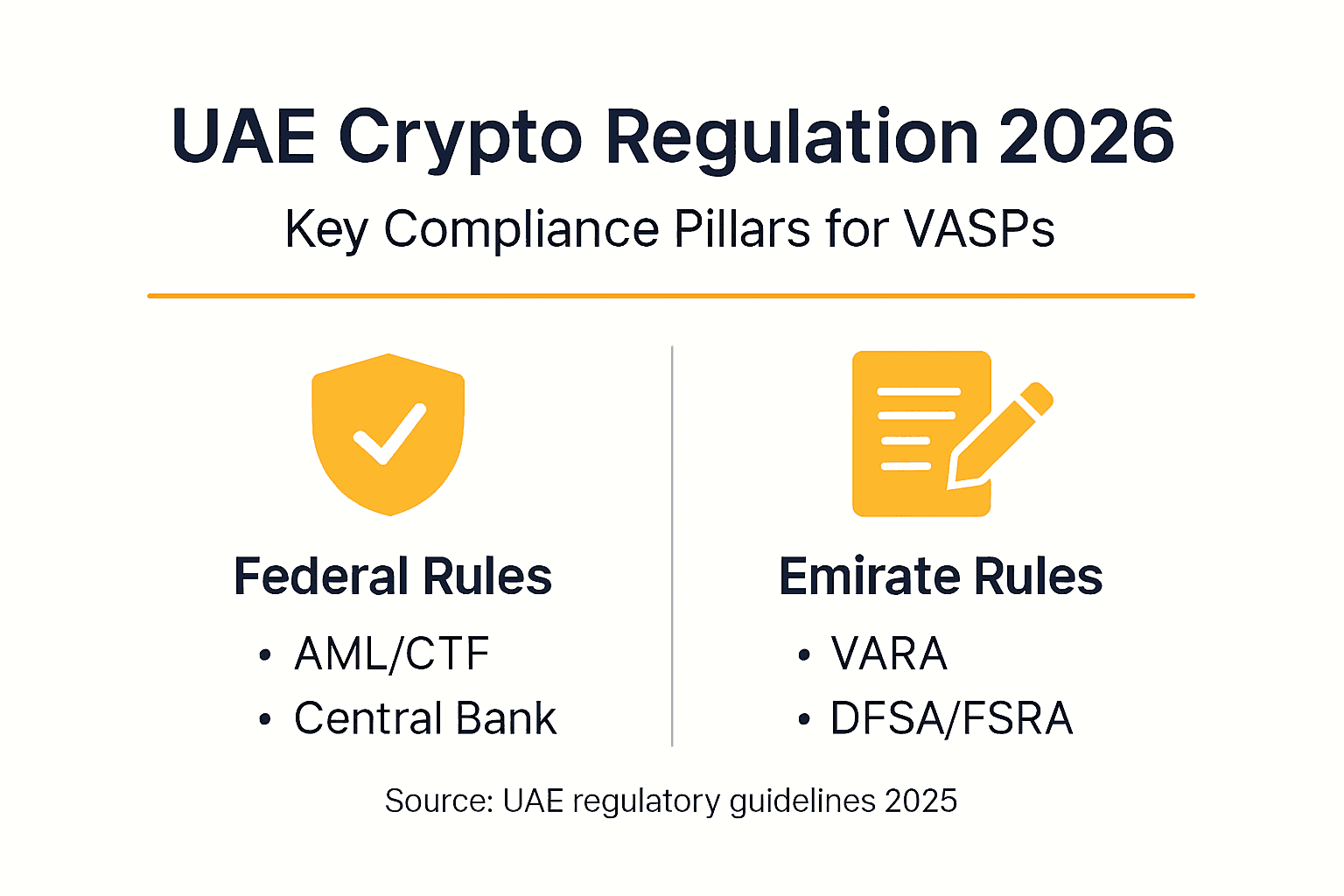
The UAE operates a dual regulatory system with federal authorities setting baseline standards and emirate regulators enforcing jurisdiction-specific frameworks. Here’s how they divide responsibility:
-
VARA (Virtual Assets Regulatory Authority): Governs crypto activities in Dubai outside DIFC, including exchanges, custody, and advisory services.
-
SCA (Securities and Commodities Authority): Federal oversight of securities, including tokenized securities across UAE.
-
DFSA (Dubai Financial Services Authority): Regulates crypto operations within Dubai International Financial Centre (DIFC).
-
FSRA (Financial Services Regulatory Authority): Oversees virtual assets in Abu Dhabi Global Market (ADGM).
-
CBUAE (Central Bank of UAE): Federal authority managing DeFi platforms, stablecoins, DEXs, and stored value facilities.
This layered structure creates flexibility. You can operate under emirate-specific innovation hubs or comply with federal baselines. The challenge? Each regulator has distinct licensing procedures, fee structures, and compliance expectations. Your business model determines which authority you approach. An exchange targeting retail investors in Dubai mainland falls under VARA. A tokenized fund raising capital from institutional investors in DIFC answers to DFSA.
Pro Tip: Map your business activities to regulatory categories before selecting jurisdiction. Misalignment causes application delays and wasted capital.
Key Reforms in Emirate-Level Crypto Regulation for 2026
Emirate regulators launched significant reforms in 2026, reshaping how crypto firms demonstrate compliance and manage token governance.
Since January 2026, DFSA requires regulated firms to independently assess crypto token suitability, shifting accountability from regulator to firm. This reform eliminates pre-approval processes. Instead, DFSA expects firms to conduct thorough due diligence on tokens they list or custody. You evaluate legal status, technical security, liquidity, and investor protection risks. Your assessment becomes the compliance foundation. If you list a scam token or fail to identify red flags, DFSA holds your firm accountable, not just the token issuer.

VARA Dubai crypto regulations also evolved in 2026. VARA updated its rulebook to address staking services, yield products, and tokenized securities. The updated framework clarifies licensing requirements for DeFi interfaces, automated market makers, and governance token issuers. If you operate smart contracts that facilitate trading or lending in Dubai, you likely need VARA approval.
FSRA strengthened institutional custody standards. ADGM-based custodians now face stricter capital adequacy ratios, segregation protocols, and insurance requirements. These reforms target institutional investors seeking secure digital asset storage with regulatory oversight.
What does this mean for your operations?
-
You own token governance decisions. Regulators expect documented risk assessments.
-
DeFi platforms need licenses. “Just code” is not a legal defense.
-
Custody providers must upgrade security infrastructure to meet 2026 institutional standards.
Pro Tip: Document every token assessment. Maintain audit trails showing how you evaluated security, compliance, and investor protection before onboarding any digital asset.
Federal Integration and Central Bank Oversight in Crypto Regulation
While emirate regulators govern local activities, federal law sets the overarching compliance framework. Federal Decree-Law No. 6 of 2025 centralizes crypto oversight under CBUAE, mandates licensing by September 2026, with penalties up to 1 billion dirhams for violations. This law fundamentally reshaped DeFi regulation.
Here’s what CBUAE federal crypto regulation now covers:
-
DeFi Platforms: Any protocol facilitating lending, borrowing, or trading requires CBUAE licensing.
-
Stablecoins: Issuers must obtain stored value facility licenses. Reserve backing, redemption mechanisms, and audit requirements apply.
-
Decentralized Exchanges: DEX operators, including those using automated market makers, fall under CBUAE jurisdiction.
-
Payment Tokens: Digital currencies used for payments need compliance approval.
September 2026 is the hard deadline. Platforms operating without licenses after this date face:
-
Immediate shutdown orders
-
Fines reaching 1 billion dirhams
-
Criminal prosecution for operators
-
Asset seizures
1 billion dirhams in maximum penalties makes this the strictest crypto enforcement regime in the Gulf. CBUAE gained broad supervisory powers. The central bank can inspect platforms, audit smart contracts, freeze assets, and impose corrective measures. They demand real-time reporting of significant incidents, security breaches, and compliance failures.
If you run a DeFi protocol serving UAE users, you cannot ignore this deadline. The “decentralized” label offers no legal shield. CBUAE looks at functional reality: does your platform facilitate financial transactions? If yes, you need a license.
Mandatory AML/CTF and Compliance Frameworks for VASPs
UAE’s AML and CTF regulations require VASPs to implement firm-wide AML frameworks, conduct KYC, monitor suspicious transactions, comply with FATF travel rule, and retain records for at least 8 years. These UAE AML/CTF requirements form the operational backbone of every licensed crypto business.
Here’s your compliance checklist:
-
Customer Due Diligence: KYC verification for all users. Enhanced due diligence for high-risk customers and politically exposed persons.
-
Travel Rule Compliance: Transfer customer data for transactions exceeding AED 3,500. Both originator and beneficiary information must accompany transfers.
-
Transaction Monitoring: Real-time systems detecting unusual patterns, high-value transactions, and potential money laundering.
-
Suspicious Activity Reporting: File reports with UAE Financial Intelligence Unit within prescribed timeframes.
-
Record Retention: Maintain transaction records, customer identification, and compliance documentation for minimum 8 years.
-
Internal Controls: Appoint compliance officers, conduct regular audits, train staff on AML procedures.
The travel rule creates technical challenges. You need systems exchanging customer data with other VASPs securely. Many platforms adopt FATF-approved protocols or third-party compliance solutions. Failure to implement travel rule compliance risks license suspension.
Your AML framework must align with both federal standards and emirate-specific requirements. VARA, DFSA, and FSRA each publish detailed AML guidance. Read them carefully. Regulators expect tailored policies reflecting your specific business model, customer base, and risk exposure.
Pro Tip: Budget 15-20% of operational costs for ongoing compliance. Automated monitoring tools, compliance personnel, and regular audits are not optional expenses.
Choosing the Right Regulatory Jurisdiction and Licensing Route
VARA, DFSA, FSRA, and CBUAE offer different licenses, timelines, fees, and jurisdictional nuances requiring tailored selection for successful crypto business operation. Your choice impacts everything: time to market, capital requirements, operational flexibility, and long-term scalability.
| Regulator | License Fee Range | Timeline | Minimum Capital | Best For |
| VARA | AED 100,000-200,000 | 6-9 months | USD 50,000+ | Retail exchanges, custody, advisory in Dubai |
| DFSA | USD 10,000-50,000 | 9-12 months | USD 50,000+ | Institutional services, tokenized securities in DIFC |
| FSRA | USD 15,000-40,000 | 6-10 months | USD 100,000+ | Custody, brokerage, fund management in ADGM |
| CBUAE | Varies | 12-18 months | AED 500,000+ | DeFi platforms, stablecoins, stored value facilities |
VARA suits retail-focused exchanges and advisory firms targeting Dubai mainland. Choosing UAE crypto jurisdiction starts with identifying your customer base. VARA licenses allow broad retail marketing but demand strict investor protection measures.
DFSA licensing pathway works for institutional players. DIFC offers regulatory credibility attractive to funds, family offices, and traditional finance entities entering crypto. DFSA licenses facilitate international operations and cross-border capital flows.
FSRA jurisdiction guide positions ADGM as the custody and brokerage hub. If you’re building infrastructure for institutional crypto storage or operating a regulated brokerage, FSRA provides robust frameworks.
CBUAE licensing is mandatory for DeFi operators, stablecoin issuers, and DEX builders regardless of emirate location. This federal requirement overrides emirate choices.
Consider these factors when selecting jurisdiction:
-
Business Model: Exchange, custody, advisory, DeFi, or tokenization?
-
Target Customers: Retail, institutional, or both?
-
Capital Access: Can you meet minimum capital thresholds?
-
Timeline: How quickly do you need operational approval?
-
Scalability: Will you expand to other emirates or internationally?
Many firms adopt multi-jurisdiction strategies. A parent entity in DIFC holds the institutional license while a Dubai mainland subsidiary under VARA serves retail clients. This structure maximizes market access while maintaining compliance.
Pro Tip: Start licensing applications 12-18 months before your planned launch date. Regulatory approvals take longer than founders expect.
Comparative Analysis with Global Crypto Regulatory Frameworks
| Framework | Structure | Innovation Approach | Cross-Border Impact |
| UAE | Multi-regulator with federal baseline | Emirate-specific innovation hubs | Requires emirate + federal compliance |
| MiCA (EU) | Centralized EU-wide passport | Uniform standards across 27 nations | Single license serves entire EU |
| MAS (Singapore) | Single national regulator | Risk-based, innovation-friendly | Streamlined international operations |
MiCA offers regulatory passporting. One license approved in France works across all EU member states. This simplifies multi-country operations but imposes rigid, uniform requirements. Every crypto firm must meet identical capital, disclosure, and operational standards regardless of size or business model.
MAS takes a principle-based approach. Singapore’s framework focuses on outcomes rather than prescriptive rules. Regulators grant flexibility in how firms achieve compliance objectives. This encourages innovation but requires sophisticated internal compliance capabilities.
UAE sits between these models. Emirate regulators create innovation zones with tailored rules. DIFC, ADGM, and Dubai mainland each offer distinct regulatory environments. Federal law establishes baseline AML, licensing, and oversight standards. This hybrid approach provides:
-
Regulatory Shopping: Choose the emirate matching your business needs.
-
Innovation Space: Test new models in supportive regulatory environments.
-
Federal Credibility: Central bank oversight reassures international partners.
-
Market Access: Serve Gulf Cooperation Council markets from UAE base.
For international VASPs, UAE’s global crypto regulation comparison reveals strategic advantages. You gain access to Middle Eastern and African markets while maintaining operations acceptable to European and Asian partners. Many firms use UAE as a regional hub, complementing licenses in EU (MiCA), Singapore (MAS), or UK (FCA).
Common Misconceptions and Legal Clarifications
Decentralized finance platforms cannot avoid licensing by claiming ‘just code’ status; UAE law requires licenses with strict penalties for non-compliance. Let’s clear up persistent myths that cause legal trouble.
Myth 1: DeFi Protocols Are Exempt Reality: CBUAE regulates any platform facilitating financial transactions, regardless of decentralization claims. Smart contracts, DAOs, and automated protocols all require licensing if they serve UAE users. Developers, governance token holders, and interface operators share liability.
Myth 2: Offshore Incorporation Avoids UAE Regulation Reality: Serving UAE customers triggers regulatory obligations. Your company’s registration location matters less than where users access services. Blocking UAE IP addresses is not sufficient. Regulators look at marketing, language options, and actual user base.
Myth 3: Token Sales Aren’t Securities Reality: SCA and emirate regulators apply functional tests. If your token resembles equity, debt, or investment contracts, securities regulations apply. Token name and marketing materials don’t determine classification. Economic reality does.
Myth 4: Regulators Approve Tokens Reality: Since 2026, DFSA shifted responsibility to firms. You assess tokens. Regulators audit your assessment process. They don’t pre-approve individual tokens or bless your business model.
Myth 5: AML Rules Only Apply to Fiat Onramps Reality: Crypto-to-crypto transactions, staking rewards, and DeFi yields all trigger AML monitoring. Travel rule applies to large crypto transfers between wallets. Regulators expect comprehensive transaction surveillance.
These misconceptions lead to enforcement actions. Clarifying UAE crypto misconceptions early saves you from costly penalties and reputational damage. When in doubt, seek legal guidance before launching products or onboarding users.
Practical Guidance for Legal Compliance and Business Structuring
Success metrics include timely VASP license acquisition, avoiding penalties, and maintaining FATF-compliant AML/CTF policies with audits. Here’s your step-by-step roadmap:
-
Define Your Activities Precisely: Map every service you offer (trading, custody, advisory, lending, staking) to regulatory categories. Vague descriptions cause application rejections.
-
Select Optimal Jurisdiction: Use the comparison table earlier. Match your business model and customer base to the regulator offering best fit.
-
Prepare Comprehensive Applications: Legal compliance steps UAE crypto demands complete documentation. Include business plans, technical architecture, AML procedures, risk assessments, and governance frameworks.
-
Implement AML/KYC Infrastructure: Build compliance systems before submitting applications. Regulators want proof of operational readiness, not promises. Drafting AML policies UAE requires tailoring FATF standards to your specific platform.
-
Establish Governance and Internal Controls: Appoint compliance officers, create audit committees, document decision-making processes. Regulators expect corporate governance matching traditional financial institutions.
-
Maintain Ongoing Compliance: Licensing is not the finish line. Submit regular reports, conduct internal audits, update policies when regulations change, and train staff continuously.
-
Plan Multi-Jurisdiction Operations: If expanding beyond one emirate, structure corporate entities appropriately. Parent-subsidiary models often work best, with each entity holding relevant licenses.
Capital requirements vary significantly. Budget for licensing fees, minimum capital deposits, operational reserves, technology infrastructure, and compliance personnel. Most startups underestimate total regulatory costs by 40-60%.
Timeline management is critical. Start licensing processes at least one year before your target launch. Regulatory approvals rarely happen faster than projected. Build buffer time for requested clarifications, additional documentation, and regulator review cycles.
Pro Tip: Engage specialized legal counsel early. Crypto regulations change frequently. Expert guidance prevents expensive mistakes and speeds approvals.
Unlock Seamless Crypto Compliance with Cryptoverse Lawyers
Navigating five regulators, federal mandates, and emirate-specific rules demands specialized expertise. CRYPTOVERSE Legal Consultancy guides crypto startups and VASPs through every licensing and compliance challenge across Dubai VARA licensing support, DFSA crypto regulatory guidance, and CBUAE federal frameworks.

Our crypto-native lawyers combine regulatory mastery with blockchain technology understanding. We structure your business for optimal jurisdictional fit, draft regulator-ready AML policies, prepare comprehensive license applications, and maintain ongoing compliance as regulations evolve. Whether you’re launching a DEX, issuing stablecoins, or building tokenized real estate platforms, we deliver legal solutions that withstand regulatory scrutiny. Don’t risk penalties exceeding 1 billion dirhams. Partner with Cryptoverse Legal Consultancy to secure your crypto business’s legal foundation today.
Frequently Asked Questions
Do DeFi protocols need licensing if they have no central operator?
Yes. UAE law focuses on functional reality, not technical architecture. If your protocol facilitates financial transactions for UAE users, licensing requirements apply regardless of decentralization. CBUAE holds developers, governance participants, and interface operators accountable.
How do frequent regulation updates affect my compliance obligations?
You must monitor regulatory changes continuously and update policies accordingly. Regulators expect firms to adapt quickly. Subscribe to official regulator newsletters, engage legal counsel for guidance, and maintain flexible compliance frameworks that accommodate regulatory evolution without complete overhauls.
What specific records must I keep to satisfy UAE regulators?
Maintain transaction logs, customer identification documents, AML risk assessments, compliance training records, suspicious activity reports, and audit trails for minimum 8 years. Records must be easily retrievable for regulatory inspections. Include both on-chain data and off-chain customer information.
What are the first steps after receiving a crypto business license?
Implement all approved policies immediately. Appoint compliance officers and begin transaction monitoring. Submit your first regulatory report on schedule. Conduct internal audits quarterly. Update your license if business activities change. Maintain open communication channels with your assigned regulator contact.
Can I operate in multiple emirates with one license?
Generally no. Each emirate regulator issues licenses valid only within their jurisdiction. VARA licenses cover Dubai mainland, DFSA covers DIFC, FSRA covers ADGM. Multi-emirate operations typically require separate legal entities and licenses in each jurisdiction, structured under a holding company for operational efficiency.
How does CBUAE’s September 2026 deadline impact existing unlicensed platforms?
Any platform serving UAE users without appropriate licenses faces immediate shutdown after September 2026. You must submit applications well before the deadline since approval processes take 12-18 months. Retroactive licensing is not possible. Operating past the deadline without approval triggers severe penalties including asset seizures and prosecution.