

Transaction monitoring crypto compliance programmes rely on the continuous, automated analysis of on‑chain activity to flag money laundering, sanctions evasion, and fraud before they reach the balance sheet. Its purpose is to generate detection, alerting, and audit‑ready evidence for suspicious activity reports. On its own, though, wallet‑level data rarely identifies a person. Effective monitoring pairs on‑chain analytics with off‑chain KYC and KYB records to attribute activity and support real investigations.
How does crypto transaction monitoring actually work?
Monitoring is a pipeline, not a single tool. Each stage feeds the next, and a weakness anywhere in the chain undermines everything downstream of it.
- Data ingestion. Feeds come from full nodes, blockchain indexers, and third‑party data providers. Raw ledger data arrives in inconsistent formats across chains, so it needs normalising into a common schema before anything useful can be done with it.
- Enrichment. Raw transaction hashes mean little to an analyst. Systems convert values into fiat equivalents using market‑aware pricing, classify the tokens involved, and attempt counterparty resolution, matching addresses to known entities such as exchanges, mixers, or sanctioned wallets. Kaiko's blockchain monitoring product, for example, layers market‑aware USD values and wallet history across multiple chains to support this enrichment step.
- Tracing. Clustering heuristics group addresses likely controlled by the same entity. Cross‑chain linking follows funds through bridges and swaps, since illicit actors routinely move value between networks specifically to break a simple, single‑chain trail.
- Scoring and typology matching. Enriched, traced transactions are scored against risk databases and rule sets, some deterministic, some machine‑learning based, that flag patterns associated with known typologies.
- Alerting, case management, and closure. A triggered rule produces an alert with a documented rationale. An analyst investigates, escalates, dismisses, or files a report, and the outcome is logged for audit purposes.
Chainalysis's KYT platform illustrates how compressed this pipeline can become in practice: real‑time ingestion paired with alerting that can fire within seconds, fast enough to screen a transfer before it settles, not merely after the fact. That speed matters for VASPs that need to block a risky transaction rather than simply report on it after the funds have already moved.
The core distinction from fiat‑era transaction monitoring is that crypto systems trace value across a public ledger using clustering and risk‑scoring techniques rather than relying solely on static thresholds built for bank wire data.
What components should a monitoring stack provide?
Wallet screening and continuous monitoring are often confused, but they solve different problems. Screening checks a wallet at a point in time, typically onboarding. Monitoring watches transaction flows continuously, catching a clean wallet that turns dirty six months into a client relationship. A programme needs both, and unifying them into one workspace rather than running separate tools cuts the time between alert and decision considerably.
A functioning stack needs six components working together:
- Data feeds covering the chains and tokens your business actually touches, not a generic subset.
- A risk database of sanctioned addresses, known illicit clusters, and darknet market wallets, updated continuously.
- A rule and scoring engine that applies both deterministic thresholds and behavioural, ML‑assisted scoring.
- A tracing engine capable of clustering and cross‑chain linking.
- Case management that routes alerts to analysts with full context, not a bare transaction hash.
- An immutable event log recording every alert, decision, and escalation for later audit or litigation.
The signals a well‑tuned system should surface include a direct sanctions list match, a mixer or tumbler link, a sudden velocity spike in transaction frequency or value, peel chain patterns (small amounts repeatedly split off a larger balance), and interactions with high‑risk smart contracts. None of this operates in isolation. Monitoring output needs to integrate with KYC and KYB systems at onboarding, with custody platforms for withdrawal controls, and with SIEM tooling where a firm already centralises security event data.
Pro Tip: Treat your risk database update frequency as a control in its own right. A sanctions list that refreshes weekly rather than in near real time leaves a compliance gap regulators will ask about directly during an examination.
Which typologies and red flags should rules be tuned for?
Global anti‑money‑laundering frameworks describe typologies that transaction monitoring exists to catch, and crypto's programmable, cross‑chain nature has produced its own variants worth tuning for specifically.
- Mixer and tumbler exposure. Funds routed through a mixing service, then split across multiple small transfers, aim to sever the link between origin and destination.
- Chain‑hopping. Moving value across bridges between unrelated blockchains defeats single‑chain tracing tools and is a deliberate obfuscation tactic, not an incidental one.
- Structuring. A pattern of many transfers just under a reporting threshold, or transfers timed and sized to avoid triggering a single large alert, points to deliberate evasion.
- Dormant wallet reactivation. A wallet inactive for months that suddenly receives funds and immediately forwards a large outflow is a classic laundering signature.
- Wash trading on DEXs. Circular trades between related wallets on an automated market maker can inflate volume or launder funds through apparent legitimate trading activity.
Rules built only around textbook definitions of these patterns miss variants. Structuring today rarely looks like ten identical transfers; it looks like ten transfers of varying, deliberately irregular amounts designed to defeat a simple threshold rule.
How should compliance teams evaluate monitoring tools?
Vendor claims about coverage need verification, not acceptance at face value. Ask for a documented list of supported chains, tokens, and bridge protocols, then test it against transaction types your business actually processes rather than a demo data set curated to look comprehensive.
- Coverage. Confirm the tool covers every chain and token in your actual transaction mix, including newer Layer 2 networks, not just the majors.
- Latency. Understand the acceptable window between a transaction entering a block and an alert firing. Some platforms alert within seconds of ingestion, which matters if you need to block a transfer before it settles rather than simply report after the fact.
- Explainability. Every alert needs a documented risk rationale, a plain narrative an examiner or auditor can read without needing to interrogate the underlying model.
- Integration readiness. Confirm API compatibility with your KYC/KYB provider, custody platform, and case management system before signing, not after.
- Commercial model and reporting outputs. Understand what monthly compliance reporting and SAR‑support exports come standard versus what requires custom development.
Coverage claims and latency figures are only useful if the tool also gives your analysts a reason for every decision it makes.
Why does alert fatigue undermine even good monitoring tools?
Signal‑to‑noise ratio is the single biggest determinant of whether a monitoring programme succeeds operationally. Custom, risk‑based thresholds and per‑rule analytics let teams focus human attention where it matters instead of drowning analysts in low‑value alerts.
- Tune per rule, not globally. A single sanctions‑match rule and a velocity‑spike rule need different thresholds and different review priorities.
- Set triage SLAs. Define how quickly a high‑severity alert must be reviewed versus a low‑severity one, and staff accordingly to prevent backlog.
- Document latency handling. Because true real‑time detection is bounded by underlying block times, teams need a written procedure for transactions still awaiting finality when an alert fires.
- Test through replay and simulation. Run historical data through new rules before deployment to estimate alert volume and catch obvious false‑positive floods.
- Report KPIs to governance. Alert volume, average time‑to‑close, and false‑positive rate should reach the board or its risk committee, not stay buried in an operations dashboard.
Pro Tip: Design monitoring service levels around chain finality windows specifically, and write down the process for handling an in‑flight transfer. An undocumented gap here is one of the first things an examiner probes.
What do regulators expect from monitoring reports?
Regulators do not want a dashboard. They want an evidentiary trail they can reconstruct months or years later without relying on the memory of the analyst who handled it.
- An immutable event log capturing every alert, the risk score at the time it fired, the analyst's decision, and the reasoning behind it.
- Exportable, explainable narratives for each alert, written so a non‑technical examiner can follow the logic without needing the underlying model explained.
- Monthly compliance reports covering alert volumes, dispositions, SARs filed, and any material rule changes made during the period.
- Jurisdictional configurability, since a rule set built for one regulator's expectations may not satisfy another's, and multi‑jurisdiction programmes need adjustable thresholds rather than one rigid global standard.
A crypto SAR typically needs transaction hashes, wallet clustering results, the specific rule or typology that triggered the alert, and, where relevant, Travel Rule counterparty data identifying the originating and beneficiary institutions. Retaining the risk score as it existed at the moment of the transaction, rather than a retrospectively recalculated figure, is what makes the audit trail defensible in a later investigation or prosecution.
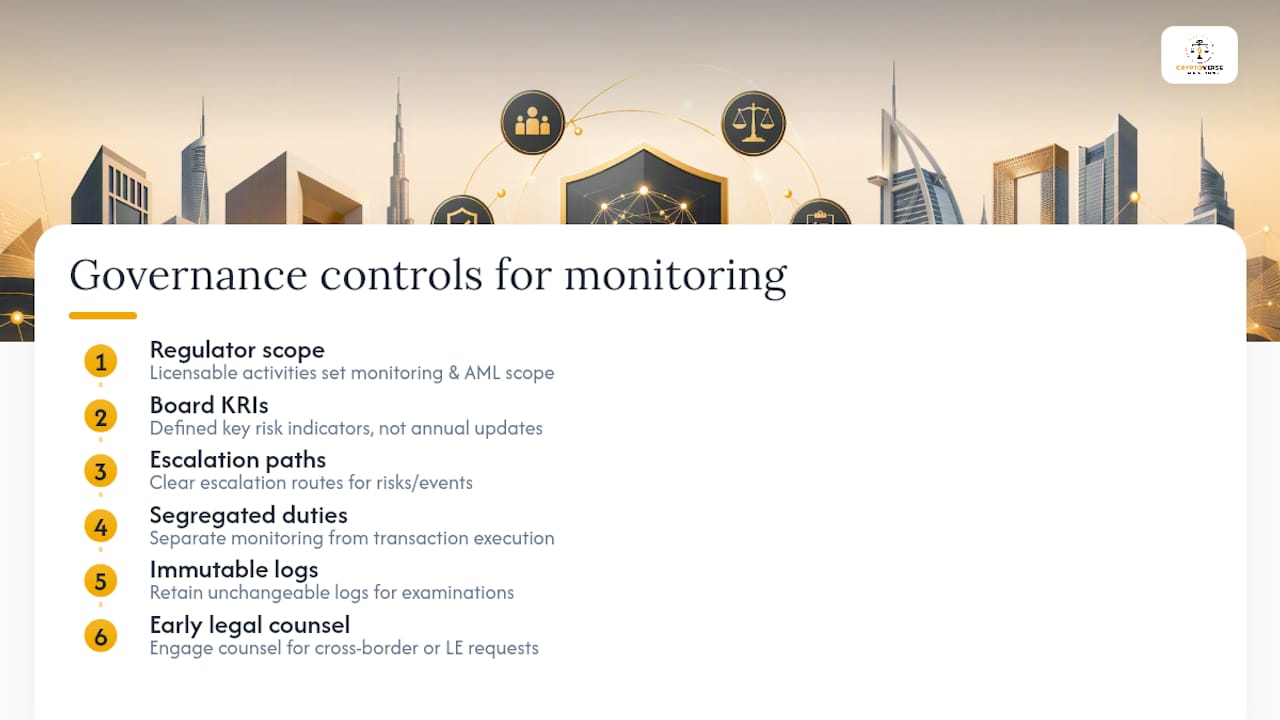
Governance checklist for transaction-monitoring programmes
Board oversight needs defined key risk indicators and clear escalation paths, not annual updates. Licensable activities under your operating regulator determine your monitoring scope and AML obligations directly. Segregate monitoring duties from transaction execution, retain immutable logs for examination readiness, and engage counsel early on cross‑border incidents or law‑enforcement requests.
What we see going wrong in client engagements
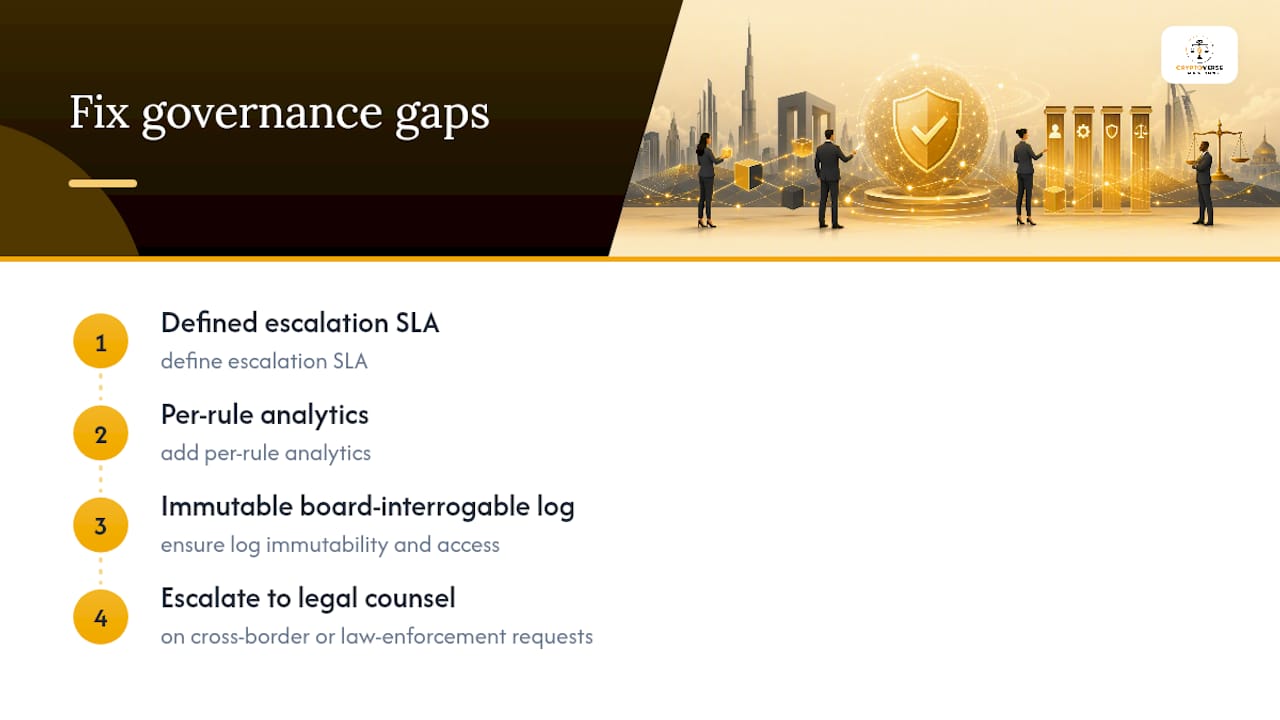
Programme failures rarely trace back to missing technology. They often trace back to governance gaps: no defined escalation SLA, no per‑rule analytics, no immutable log a board can actually interrogate. Fix those three first. Escalate to legal counsel the moment a cross‑border request or law‑enforcement inquiry lands.
Sources
Key sources: TRM Labs, Chainalysis KYT, Elliptic Lens, Kaiko, and Cryptoverselawyers' VARA guidance for regulatory follow‑up.
- Crypto Transaction Monitoring: Definition & Guide | TRM Labs
- Lens: Transaction & Wallet Screening | Elliptic