

TL;DR:
- Crypto compliance requires VASPs to align operations with diverse regulatory standards through risk assessments and jurisdiction mapping.
- Building a compliance program involves legal classification, detailed policies, staff training, and active monitoring to ensure ongoing adherence and regulator oversight.
Crypto compliance is defined as the process by which a virtual asset service provider (VASP) aligns its operations, governance, and controls with applicable regulatory requirements across every jurisdiction it serves. The industry term for this process is regulatory compliance for VASPs, and it encompasses AML/CFT policy design, licensing, transaction monitoring, and board-level governance. Step by step crypto compliance matters because improper market mapping triggers enforcement actions, fines, and operational shutdowns. Regulators including VARA, FSRA, MiCA, and MAS each impose distinct obligations, and a VASP that conflates them risks both licence rejection and reputational damage. This guide walks founders and compliance officers through the full sequence, from initial legal assessment to ongoing monitoring readiness.
What are the foundational prerequisites for step by step crypto compliance?
Effective crypto compliance begins before a single policy is drafted. The first task is a formal legal risk assessment that maps your product's actual mechanics: how funds move, who holds custody, which users you serve, and in which jurisdictions. Legal assessment costs for DeFi startups generally range from £4,000 to £12,000 per jurisdiction. That cost is not optional overhead. It is the document that determines whether your token is a utility token, a security, an e-money instrument, or a virtual asset under FATF guidance.

Mapping your product before selecting tools
A plain-language flow-of-funds map is the starting point every compliance programme needs. Boilerplate AML policies fail when they do not reflect actual funds flow. Your map should identify every point at which your platform touches, moves, or holds value on behalf of a user. Once that map exists, you can match each activity to a legal category and identify which regulator has jurisdiction.
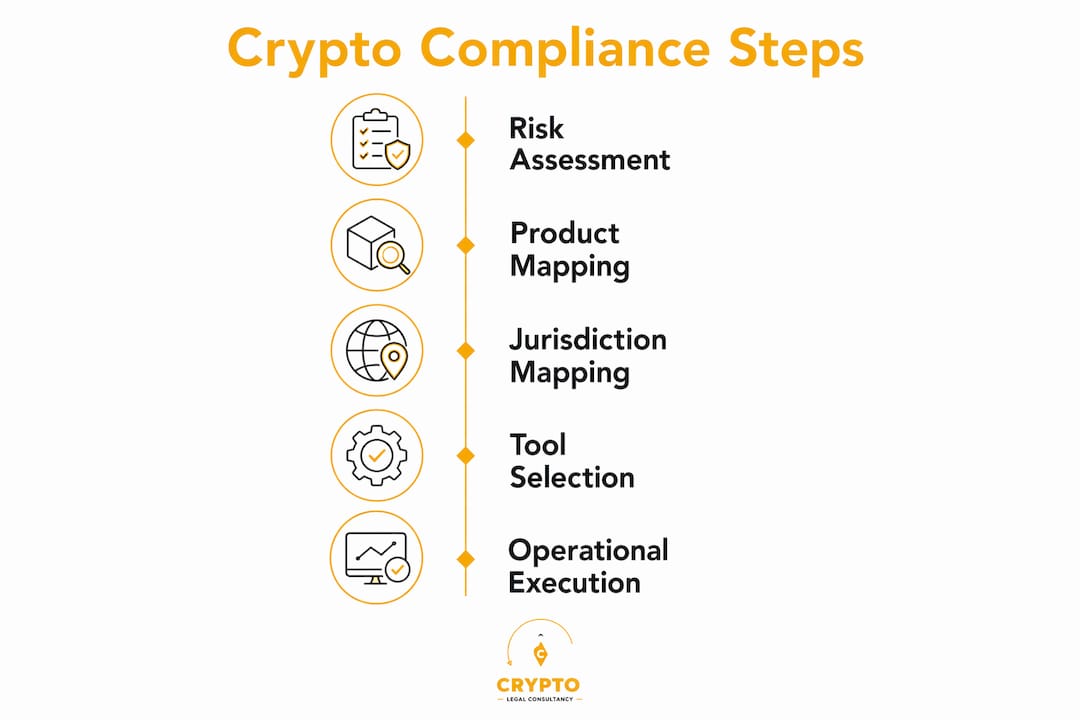
Jurisdiction mapping follows product mapping. If you serve users in the EU, MiCA applies. If you operate from the UAE, VARA or FSRA licensing is required depending on your free zone or mainland status. If you accept users from the United States, federal Bank Secrecy Act obligations and state money transmitter licences may apply simultaneously.
Essential tools and their functions
The following tools form the minimum viable compliance stack for a VASP at launch:
- KYC/identity verification platform: collects and verifies government-issued identity documents and performs liveness checks at onboarding
- Transaction monitoring software: flags unusual velocity, threshold structuring, and layering patterns in real time
- Blockchain analytics platform: screens wallet addresses against known illicit clusters, sanctions lists, and darknet market associations
- Sanctions screening feed: integrates OFAC, EU Consolidated List, UN Security Council, and local lists for pre-onboarding and transaction-level checks
- Document management system: stores policies, risk assessments, SARs, and audit logs with version control and access restrictions
Pro Tip: Before purchasing any compliance tool, confirm it supports the specific blockchain networks your product uses. A platform that covers Bitcoin and Ethereum but not Solana or Tron creates a blind spot that regulators will identify during examination.
How do you build a tailored crypto compliance programme step by step?
Building a compliance programme is a sequential process. Skipping steps creates gaps that regulators identify during examination. The sequence below reflects the order in which controls depend on one another.
-
Conduct a formal legal risk assessment. Obtain written legal opinions on token classification and protocol categorisation. Legal opinions on token classification are a critical foundation that can mitigate costly disputes with regulators later.
-
Draft a Business Risk Assessment (BRA). The BRA documents your inherent risk exposure by product line, customer segment, geography, and delivery channel. It forms the basis for all downstream controls.
-
Develop your AML/CFT policy suite. Policies must reflect your actual custody model and funds flow. A centralised exchange holds client assets and therefore requires full VASP-level AML controls. A non-custodial protocol faces a different, though not absent, regulatory perimeter.
-
Design KYC and Customer Due Diligence (CDD) procedures. Tier your onboarding by risk: simplified due diligence for low-value retail users, standard CDD for most customers, and Enhanced Due Diligence (EDD) for politically exposed persons, high-risk jurisdictions, and large-value transactions.
-
Implement sanctions screening workflows. Sanctions screening against OFAC, EU, and UN lists must be integrated before onboarding and applied at the transaction level. Geofencing and IP blocking reduce exposure to prohibited jurisdictions.
-
Establish Travel Rule compliance procedures. Under FATF Recommendation 16, VASPs must collect and transmit originator and beneficiary information for transfers above the applicable threshold. The UAE's CBUAE Circular 2/2024 and VARA Rulebooks specify local Travel Rule obligations.
-
Appoint a named AML Compliance Officer. Governance ownership of AML requires a named officer with formal reporting lines to the board and documented escalation paths. This is not a nominal appointment. The officer must have authority, budget, and direct board access.
-
Create your Suspicious Activity Reporting (SAR) workflow. Define the internal escalation path from alert to investigation to SAR filing. Document every step with timestamps and decision rationale.
The key compliance documents your programme must produce and maintain include:
- Business Risk Assessment
- AML/CFT Policy and Procedures Manual
- KYC/CDD and EDD Procedures
- Sanctions Screening Policy
- Travel Rule Compliance Procedure
- SAR Filing Log and Internal Investigation Records
- Board Compliance Reporting Pack
- Annual Compliance Review Report
Pro Tip: Regulators increasingly look at operational execution evidence rather than static policy documents. A well-written policy with no audit trail of implementation carries less weight than a simpler policy with documented alerts, investigations, and decisions.
What are the licensing requirements across major jurisdictions?
Licensing obligations depend on your business model, the activities you conduct, and the jurisdictions you operate in or serve. Non-compliance carries severe penalties, including fines and operational shutdowns. The table below summarises the primary frameworks relevant to VASPs in 2026.
| Jurisdiction | Regulator | Framework | Typical Timeline |
|---|---|---|---|
| UAE (ADGM) | FSRA | Virtual Asset Framework | 6–12 months |
| UAE (Dubai) | VARA | VARA Regulations and Rulebooks | 6–12 months |
| European Union | ESMA / NCAs | MiCA (CASP licence) | 3–18 months |
| Singapore | MAS | Payment Services Act (MAS licence) | 6–12 months |
| United Kingdom | FCA | MLRs 2017 / FSMA authorisation | 12–24 months |
| Canada | FINTRAC | PCMLTFA registration | 3–6 months |
| United States | FinCEN + State | BSA MSB + state MTL | 12–36 months |
UAE's VARA and FSRA require detailed business plans, AML policies, and technical documentation as part of the licence application. Incomplete submissions are the primary cause of delays. The UAE regulatory compliance guide published by Cryptoverselawyers provides a detailed breakdown of each submission requirement.
EU MiCA applies uniformly across all 27 member states and mandates CASP licensing, capital requirements, custody safeguards, and consumer disclosures. A single MiCA authorisation grants passporting rights across the EU, making it one of the most efficient licensing pathways for firms targeting European markets. For DeFi founders, the MiCA framework overview from Cryptoverselawyers clarifies which decentralised protocols fall within scope.
Consequences of operating without a licence include regulatory fines, asset freezes, forced wind-down orders, and personal liability for directors. In the UAE, VARA has the authority to publish public censure notices, which carry significant reputational consequences beyond financial penalties.
How do you operationalise ongoing compliance monitoring?
A compliance programme is not a one-time build. Regulators define a compliant programme by its operational evidence, not its written policies. Ongoing monitoring requires active management across four areas.
Transaction monitoring and blockchain analytics
Transaction monitoring tuned to customer profiles and product use cases is the core of operational AML. Your monitoring scenarios must detect layering, rapid cycling, threshold structuring, and sanctions evasion techniques specific to the blockchain networks you support. Generic bank-style rules do not capture crypto-specific patterns such as chain-hopping or mixer usage. Blockchain analytics platforms should screen every wallet at onboarding and flag high-risk counterparties on an ongoing basis.
Policy maintenance and regulatory updates
Regulatory frameworks change. MiCA technical standards are still being finalised by ESMA. VARA issues updated Rulebooks and guidance notices. FATF periodically revises its Recommendations. Your compliance programme must include a formal process for monitoring regulatory developments and updating policies within a defined timeframe. Assign ownership of this process to your AML Compliance Officer with board-level sign-off on material changes.
Board reporting and governance reviews
Governance ownership must be active and evidenced. The board should receive a compliance report at least quarterly, covering alert volumes, SAR filings, training completion rates, and any regulatory correspondence. Board minutes must record that compliance was discussed and that the board exercised oversight. This documentation is what regulators examine during supervisory visits.
Common compliance gaps that trigger enforcement include:
- Transaction monitoring rules that were never tuned after launch
- KYC records that are incomplete or stored outside the required retention period
- Sanctions screening that covers only onboarding and not ongoing transactions
- No documented escalation path from alert to SAR decision
- AML Compliance Officer with no direct board access or reporting line
Pro Tip: For AI-assisted compliance governance tools that integrate with regulatory frameworks such as MAS and the EU AI Act, verify that the tool produces audit-ready outputs. Regulators will ask to see the decision logic behind automated alerts.
What we have learned from building compliance programmes for crypto startups
The most common mistake we see at Cryptoverselawyers is founders treating compliance as a documentation exercise. They commission a policy suite, file it, and consider the job done. Regulators do not share that view. The VARA Compliance and Risk Management Rulebook and the FSRA Virtual Asset Framework both require evidence of operational execution: tuned monitoring rules, documented alert investigations, and board minutes that show active oversight.
The second lesson is that legal opinions on token classification are not a luxury. They are a defensive asset. When a regulator questions whether your token is a security or a virtual asset, a written legal opinion from qualified counsel is the difference between a supervisory query and an enforcement action. We have seen founders spend months in regulatory dialogue that a timely legal opinion would have resolved in days.
Multi-jurisdictional compliance is genuinely difficult. The instinct is to pick the most permissive jurisdiction and build outward. That approach fails when your user base spans the EU, the UAE, and Singapore simultaneously, because each regulator asserts jurisdiction based on where users are located, not where the company is incorporated. The correct approach is to map your user geography first, then build a compliance architecture that satisfies the most demanding applicable framework and adapts downward.
The final lesson is governance ownership. Compliance programmes without a named, empowered AML Compliance Officer deteriorate quickly. The officer must have authority to halt onboarding, file SARs without board approval, and escalate directly to directors. Anything less creates a structural gap that regulators will find.
— CRYPTOVERSE
How Cryptoverselawyers supports your crypto compliance programme
Cryptoverselawyers advises VASPs, exchanges, DeFi protocols, and token issuers across the full compliance lifecycle, from initial legal risk assessment through to licence approval and ongoing regulatory monitoring.

For founders preparing a VARA licence application, Cryptoverselawyers prepares the complete submission package: business plan, AML/CFT policy suite, governance framework, and technical documentation. For compliance officers building or auditing an existing programme, the firm provides gap analysis, policy redrafting, and board-level compliance reporting templates. Cryptoverselawyers also issues formal legal opinions on token classification in Dubai under VARA's framework, which are accepted as part of licence submissions and used to defend regulatory positions. With coverage across VARA, FSRA, MiCA, MAS, FCA, and FINTRAC, the firm provides a single point of legal accountability for multi-jurisdictional compliance programmes.
FAQ
What is crypto compliance for a VASP?
Crypto compliance is the process by which a virtual asset service provider aligns its operations, AML/CFT controls, governance, and licensing with applicable regulatory requirements in every jurisdiction it serves.
How long does a VARA or FSRA licence application take?
VARA and FSRA licensing timelines are typically 6–12 months, depending on the licence category and the completeness of the initial submission.
What documents are required for a crypto compliance programme?
A compliant programme requires a Business Risk Assessment, AML/CFT Policy Manual, KYC/CDD Procedures, Sanctions Screening Policy, Travel Rule Procedure, SAR Filing Log, and a Board Compliance Reporting Pack.
Does MiCA apply to DeFi protocols?
MiCA primarily targets centralised crypto asset service providers. Fully decentralised protocols without an identifiable issuer or service provider may fall outside its scope, but the boundary is not yet settled and ESMA continues to issue guidance.
What are the penalties for operating without a crypto licence?
Non-compliance penalties include regulatory fines, asset freezes, forced operational shutdown, and personal liability for directors, with VARA additionally empowered to issue public censure notices.