

Source of funds for crypto is the documented origin of the specific tokens or fiat used in a transaction, distinct from source of wealth, which covers your entire net worth history. When an exchange or bank asks, the fastest path to clearance is a small evidence bundle: your strongest fiat or exchange document paired with the relevant on-chain transaction hashes. Institutions want provenance they can verify independently, not just a story.
What source of funds and source of wealth mean in crypto
Source of funds (SoF) identifies the origin of capital behind one specific deposit, trade, or withdrawal. Source of wealth (SoW) is broader: it explains how you accumulated your overall net worth, not just the money moving through a single transaction, a distinction Nexo's compliance guidance sets out clearly. Crypto adds a layer traditional finance lacks: a public, immutable ledger that lets a reviewer trace a token's path independently of anything you submit.
Regulators frame this through a risk-based lens rather than a fixed document checklist. FATF guidance and FinCEN expectations both push institutions to scale scrutiny to the risk the customer or transaction presents, rather than demanding maximal paperwork from everyone. That risk-based principle matters because it explains why:
- Some deposits clear instantly with no request at all
- Others trigger a full documentary and on-chain review
- The same customer can face different scrutiny levels depending on the asset, counterparty, or transaction size involved
When institutions ask: typical triggers and thresholds
Source of funds requests rarely arrive at random. They follow identifiable patterns, and knowing them lets you prepare before a compliance team ever emails you.
- Large or unusual deposits relative to your account history, especially a sudden jump in size or frequency.
- Travel Rule flags on transfers between virtual asset service providers, where originator or beneficiary information is incomplete.
- Mixer or bridge exposure, where funds have passed through privacy tools or cross-chain bridges that obscure origin.
- Sanctions list hits, even indirect ones several hops away from a flagged address.
- Account opening or tier upgrades, where platforms verify wealth before raising withdrawal limits.
- Manual compliance review, triggered by an analyst rather than an automated rule.
A trader who converts a large OTC settlement into stablecoins, or a founder who liquidates a token allocation after a lookup expires, will almost always sit inside one of these categories.
Acceptable documents and evidence for crypto source of funds
Reviewers want documents that corroborate each other, not a single certificate. Coinbase's help centre lists payslips, bank statements, tax returns, and exchange transaction exports among acceptable proof of source of funds and wealth, and most regulated exchanges follow a similar pattern.
- Fiat proofs: payslips, tax filings, and bank statements showing transfers into an exchange account.
- Exchange proofs: transaction history exports, deposit and withdrawal confirmations, KYC verification screenshots.
- Crypto-native proofs: wallet transaction exports, staking or mining reward reports, cryptographically signed wallet messages proving ownership.
- Business evidence: invoices, sale contracts, or settlement agreements for anyone paid in crypto for goods or services.
Kraken's support team explains the split simply: if funds are already sitting on an exchange, provide the transfer history; if they originated elsewhere, provide documents showing how the money was earned plus proof you actually received it.
Pro Tip: Redact account numbers and personal identifiers before submission, but never redact dates, amounts, or transaction hashes. A document that hides the wrong details becomes unverifiable, which slows your case rather than protecting your privacy.
On-chain evidence and blockchain forensics: what reviewers look for
Documents can be fabricated. The blockchain cannot. That is why sophisticated compliance teams treat on-chain evidence as the anchor point for any source of funds decision, then use paperwork to corroborate it.
Forensic analysis, of the kind Lukka's blockchain forensics methodology describes, combines on-chain and off-chain data into a provenance report and risk score. Reviewers typically want to see:
- The full transaction path from origin wallet to the current custodian
- Wallet age and transaction frequency, since dormant wallets suddenly moving funds attract more scrutiny
- Interactions with known exchanges, mixers, or sanctioned addresses
- A calculated risk score reflecting the number of hops and the nature of intermediary wallets
On-chain evidence is strongest when it is unambiguous, a direct wallet-to-exchange deposit with a clean history rarely needs much more. It becomes weaker evidentially the moment funds pass through a mixer or an opaque over-the-counter desk, where AMLBot's analysis of matching customer data with on-chain evidence notes that documentary corroboration becomes essential rather than optional. The chain tells reviewers what happened; documents tell them why.
How to assemble a bank- or exchange-ready source-of-funds report
A scattered pile of screenshots rarely satisfies a reviewer. A structured report does, and the format below mirrors what professional proof-of-funds reports use in practice.
- Executive summary: one paragraph stating who you are, what the funds are, and how they were acquired.
- Acquisition history: the original event, salary, sale, mining reward, or investment exit, that produced the funds.
- Transaction timeline: a chronological table linking dates, amounts, and wallet or account addresses.
- Ownership proof: signed wallet messages or KYC-linked exchange accounts confirming control.
- Conversion chain: the fiat to exchange to crypto to wallet path, showing every hop.
- Evidence appendix: labelled exchange exports, transaction hashes, and bank statements, each named to match its reference in the timeline.
AurumFSG's proof-of-funds report template recommends exactly this structure: a short summary, a timeline, and a well-labelled appendix rather than an exhaustive transaction dump.
Pro Tip: If records are missing, mainly for older wallets or exchanges that have since shut down, reconstruct the history using on-chain traces, a signed affidavit explaining the gap, and, where possible, a third-party confirmation from a counterparty or former employer.
How institutions assess risk and make a defensible decision
Institutions do not weigh every document equally. A risk-based framework assigns more evidential weight to independently verifiable data, principally the blockchain record, and treats self-reported documents as supporting context.
- Direct wallet-to-exchange deposits with clean transaction histories usually clear quickly.
- Funds routed through mixers, unlicensed OTC desks, or unexplained multi-hop chains draw escalation almost every time.
- A reviewer builds a case file combining your explanation, your documents, and the forensic trace, then records why the decision was made, an approach AMLBot's compliance framework treats as the defensible standard for audit purposes.
The submission most likely to succeed presents its strongest, most independently verifiable evidence first, then lets supporting documents fill the gaps rather than burying the reviewer in unlabelled screenshots.
Practitioner perspective: building a regulatory-ready SoF file
A legal consultancy specializing in virtual assets reviews source-of-funds files the way a regulator eventually will: checking whether the documentary story and the on-chain trail actually reconcile, not just whether the paperwork looks complete. A governance sign-off process typically checks acquisition history, ownership proof, and forensic risk scoring before a file goes to counsel or a compliance officer.
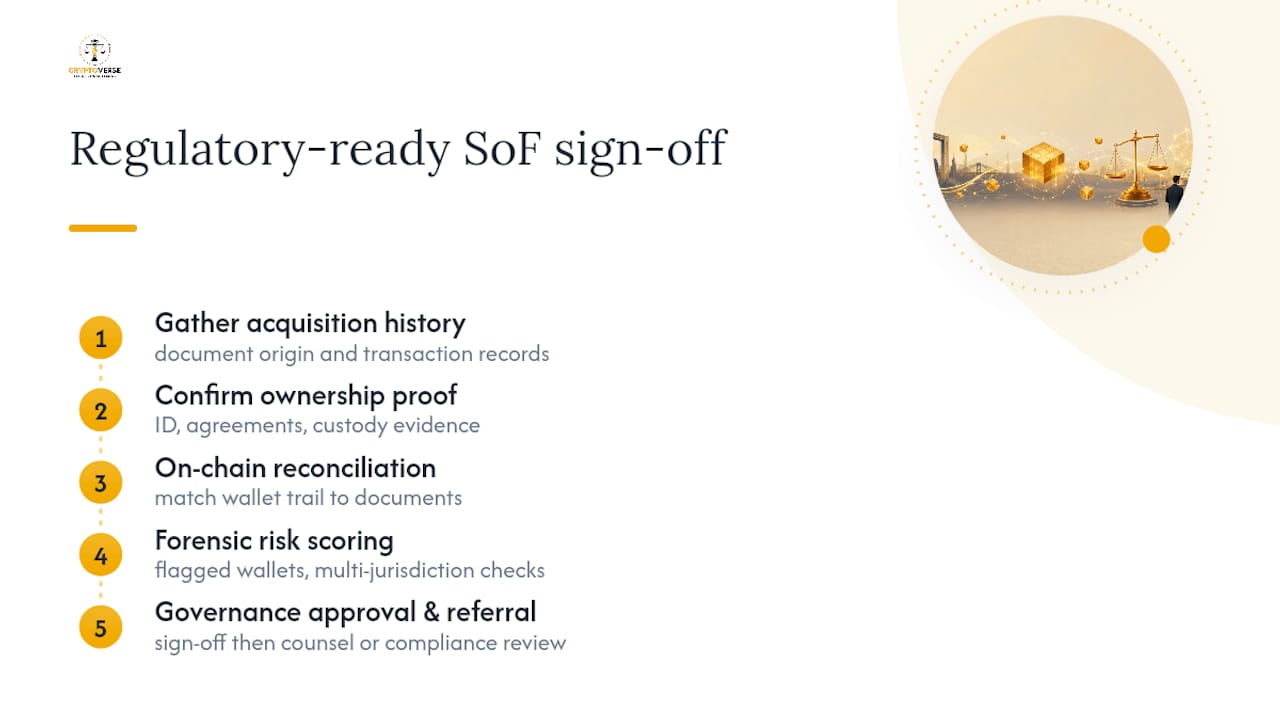
Instruct a blockchain-forensics provider or legal counsel once the case involves multi-jurisdictional exposure, a flagged wallet, or a licensing application where the regulator will independently verify the same trail. That legal documentation becomes the anchor for remediation, licensing submissions, or remedial regulatory reporting later, particularly relevant for firms working through VARA's licensing requirements for virtual asset issuance or comparable frameworks elsewhere.
For businesses building risk-scoring processes internally, frameworks like AML Guard's approach to AML risk scoring offer a useful reference point for structuring escalation triggers before a regulator asks why they weren't there.
Where conventional advice on this gets it wrong
Most guidance on this topic treats source of funds as a paperwork exercise: gather documents, upload them, wait. That undersells what actually clears a case. The research is consistent on one point: reviewers trust the blockchain more than they trust a submitted PDF, because a bank statement can be altered and a transaction hash cannot. Anyone treating documentary evidence as sufficient on its own is solving only half the problem.
The bigger gap is timing. Most crypto users start assembling evidence only after a freeze notice arrives, when reconstructing an acquisition history from two years ago is far harder than logging it at the time. The practitioners who never face a prolonged review are usually the ones who kept transaction records, signed wallet ownership proofs, and exchange exports as routine housekeeping, not as a crisis response.
If you take one thing from this, prioritise the conversion chain: fiat to exchange to crypto to wallet. Reviewers reject far more files for a broken link in that chain than for a missing payslip. Get that sequence airtight, and the surrounding documents become confirmation rather than the whole case.
— CRYPTOVERSE
This article is general information, not a substitute for advice from a qualified financial advisor. Consult a qualified financial professional about your own circumstances before acting on anything here.
Sources
- Kraken support — why we ask for source of wealth or source of funds documents
- Coinbase — proof of source(s) of funds and wealth documents
- AMLBot — source of funds in crypto: matching customer information with on‑chain evidence
- Lukka — Source of Funds: Comprehensive Blockchain Forensics