

Smart contract disputes are resolvable today, but not by code alone. Effective outcomes pair arbitration or mediation clauses with on‑chain enforcement mechanisms such as escrow and multisig release, triggered once a human or institutional process reaches a decision. Low‑value, high‑volume disputes suit online dispute resolution (ODR) or decentralised dispute resolution (DDR); complex or high‑stakes disputes still need arbitrators, technical experts, and carefully drafted clauses. The first moves after a dispute surfaces: preserve evidence, check the contract's dispute hooks, and confirm the status of any escrowed funds.
Common smart contract dispute types and technical failure modes
Most smart contract disputes fall into a small number of recurring categories, and each one tends to push the parties towards a different resolution route.
- Coding bugs and logic errors — a misconfigured condition or integer overflow produces an outcome neither party intended, usually resolved through technical expert evidence and negotiated settlement.
- Oracle failures — incorrect or delayed price feeds trigger wrongful liquidations or settlements, requiring forensic analysis of the oracle's data source and timing.
- Security exploits and hacks — a breach drains funds mid‑execution, often demanding emergency injunctive relief alongside forensic tracing before any arbitration can proceed.
- Interpretation mismatches — the code does exactly what it says, but not what the natural‑language agreement intended, a classic candidate for mediation or contractual interpretation by an arbitrator.
- Off‑chain performance failures — a counterparty fails to deliver the real‑world asset or service a smart contract was meant to settle, which courts and arbitral tribunals are generally better placed to assess than any on‑chain mechanism.
Security incidents are the outlier: they often require urgent freezing orders or multisig intervention before a formal dispute process even begins, which is why enforceable arbitration and mediation clauses matter more once funds are moving than after the fact.
Choosing between courts, arbitration, mediation and decentralised resolution
The right forum depends on value, complexity, and how much the parties need privacy or specialist technical understanding.
- Courts remain necessary where enforceability against a non‑cooperative party, injunctive relief, or complex factual findings are at stake, particularly for high‑value or cross‑border disputes involving off‑chain performance.
- Arbitration suits most commercial smart contract disputes because awards are enforceable across borders under the New York Convention, provided the seat, governing law, and consent mechanism are properly drafted into the agreement.
- Mediation works well for interpretation mismatches and ongoing commercial relationships where the parties want a negotiated outcome rather than a binding ruling.
- ODR platforms handle high‑volume, low‑value claims efficiently, and AI‑assisted digital arbitration systems have shown significant reductions in resolution time with strong accuracy in tamper detection for digital evidence compared with traditional benchmarks.
- Decentralised dispute resolution (DDR), including crowdarbitration and expert‑pool models, uses juror selection and escrow‑based enforcement to produce on‑chain enforceable outcomes, though it trades specialised legal expertise for speed and accessibility.
Pro Tip: Match the forum to the dispute's technical depth, not just its dollar value. A £50,000 oracle manipulation claim can be more complex than a £2 million payment default, and complexity should drive the choice of arbitrator or expert panel, not the amount at stake.
Traditional courts and arbitration continue to handle nuanced factual disputes that DDR and blockchain‑based crowdsourced arbitration platforms (BCAPs) were never designed to scale into, according to academic analysis of blockchain dispute institutions.
On‑chain enforcement and escrow: how awards actually get executed
Once a resolution is reached, on‑chain mechanics can execute it automatically, but only within careful limits.
- Multisig with arbitrator keys: funds sit in a wallet requiring signatures from both parties plus a neutral arbitrator, who signs only after a determination is made.
- Escrow smart contracts: deposits are locked with conditional release triggers tied to an oracle, an arbitrator's on‑chain attestation, or a court order relayed by an authorised party.
- Layer‑2 dispute protocols: mechanisms such as BoLD use staking and slashing to resolve computational disagreements within a bounded time window, relying on Layer‑1 finality to settle the outcome.
The limits matter as much as the mechanics. Off‑chain assets, real‑world performance obligations, and enforcement against uncooperative parties in unfavourable jurisdictions still need court involvement. The safest default is to route disputed funds into a held state rather than an automatic timeout release, since silence from one party should never be read as acceptance.
Drafting smart contracts and dispute clauses that hold up
Enforceability starts at the drafting table, not the courtroom. An arbitration clause referenced by code still needs to satisfy ordinary contract formation rules: capacity, genuine consent, and, in most jurisdictions, a written record satisfying New York Convention formalities for cross‑border recognition.
- Name a specific arbitral seat and governing law rather than leaving the contract silent on jurisdiction.
- Build fallback natural‑language clauses that explicitly record consent, seat, and enforcement expectations alongside the coded trigger conditions.
- Specify oracle fallback procedures for when a price feed fails or is disputed, including who bears the burden of proving manipulation.
- Include an evidence submission mechanism so both parties know what counts as admissible proof before a dispute ever arises.
Pro Tip: Draft the arbitration clause as if the code did not exist. If the natural‑language version cannot stand alone in a courtroom, the coded trigger will not save it. Norton Rose Fulbright's practice guidance on arbitrating smart contract disputes treats this dual drafting approach as standard practice for cross‑border commercial deployments, and Cryptoverselawyers structures contract drafting and review engagements around exactly this pairing.
Evidence, chain of custody and technical forensics
Blockchain records prove that a transaction occurred and what state it produced, but they say nothing about intent, off‑chain performance, or whether an oracle feed was accurate at the moment it was consumed.
- Preserve signed transaction logs, oracle input history, and node timestamps immediately once a dispute is anticipated, before logs rotate or nodes are decommissioned.
- Commission a forensic review of the disputed transaction sequence, oracle inputs, and contract state transitions rather than relying on a single block explorer snapshot.
- Maintain a documented chain of custody for every piece of digital evidence submitted to a tribunal, mirroring the standards courts already apply to other forms of electronic evidence.
- Expert reports carrying this forensic detail routinely determine outcomes in arbitration, particularly for oracle failure and exploit cases.
Practical guidance on preserving blockchain evidence for court proceedings reinforces that tamper detection and custody documentation, not the existence of a blockchain record itself, is what persuades a tribunal.
What to do first when a dispute arises
- Contain immediately: pause any pending contract upgrades, isolate the affected smart contract from further interaction if governance permits, and snapshot the current state and transaction logs.
- Triage the legal position: identify all parties, check whether the contract or side agreement contains a dispute resolution clause, and formally notify the counterparty in writing.
- Check escrow and deposit status: confirm whether funds are already held in escrow or multisig, and whether a release trigger has fired or is pending.
- Escalate in sequence: attempt direct negotiation first, move to mediation if the relationship is worth preserving, then arbitration for a binding outcome, and only pursue court enforcement of an award once that stage is exhausted.
Pro Tip: Set a hard internal deadline for each escalation stage. Disputes that drift without a deadline tend to lose evidentiary value, particularly volatile off‑chain logs that third‑party infrastructure providers do not retain indefinitely.
Aligning dispute design with regulatory expectations
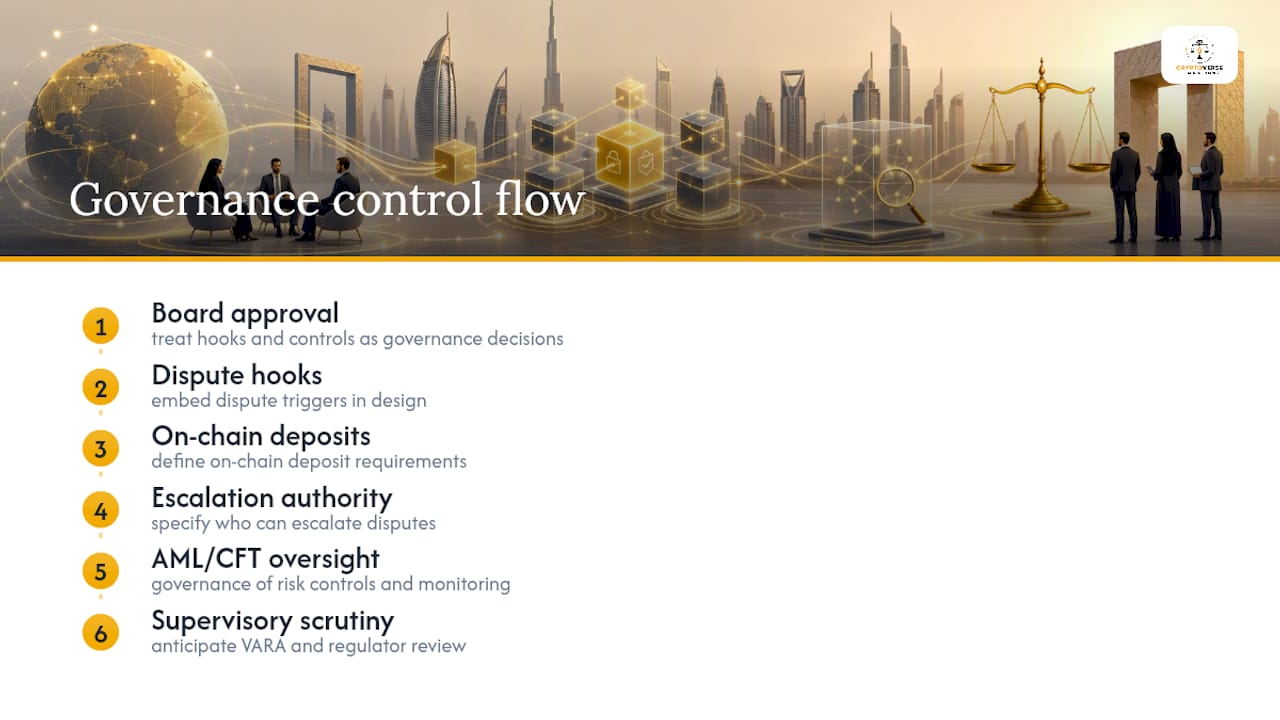
Dispute architecture is not just a legal drafting exercise; it intersects directly with supervisory expectations on governance and AML/CFT risk controls. A board approving a tokenisation or escrow structure should treat dispute hooks, on‑chain deposit requirements, and escalation authority as governance decisions, not engineering afterthoughts. Cryptoverselawyers advises on structuring these controls within frameworks such as VARA's virtual asset regulations and supports clients building blockchain legal infrastructure that anticipates supervisory scrutiny rather than reacting to it.
Where smart contract dispute resolution is heading
The direction is hybrid, not automated. Routine, low‑value claims will increasingly move through ODR and DDR channels, while complex disputes stay firmly with human arbitrators and courts. Machine‑readable dispute protocols, such as the draft Agentic Dispute Protocol points towards contracts built with modular dispute hooks from day one, rather than bolted on after a failure.
— CRYPTOVERSE
How Cryptoverselawyers helps you build disputes out of your contracts
Most disputes that end up costly were preventable at the drafting stage, not the litigation stage. Legal consultants can work directly with founders, compliance officers, and in‑house legal teams to draft enforceable arbitration and mediation clauses, structure escrow and multisig release mechanics that hold up under scrutiny, and run evidence‑readiness reviews before a dispute ever reaches a tribunal.
That combination, legal drafting paired with technical architecture review, is what separates a contract that survives a dispute from one that generates years of litigation over what the code was supposed to mean. If your business is issuing tokens, running escrow arrangements, or structuring a multi‑party smart contract deal, book a contract review or dispute architecture session with Cryptoverselawyers and get your VARA licensing and regulatory position assessed alongside your dispute design, before a failure forces the conversation.
This article is general information, not a substitute for advice from a qualified lawyer. Consult a qualified legal professional about your own circumstances before acting on anything here.
Sources
- AI‑powered digital arbitration (Nature)
- When smart contracts fail: disputes & risk factors (ADR Institute)
- Decentralized dispute resolution: using blockchain and smart contracts in arbitration (Pepperdine DRLJ)
- BoLD: a bounded‑delay dispute resolution protocol (ArXiv)
FAQ
Are smart contracts legally enforceable?
Code execution alone is not legally enforceable in most jurisdictions; enforceability depends on pairing the contract with standard ADR clauses that trigger on coded events and satisfy ordinary contract formation requirements.
What are the four types of dispute resolution?
The four main routes are litigation through courts, arbitration, mediation, and negotiation, with ODR and DDR functioning as technology‑enabled variants of arbitration and mediation for smart contract disputes specifically.
Can XRP handle smart contracts?
The XRP Ledger supports smart contract functionality through its hooks and native features, but any dispute arising from those contracts still requires an ADR clause or court process, since ledger‑level execution does not itself resolve legal disagreements.
What is the likelihood of winning an arbitration case?
Outcomes vary too widely by dispute type, evidence quality, and drafting to state a general success rate; strong forensic evidence and a well‑drafted arbitration clause materially improve a party's position, as detailed in the drafting and evidence sections above.
How long does resolving a smart contract dispute typically take?
Timelines depend heavily on the forum: AI‑assisted ODR platforms have demonstrated significant reductions in resolution time compared with traditional arbitration, while complex cross‑border disputes routed through courts or full arbitration proceedings can take considerably longer.