

TL;DR:
- AML plays a vital role in virtual assets regulation, with strict compliance requirements across UAE authorities. VASPs must implement comprehensive governance, meet Travel Rule obligations, and leverage advanced blockchain analytics to mitigate risks. Continuous risk assessment and proactive regulator engagement are essential for maintaining a credible AML compliance framework.
The role of AML in virtual assets has never carried greater regulatory weight. Illicit crypto addresses received $154 billion in 2025, representing a 162% year-on-year increase, which dispels the persistent misconception that on-chain transparency is sufficient to deter financial crime. For virtual asset service providers (VASPs) and fintech startups operating under or seeking entry into the UAE's regulatory frameworks, understanding anti-money laundering obligations is not a preliminary step. It is the structural foundation on which every licence, every product launch, and every client relationship is built. This guide covers the full scope of regulatory mandates, governance architecture, Travel Rule obligations, technology controls, and enforcement risks.
Key Takeaways
| Point | Details |
|---|---|
| AML compliance central | AML frameworks form the core defence against illicit use of virtual assets under UAE regulation. |
| Travel Rule adherence | VASPs must comply with the Travel Rule, collecting and transmitting originator and beneficiary data for transfers above AED 3,500. |
| Governance and controls | Robust governance, capital adequacy, and custody controls are essential to effective AML for VASPs. |
| Continuous risk management | Quarterly Business Risk Assessments integrating emerging risks ensure ongoing compliance and regulator confidence. |
| Technology enabler | Blockchain analytics and secure messaging technologies are key to operationalising AML enforcement in virtual assets. |
Regulatory mandate and role of AML in virtual assets under UAE law
The UAE's primary legislative instrument governing anti-money laundering virtual currencies and traditional financial activity is Federal Decree-Law No. 20 of 2018 on AML/CFT, as amended, supplemented by Cabinet Decision No. 10 of 2019. This framework expressly captures VASPs within its scope, placing them alongside banks and insurance firms as regulated entities with full AML/CFT compliance obligations. The law requires customer due diligence (CDD), suspicious transaction reporting, record keeping for a minimum of five years, and the appointment of a designated compliance officer.
The regulation of digital assets in the UAE is distributed across five competent authorities, each with a distinct statutory remit:
- VARA (Virtual Assets Regulatory Authority): Governs mainland Dubai and free zone virtual asset activity under the Dubai Virtual Assets Law.
- DFSA (Dubai Financial Services Authority): Supervises virtual asset activities within the Dubai International Financial Centre (DIFC).
- FSRA (Financial Services Regulatory Authority): Oversees digital asset business conducted from Abu Dhabi Global Market (ADGM).
- SCA (Securities and Commodities Authority): Regulates virtual asset activities at the federal level outside free zones.
- CBUAE (Central Bank of the UAE): Supervises payment token service providers and stablecoin-related activities.
VARA regulations and licensing sit at the centre of most commercial VASP applications in the emirate of Dubai, covering licensable activities including exchange, transfer, custody, issuance, and brokerage. 81% of jurisdictions globally now require VASPs to hold a licence before operating, and the UAE mandates licensure as a precondition to any regulated virtual asset activity. Compliance with AML laws for virtual currencies begins at the application stage, not after approval.
Capital, prudential standards and robust governance requirements
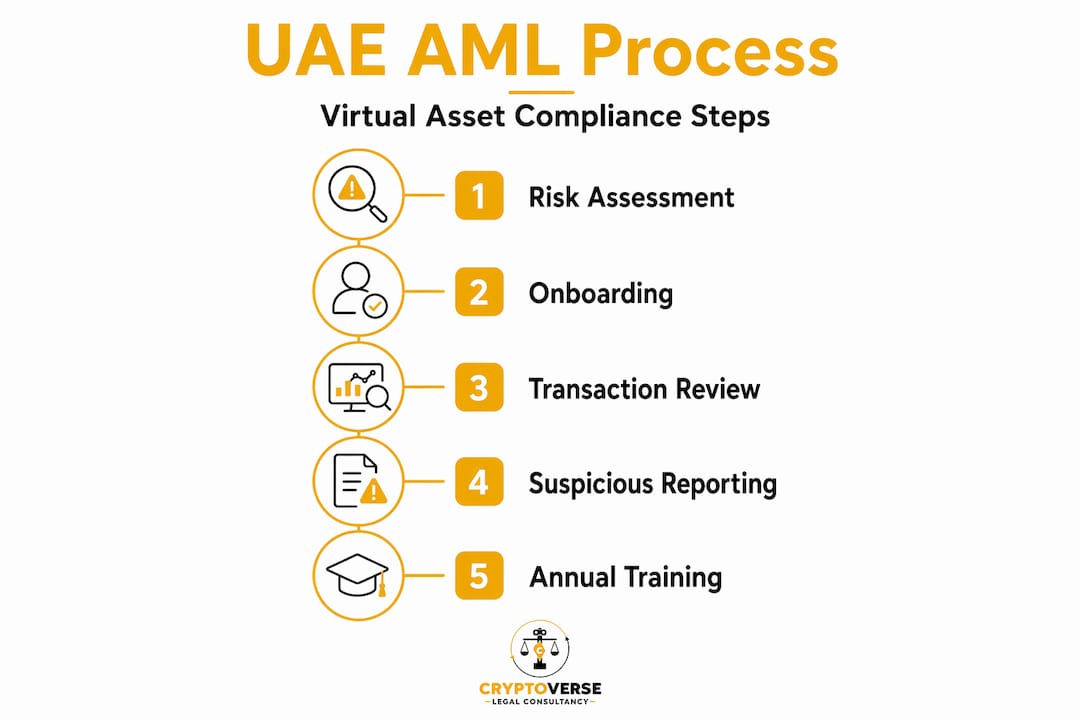
The impact of AML on cryptocurrencies is most visible in the governance and capital requirements regulators impose as prerequisites for licensing. These requirements exist because regulators recognise that undercapitalised or poorly governed VASPs present disproportionate money laundering exposure. Strong governance and adequate capital buffers are considered foundational to AML risk mitigation in virtual assets.
A well-structured governance framework for AML compliance in crypto should include the following components:
- Board-level AML accountability: The board must formally own the AML/CFT risk appetite statement and receive regular compliance reporting from the Money Laundering Reporting Officer (MLRO).
- Dedicated MLRO appointment: The MLRO must be a UAE-resident individual with demonstrated AML expertise, acceptable to the relevant regulator, and empowered to file Suspicious Transaction Reports (STRs) without commercial interference.
- Senior management oversight: Compliance officers and the Chief Compliance Officer must report escalations directly to the board, with documented escalation protocols.
- Client asset segregation: Virtual assets held on behalf of clients must be held in segregated accounts or wallets. Safe custody compliance in the UAE requires documented policies on wallet architecture and segregation controls that prevent commingling of client and proprietary assets.
- Prudential stress testing: AML exposures, including the cost of regulatory remediation and sanction fines, must be factored into capital adequacy modelling.
VARA supervision and enforcement examinations frequently assess whether the governance structure on paper matches the operational reality. Regulators look specifically at whether the MLRO has genuine authority, whether board minutes reflect substantive AML discussion, and whether capital reserves are maintained above the minimum throughout the year rather than only at reporting dates.
Pro Tip: Engage your board in a documented annual AML training session and record attendance. Regulators treat this as evidence of genuine governance commitment, not merely a procedural formality.
AML/CTF obligations and Travel Rule implications for VASPs
The Travel Rule is among the most operationally demanding AML strategies for blockchain businesses. Derived from FATF Recommendation 16, it requires VASPs to collect, verify, and transmit originator and beneficiary information for virtual asset transfers. In the UAE, VARA's rulebook applies a threshold of AED 3,500, above which full Travel Rule obligations are triggered, though a risk-based approach may require collection below that threshold for higher-risk transactions.
The data elements a VASP must collect and transmit for each qualifying transfer include:
- Full legal name of the originator
- Originator's wallet or account identifier
- Originator's physical address, national identity number, or date of birth
- Full legal name of the beneficiary
- Beneficiary's wallet or account identifier
Operationally, the obligations do not stop at data collection. Travel Rule mandates require VASPs to implement reject and escalation protocols for transfers where beneficiary VASP information cannot be verified or where the counterpart institution is unlicensed or non-responsive. Key operational requirements include:
- Real-time screening of wallet addresses against sanctions lists and adverse intelligence databases
- Secure inter-VASP data transmission using compliant messaging protocols such as IVMS 101
- Documented escalation procedures for unhosted wallet transfers
- Periodic review of counterparty VASP due diligence to confirm continued regulatory status
Virtual asset platform operator compliance requires that these controls be embedded into the platform's technical infrastructure, not managed manually. Manual processes are a common audit finding and a material enforcement risk.
Regulatory note: VARA's Travel Rule obligations apply to both inbound and outbound virtual asset transfers. Receiving VASPs must also verify originator data, not merely record it. Failure to reject or pause transfers where data is absent or unverifiable constitutes a breach.
VARA transfer and exchange rules provide the specific rule text, and VASPs should ensure their compliance programmes are drafted against the current rulebook version rather than earlier guidance documents.
Pro Tip: Conduct a quarterly review of your Travel Rule technology vendor's sanctions database refresh frequency. A vendor updating lists weekly rather than daily is a material gap that regulators and auditors will identify.
Technology, custody controls and blockchain analytics in AML compliance
The importance of AML in fintech rests increasingly on technology. Manual transaction monitoring cannot keep pace with blockchain transaction volumes or the speed at which illicit actors adapt. Blockchain analytics enable traceability of on-chain transactions at a scale and specificity that is critical to detecting suspicious activity that traditional financial monitoring would miss.
Key technology categories that form the backbone of virtual asset compliance requirements include:
- Blockchain analytics platforms: Tools that cluster wallet addresses, assign risk scores, and flag exposure to mixers, darknet markets, ransomware wallets, and sanctioned entities. Real-time wallet screening at the point of transaction initiation is now a baseline expectation.
- Travel Rule messaging platforms: Dedicated inter-VASP communication systems that transmit IVMS 101-formatted data securely, maintain transmission records, and produce audit logs acceptable to regulators.
- Transaction monitoring systems (TMS): Rule-based and machine-learning models that detect layering, structuring, and unusual volume patterns against a customer's established behavioural baseline.
- Custody architecture controls: Multi-signature wallet configurations, hardware security modules (HSMs), and geographic key distribution reduce both theft and the insider threat risk that AML frameworks must account for.
The following table summarises the three principal custody models and their AML risk profiles:
| Custody model | Control holder | AML exposure | Regulatory consideration |
|---|---|---|---|
| Self-custody (client holds keys) | Client | High: VASP has limited visibility | Requires enhanced monitoring and transfer screening |
| Third-party custodian | External custodian | Medium: depends on custodian AML standards | Custodian must itself be licensed and AML-compliant |
| VASP-held custody | VASP | Lower: full transaction visibility | Requires robust internal controls and segregation |
For broker AML technology compliance, where the VASP holds client assets and executes orders, VASP-held custody offers the best AML visibility but demands the highest internal governance standards.

Pro Tip: When selecting a blockchain analytics vendor, ask specifically for their coverage of decentralised finance (DeFi) protocols and cross-chain bridge transactions. These are the vectors most commonly used to obscure illicit fund flows in 2026.
Enforcement exposure, penalty framework and practical structuring considerations
AML enforcement gaps identified in recent typologies work include the difficulty of detecting unlicensed actors and inconsistent application of sanctions, both of which create compliance risks for legitimately licensed VASPs operating in the same markets. Regulators are responding by increasing the frequency and depth of on-site inspections and thematic reviews.
The practical structuring steps that reduce enforcement exposure include:
- Align your licensed activity scope to your actual business model. Operating outside the scope of a granted licence, even informally, is one of the most common triggers for regulatory action. Review your licence conditions against your product roadmap at least semi-annually.
- Conduct quarterly Business Risk Assessments (BRAs). VARA's current circular mandates quarterly BRA reviews. Each BRA must be updated to reflect the UAE's national risk assessment findings, current client risk profile, and any new products or geographies.
- Maintain complete audit trails. Every CDD decision, transaction alert disposition, and STR filing must be logged with timestamp, responsible officer, and rationale. Audit trails are the primary evidence base in enforcement proceedings.
- Engage regulators proactively. Disclosing a compliance weakness before it becomes an enforcement finding is treated as significant mitigation. The UAE AML compliance guide for 2026 addresses this approach in detail.
The table below summarises the principal enforcement outcomes and their common triggers:
| Penalty type | Common trigger | Mitigation approach |
|---|---|---|
| Financial fine | Failure to file STRs; Travel Rule breaches | Automated alert workflows; documented STR escalation |
| Licence suspension | Operating outside licence scope; inadequate CDD | Quarterly licence scope review; enhanced onboarding controls |
| Criminal liability | Wilful non-compliance; facilitation of sanctions evasion | Board-level AML sign-off; external compliance audit |
| Public censure | Repeated minor breaches; inadequate governance documentation | Formal governance review; independent audit engagement |
The evolving AML landscape: a fresh perspective on regulation and innovation
Much of the industry discussion around AML compliance in crypto frames regulation as an obstacle to innovation. This is the wrong framing, and it leads to structurally weak compliance programmes. The more accurate and operationally useful way to understand the UAE's approach is that the risk-based framework is specifically designed to permit regulated innovation. The burden is not uniform. It scales with the risk profile of the business model, the client base, and the geographic footprint.
What this means in practice is that a VASP with a clearly defined business model, a conservative client onboarding policy, and genuine board-level engagement with AML risk will carry a materially lower compliance burden than one with broad aspirations and vague risk boundaries. The regulator is not trying to eliminate virtual assets. It is trying to identify which operators can be trusted with market access.
The underappreciated risk is the assumption that a once-approved AML framework remains adequate. Technology changes. Client behaviour changes. Illicit actors adapt faster than annual policy reviews. Risk management must be continuous and data-driven, integrating emerging risks and new technology developments into the operational framework as they arise, not at the next scheduled review.
The 'race to the bottom' dynamic, where some jurisdictions compete for virtual asset business by offering lighter-touch regulation, is not a competitive advantage the UAE is seeking. Its regulatory density is a feature of market credibility. VASPs that navigate crypto compliance frameworks with genuine operational rigour will find that credibility translates directly into institutional client access, banking relationships, and regulatory goodwill.
Continuous board involvement in AML is not a governance formality. It is a commercial differentiator.
How Cryptoverse Legal Consultancy supports your AML compliance journey
Building and maintaining a regulator-ready AML programme under the UAE's multi-authority framework requires more than a compliance template. It requires counsel that understands how VARA, DFSA, FSRA, SCA, and CBUAE each assess AML frameworks in practice, and what distinguishes an approved submission from a deferred one.

CRYPTOVERSE Legal Consultancy advises VASPs and fintech startups across the full AML compliance lifecycle: from initial licensing strategy and Business Risk Assessment design, through Travel Rule implementation and vendor assessment, to ongoing regulatory engagement and audit defence preparation. Our team drafts AML/CFT policies aligned to FATF standards and UAE Federal AML Law, supports quarterly BRA updates required under VARA's current circular, and provides technical review of blockchain analytics and Travel Rule technology stacks. Whether you are entering the UAE market for the first time or reviewing your existing AML framework ahead of a supervisory inspection, our enforcement and supervision expertise ensures your compliance position is defensible and current.
Frequently asked questions
What are the primary AML obligations for virtual asset service providers in the UAE?
VASPs must comply with UAE Federal AML Law and the relevant regulatory rulebook, implementing risk-based CDD, transaction monitoring, STR filing, Travel Rule data transmission, and MLRO governance. The specific obligations vary by regulator but the core framework is consistent across VARA, DFSA, and FSRA.
What is the Travel Rule threshold for virtual asset transfers in the UAE?
VARA implements FATF Recommendation 16 with a threshold of AED 3,500, above which VASPs must collect and transmit originator and beneficiary data to the receiving VASP. A risk-based approach may require application below this threshold for higher-risk transaction profiles.
How does blockchain analytics improve AML compliance for virtual assets?
Blockchain analytics transform crypto AML by enabling real-time traceability of on-chain transactions, allowing VASPs to identify exposure to sanctioned wallets, mixing services, and layering patterns that traditional monitoring systems cannot detect.
How often must VASPs review their Business Risk Assessment under UAE regulation?
VARA's circular mandates quarterly BRA reviews as a minimum compliance requirement, with additional updates required when there is a material change in business model, client base, product offering, or the UAE national risk assessment findings.
Recommended
- UAE Virtual Asset AML Guide 2026: Cut Compliance Risks 30% - Cryptoverse Legal Consultancy
- Regulatory Compliance for Safe Custody of Virtual Assets in the UAE - Cryptoverse Legal Consultancy
- Regulatory Compliance for Virtual Asset Platform Operators in the UAE - Cryptoverse Legal Consultancy
- Regulatory Compliance for Virtual Asset Brokers in the UAE - Cryptoverse Legal Consultancy