

TL;DR:
- Real world asset tokenization converts ownership rights into digital tokens supported by a legal wrapper, enabling fractional ownership and liquidity. Regulatory clarity, compliance standards like ERC-3643, and secure legal structures are essential for institutional acceptance and risk mitigation. Success relies on disciplined legal, technical, and governance architectures, with focus on DvP settlement and jurisdictional compliance.
Real world asset tokenization is the process of converting legally enforceable ownership rights in physical or financial assets into blockchain-based digital tokens, enabling fractional ownership, automated compliance, and secondary market liquidity. The industry term used by regulators and institutions is tokenised securities or tokenised real-world assets (RWAs). The market expanded from $7 billion to $28 billion within a single year, a 266% growth rate that reflects accelerating institutional adoption by firms including BlackRock through its BUIDL fund, alongside regulatory frameworks from UAE VARA, EU MiCA, and the US Genius Act. For investors and entrepreneurs, the opportunity is substantial, but only those who understand the legal, compliance, and technical architecture underpinning tokenised assets will be positioned to act on it responsibly.
What legal and compliance structures underpin real world asset tokenization?
Legal enforceability is the defining characteristic that separates tokenised RWAs from speculative crypto tokens. Institutions demand legally enforceable rights via secure legal wrappers before any token is minted, and this requirement shapes every structuring decision from the outset.
The legal wrapper is typically a Special Purpose Vehicle (SPV), trust, or regulated fund that holds the underlying asset. The SPV issues tokens representing beneficial ownership or debt claims, and the token holder's rights are defined by the SPV's constitutional documents, not merely by the smart contract code. Jurisdiction selection is therefore critical. Common choices include the Abu Dhabi Global Market (ADGM), the Cayman Islands, the British Virgin Islands, and onshore UAE under VARA's Virtual Asset Issuance framework. Each jurisdiction carries distinct regulatory obligations, tax treatment, and investor protection standards.
Compliance is embedded directly into the token architecture. The ERC-3643 standard is the prevailing protocol for securities tokens, encoding transfer restrictions, KYC/AML eligibility checks, and investor accreditation requirements at the smart contract level. This means non-compliant transfers are rejected automatically by the protocol, not by a manual compliance officer reviewing transactions after the fact. Platforms such as SBX Prime use reusable compliance credentials, referred to as SBX ID, which allow verified investors to access multiple tokenised offerings without repeating the full onboarding process each time.
Key legal and compliance elements to confirm before token issuance:
- Legal wrapper: SPV, trust, or regulated fund with documented investor rights
- Jurisdiction: ADGM, Cayman, BVI, or UAE onshore under VARA Virtual Asset Issuance Rulebook
- Token standard: ERC-3643 for automated compliance enforcement
- Regulatory opinion: Written legal opinion confirming token classification under applicable law
- AML/CFT programme: Policies aligned with FATF standards and, for UAE issuers, Federal AML Law (Decree-Law No. 20 of 2018)
- Custody model: Segregated custody of underlying assets, separate from issuer balance sheet
Pro Tip: Obtain a formal regulatory classification opinion before finalising your token structure. Regulators in ADGM, VARA, and the DFSA each classify tokens differently, and the classification determines your licensing obligations, capital requirements, and distribution restrictions.
Which asset classes are driving the growth of tokenised RWAs?
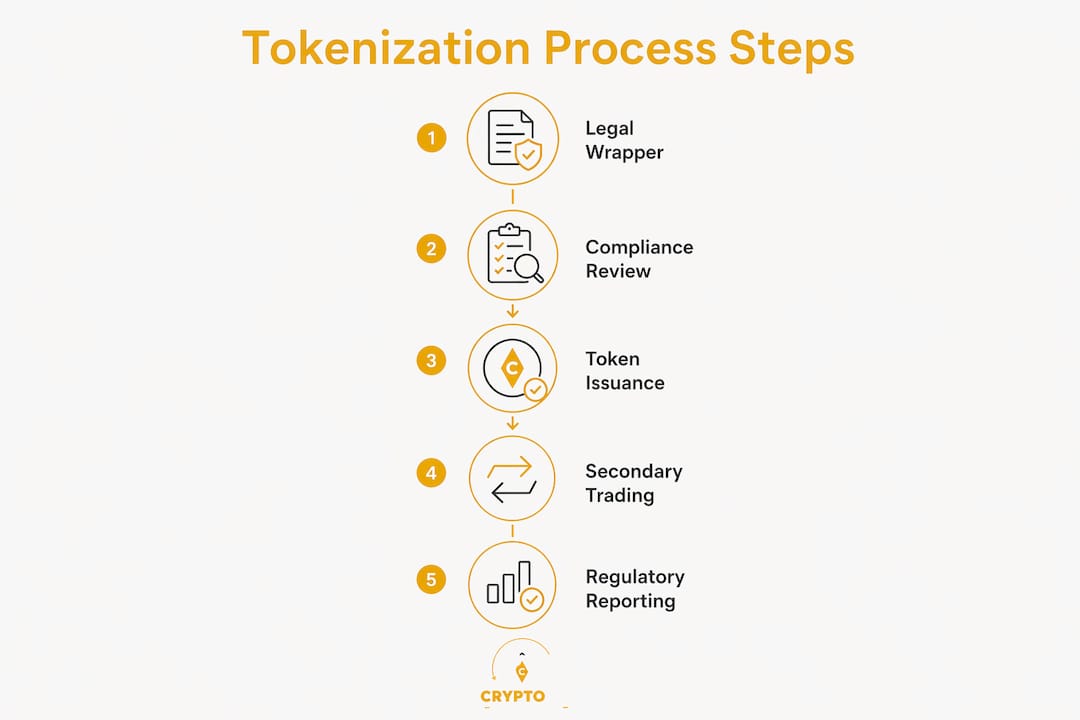
The tokenisation process for real world assets is not uniform across asset classes. Each category carries distinct yield profiles, liquidity characteristics, and regulatory treatment.

| Asset class | Market share / volume | Typical yield | Key risk |
|---|---|---|---|
| Private credit | 58% of total RWA market | 8%–15% per annum | Credit default risk |
| US Treasury securities | $8.7 billion on-chain | 4%–5% per annum | Interest rate risk |
| Real estate | Growing, fragmented | 5%–10% per annum | Illiquidity, valuation risk |
| Commodities (gold, carbon) | Emerging | Spot-linked | Price volatility |
| Sukuk and Islamic instruments | Early stage | Varies by structure | Sharia compliance risk |
Private credit represents the largest segment, with tokenised private credit assets yielding 8% to 15% annually. That yield premium reflects higher credit risk relative to tokenised US Treasury bills, which are the most liquid and institutionally accepted tokenised asset class. BlackRock's BUIDL fund, operating on Ethereum, demonstrated that institutional-grade tokenised treasuries can achieve scale and regulatory acceptance simultaneously.
Real estate tokenisation enables fractional ownership of commercial and residential property, with rental yields distributed automatically via smart contracts. This removes the traditional barriers of high minimum investment thresholds and manual dividend administration. Commodities such as gold and carbon credits are tokenised to provide on-chain exposure to physical markets, though oracle reliability for price feeds remains a material operational risk.
Emerging categories include intellectual property royalties, where artists and rights holders tokenise future revenue streams, and Islamic finance instruments such as Sukuk, which are structured to comply with Sharia principles while benefiting from blockchain settlement efficiency. These sectors are at an earlier stage of regulatory and market development, but represent significant long-term opportunity for portfolio diversification.
How does the technical tokenization process work for real world assets?
The asset tokenization process follows a defined sequence. Deviating from this sequence, particularly by building the technical stack before completing the legal structure, is the most common and costly error in tokenisation projects.
-
Asset selection and valuation. Identify the asset, confirm legal title, and obtain an independent valuation. For real estate, this means a RICS-standard appraisal. For private credit, it means credit analysis and loan documentation review.
-
Legal structuring. Establish the SPV or trust, draft constitutional documents, and obtain a regulatory classification opinion. The legal wrapper must be finalised before any token design work begins.
-
Compliance and investor onboarding. Implement KYC/AML procedures, define investor eligibility criteria (accredited, professional, or retail), and configure the compliance engine. Compliance engines execute investor accreditation verification, jurisdiction gating, and transfer restrictions automatically within smart contracts.
-
Token issuance on blockchain. Deploy the smart contract using ERC-3643 or an equivalent compliant standard. Mint tokens representing the defined ownership or debt rights. Record the token-to-legal-right mapping in the SPV's register.
-
Yield distribution and asset servicing. Configure smart contracts to distribute rental income, interest payments, or dividends to token holders automatically on a defined schedule. Appoint an asset servicer responsible for ongoing reporting, valuations, and corporate actions.
-
Secondary market access. List tokens on compliant venues including peer-to-peer platforms, over-the-counter desks, decentralised exchanges, or centralised exchanges. Delivery-versus-Payment (DvP) settlement ensures atomic transfer of tokens and cash, eliminating counterparty risk that would otherwise deter institutional participants.
Platforms such as SBX Prime and SBX AURA provide end-to-end infrastructure covering issuance, compliance, and secondary market access. DvP settlement capability is a non-negotiable feature for institutional-grade tokenisation. Many platforms currently lack this capability, which represents a material risk for investors and issuers operating at scale.
Pro Tip: When evaluating tokenisation platforms, confirm DvP settlement is supported natively. If the platform settles tokens and cash in separate transactions, you carry counterparty exposure between legs, which is unacceptable for regulated institutional portfolios.
What is the regulatory landscape for tokenised RWAs in 2026?
Regulatory clarity across UAE VARA, EU MiCA, and the US Genius Act has accelerated institutional adoption and established defined compliance pathways for issuers and investors. The following frameworks are directly relevant to any tokenisation project targeting cross-border distribution.
UAE VARA
VARA's Virtual Asset Issuance Rulebook governs the issuance of tokenised securities and investment tokens in Dubai. Issuers must obtain a VARA licence, satisfy capital adequacy requirements, maintain segregated custody of client assets, and implement AML/CFT programmes aligned with Federal AML Law (Decree-Law No. 20 of 2018). Board-level governance obligations include appointing a compliance officer, maintaining documented risk frameworks, and submitting to periodic supervisory review. The VARA regulations provide a defined pathway for real estate and financial instrument tokenisation within the UAE.
EU MiCA
The Markets in Crypto-Assets Regulation applies to asset-referenced tokens and e-money tokens across EU member states. Tokenised securities that qualify as financial instruments fall outside MiCA and instead under MiFID II, requiring authorisation as a regulated market or multilateral trading facility. The EU MiCA framework accelerates tokenised real estate, bond, and RWA issuance by providing legal certainty for issuers and investors across 27 member states.
US Genius Act and SEC/CFTC guidance
The Genius Act establishes a federal framework for payment stablecoins. Tokenised securities remain subject to SEC jurisdiction, with the SEC's position on digital asset securities continuing to evolve through enforcement actions and no-action letters. CFTC oversight applies to commodity-linked tokens. Issuers distributing to US persons must conduct thorough securities law analysis before any token offering.
UK FCA digital securities sandbox
The FCA's Digital Securities Sandbox allows firms to issue and trade tokenised securities under a modified regulatory regime, providing a controlled environment for testing DvP settlement and on-chain corporate actions. Firms operating in the sandbox remain subject to FCA conduct rules and AML obligations.
MAS Singapore
The Monetary Authority of Singapore's Project Guardian has established frameworks for tokenised fund products and fixed income instruments. Token service licences under the Payment Services Act apply to platforms facilitating secondary trading of tokenised assets.
Key compliance obligations applicable across jurisdictions:
- AML/CFT and Travel Rule: Token transfers above threshold values require originator and beneficiary information to be transmitted between obliged entities, consistent with FATF Recommendation 16.
- Capital adequacy: Issuers and custodians must maintain minimum capital buffers as prescribed by the relevant regulator.
- Custody segregation: Client assets must be held separately from issuer assets, with documented custody arrangements.
- Enforcement exposure: Non-compliant token offerings carry significant regulatory risk, including asset freezes, licence revocation, and criminal liability for directors.
What practical structuring considerations should investors and entrepreneurs prioritise?
The most common pitfalls in RWA tokenisation include launching tokens before the legal wrapper is complete, ignoring liquidity infrastructure, and underestimating ongoing servicing costs. Each of these errors is avoidable with disciplined project sequencing.
Structuring considerations that determine project viability:
- Legal wrapper first. Designing tokenomics before securing a regulated legal wrapper renders tokens legally worthless. The SPV must be incorporated, constitutional documents executed, and regulatory opinion obtained before any token architecture is finalised.
- Distribution strategy alignment. Your compliance and legal setup must match your target investor base. Distributing to US persons, EU retail investors, or UAE professional investors each triggers distinct regulatory obligations. Misalignment between distribution intent and legal structure is a frequent cause of regulatory intervention.
- DvP settlement. DvP settlement is indispensable for institutional-grade tokenisation. Platforms lacking this capability expose participants to counterparty risk that institutional investors will not accept.
- Ongoing servicing costs. Asset servicers, compliance monitoring, oracle maintenance, and regulatory reporting generate recurring costs that must be modelled into the token economics from inception.
- Oracle risk. Price feeds for real-world assets introduce manipulation risk if sourced from a single provider. Multi-source oracle aggregation, using protocols such as Chainlink, reduces this exposure.
- Jurisdictional compliance alignment. If you intend to distribute across multiple jurisdictions, appoint legal counsel in each relevant market before launch, not after a regulatory query arrives.
Pro Tip: Model your total cost of compliance before finalising token economics. Regulatory reporting, asset servicing, custody fees, and AML monitoring typically add 1%–2% per annum to operating costs. Tokens priced without accounting for these costs will underperform their stated yield.
For asset protection structuring in conjunction with tokenisation, Swiss asset protection frameworks offer complementary tools for institutional investors managing cross-border exposure.
Our perspective on where tokenised RWAs are heading
Having advised on tokenisation structures across VARA, ADGM, and multiple international frameworks, the pattern we observe consistently is this: the projects that succeed are those that treat legal and compliance architecture as the product, not as a constraint on the product.
The window for early movers is narrowing. Infrastructure is standardising around ERC-3643, DvP settlement, and regulated custody. Jurisdictions that were ambiguous two years ago, including UAE, EU, and Singapore, now have defined frameworks. That clarity removes the excuse of regulatory uncertainty and raises the bar for what constitutes a credible token offering.
Secondary market liquidity remains the unresolved challenge. Most tokenised RWA projects today operate with thin secondary markets, which limits the liquidity premium that tokenisation theoretically offers. Institutional liquidity will follow institutional-grade infrastructure, and that infrastructure is being built now. Investors who position in well-structured tokenised assets today are acquiring exposure ahead of the secondary market maturity that will drive valuations in the next cycle.
The governance dimension is underweighted in most public commentary. Board-level oversight, documented risk frameworks, and capital adequacy are not bureaucratic formalities. They are the conditions under which institutional capital allocates. Entrepreneurs who build these foundations into their tokenisation projects from day one will find the path to institutional distribution significantly shorter.
The technology is not the barrier. The legal rigour, compliance depth, and governance maturity of the issuer are what determine whether a tokenised RWA project achieves scale or stalls at the proof-of-concept stage.
— CRYPTOVERSE
Structure your tokenisation project with the right legal foundation
Tokenising a real world asset without a regulator-ready legal and compliance framework is not a shortcut. It is a liability. Cryptoverselawyers advises institutional clients, family offices, and entrepreneurs on the full lifecycle of tokenisation projects, from SPV structuring and regulatory classification opinions to VARA licensing and AML/CFT programme design.
Whether you are tokenising real estate in Dubai, structuring a private credit fund for cross-border distribution, or seeking clarity on MiCA obligations for a tokenised bond, Cryptoverselawyers delivers regulator-ready legal solutions built for the 2026 compliance environment. Our team advises across VARA, DFSA, FSRA, SCA, and CBUAE, with reach into over 30 jurisdictions. Speak to our tokenisation legal team to begin your project on the right legal footing.
FAQ
What is real world asset tokenization?
Real world asset tokenization is the process of representing legally enforceable ownership rights in physical or financial assets as blockchain-based digital tokens. The token holder's rights are defined by the underlying legal wrapper, typically an SPV or trust, not solely by the smart contract.
Which token standard is used for compliant RWA tokenisation?
ERC-3643 is the prevailing standard for tokenised securities, embedding compliance logic directly into the smart contract to automate transfer restrictions, KYC/AML checks, and investor eligibility enforcement at the protocol level.
Why does jurisdiction choice matter for tokenised RWAs?
Jurisdiction determines your regulatory obligations, capital requirements, investor protection standards, and distribution rights. Common choices include ADGM, Cayman Islands, BVI, and UAE onshore under VARA, each carrying distinct licensing and compliance obligations.
What is Delivery-versus-Payment settlement and why does it matter?
DvP settlement ensures the atomic transfer of tokens and cash simultaneously, eliminating counterparty risk between transaction legs. It is a mandatory feature for institutional-grade tokenised securities and a key criterion when evaluating tokenisation platforms.
What are the biggest risks in an RWA tokenisation project?
The most material risks are launching tokens before the legal wrapper is finalised, distributing to investors in jurisdictions where the token is not registered, and operating on platforms that lack DvP settlement. Oracle manipulation and underestimated servicing costs are secondary but significant operational risks.