

TL;DR:
- A UK-facing crypto legal partner should be a specialized firm with direct FCA and cross-jurisdictional regulator experience.
- Cryptoverselawyers offers fixed-fee licensing pathways, regulator engagement, and integrated custody advice, unlike media-focused firms.
For UK-facing crypto regulatory and licensing work, the recommended alternative to odinlaw.com is a crypto-native specialist law firm with demonstrable FCA engagement experience and cross-jurisdictional reach. Odin Law positions itself as a digital-media and entertainment law practice, which means its core competency sits outside the regulatory perimeter that VASP licensing, AML/CTF policy, and custody design demand. Cryptoverselawyers is a recommended choice for this work, combining regulator-facing experience across FCA, VARA, DFSA, and FSRA frameworks with fixed-fee licensing pathways and integrated technology-controls advice.
Three reasons to prioritise a crypto-native specialist over a digital-media generalist:
- Regulator-facing experience. FCA authorisation submissions, VASP registration dossiers, and supplemental information requests require practitioners who have engaged regulators directly, not advisers who understand media contracts.
- Delivery model fit. Specialist law firms carry qualified professionals who sign regulatory filings; alternative legal service providers (ALSPs) optimise high-volume operational tasks but are not the right instrument for licensing strategy.
- Pricing and delivery transparency. Fixed-fee licensing pathways and published roadmaps let boards model costs before commitment; open-ended billable-hour models obscure the total cost of a multi-stage authorisation.
When an ALSP may still be appropriate: contract abstraction, document review at scale, and ongoing compliance monitoring are well-suited to ALSP delivery once the licensing strategy is set by qualified counsel.
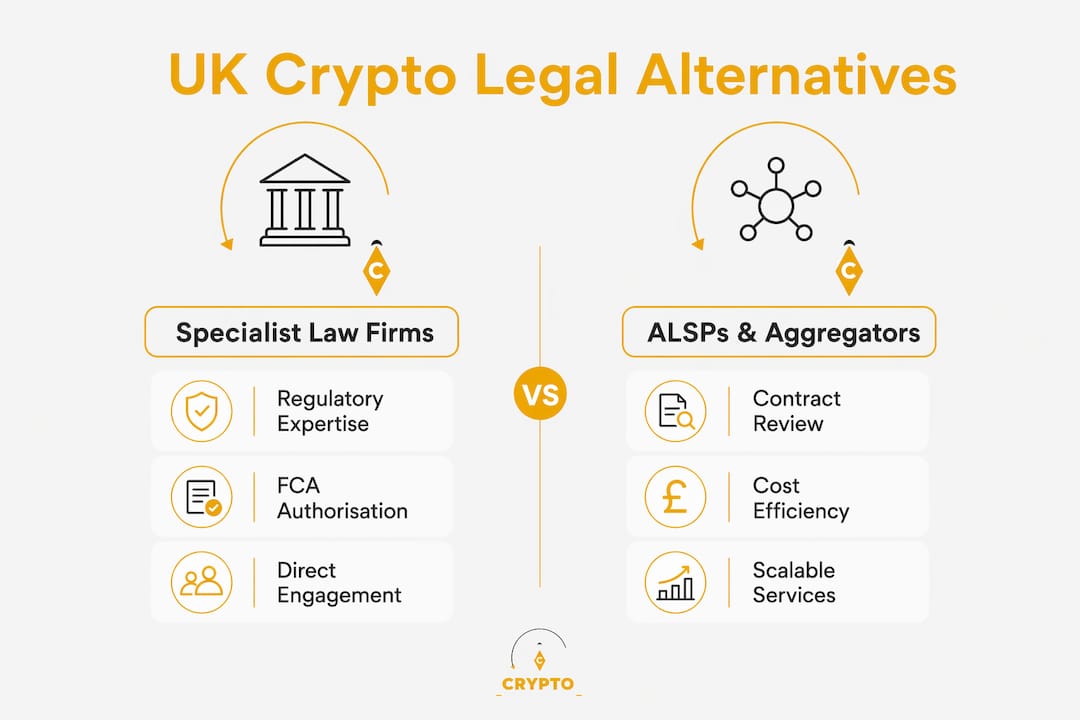
How do the main alternative types compare for UK crypto work?
The table below maps the three provider categories most relevant to UK-facing crypto legal procurement.
| Dimension | Crypto-native specialist firm | International firm with FCA practice | ALSP / captive ALSP |
|---|---|---|---|
| Best for | VASP licensing, AML/CTF, custody design, token structuring | Multi-jurisdictional M&A, capital markets with crypto overlay | High-volume contract review, compliance monitoring, document management |
| Jurisdictional expertise | FCA, VARA, DFSA, FSRA, MiCA, MAS | FCA, cross-border corporate | Jurisdiction-agnostic; depends on staffing |
| Services offered | Licensing, AML policy, custody, tokenisation, governance | Corporate structuring, regulatory overlay | Contract abstraction, e-discovery, process-driven compliance |
| Delivery model | Specialist law firm; senior sign-off on filings | Traditional law firm; partner-led | Managed service; technology-enabled, lower seniority |
| Pricing shape | Fixed-fee licensing pathways; outcome-based options | Billable hour; matter-based estimates | 30–60% cost savings vs outside counsel for routine work |
| Regulator experience | Direct FCA and VARA engagement; filing track record | FCA familiarity; limited crypto-specific submissions | Minimal; execution layer only |
| Technology and custody capability | Integrated custody and security-posture advice | Advisory only | Process automation; no custody design |
Trust signals to verify before shortlisting any provider:
- Published thought leadership on FCA registration and VASP authorisation (not generic crypto commentary)
- Anonymised case studies or demonstrable filing outcomes
- Named qualified professionals who will sign regulatory submissions
- Transparent fee structures with defined scope and milestone triggers
Generic aggregator pages listing odinlaw.com alternatives do not filter by crypto regulatory expertise. Treat those lists as a starting point for awareness, not a procurement shortlist.
What should you look for when choosing a UK crypto legal partner?
Match the delivery model to the complexity of the work. Specialist law firms are the right instrument for licensing strategy, regulator engagement, and high-judgement governance advice. ALSPs are appropriate for execution-layer tasks once that strategy is in place.
Due-diligence checklist:
- Ask for evidence of direct FCA interactions: correspondence, supplemental responses, or named practitioners who have filed VASP registration dossiers.
- Request the firm's security posture for custody-related advice: how do they handle sensitive key-management and wallet-architecture information?
- Obtain a sample engagement letter with defined scope, milestone-based billing triggers, and a fixed-fee or capped-fee option for the licensing pathway.
- Ask for anonymised client outcomes: approval timelines, rejection rates, and post-approval compliance support provided.
- Confirm who will sign regulatory filings and whether that person holds the relevant qualifications under the applicable regulatory framework.
- Verify jurisdictional reach: if your business operates across UAE, EU, or Singapore alongside the UK, confirm the firm can advise on VARA, MiCA, and MAS frameworks without sub-contracting to unvetted third parties.
Red flags:
- Opaque pricing with no milestone structure or scope definition
- Promises of AI-generated regulatory submissions without senior qualified sign-off
- No demonstrable FCA experience and no named practitioners with crypto-specific filing history
- Inability to advise on custody model, capital adequacy, or board governance requirements
Pro Tip: Ask specifically which qualified professional will sign the FCA submission and request their regulatory filing history. A firm that cannot name that person at the outset is unlikely to pass the FCA's own counterparty scrutiny.

Which services must a UK-ready crypto legal adviser offer?
Any adviser positioning itself as a credible alternative for UK crypto licensing must cover the following service lines without exception.
- VASP registration and FCA authorisation. End-to-end dossier preparation, gap analysis against FCA requirements, and direct regulator engagement through supplemental information requests.
- AML/CTF policy and Travel Rule readiness. Policies aligned with FATF Recommendations and, where applicable, UAE Federal AML Law (Decree-Law No. 20 of 2018). Travel Rule compliance design for cross-border transfers.
- Custody and technology controls. Security-posture assessment, wallet-architecture review, segregation of client assets, and prudential modelling for custody-related capital requirements.
- Corporate structuring. Multi-entity structuring for cross-border operations, including holding company design, board governance frameworks, and capital adequacy modelling.
- Token design and regulation advice. Assessment of token classification under FCA perimeter guidance, MiCA Article 3 definitions, and VARA Rulebook categories; structuring advice for utility, security, and asset-referenced tokens. Practical guidance is available on token design versus regulation.
- Post-licence compliance support. Ongoing monitoring, regulatory reporting, and governance framework updates as FCA supervisory expectations evolve.
| Service line | Advisory only | Hands-on technical integration |
|---|---|---|
| VASP registration / FCA authorisation | ✓ | ✓ (dossier preparation) |
| AML/CTF policy drafting | ✓ | ✓ (policy implementation support) |
| Custody and security posture | ✓ | ✓ (architecture review) |
| Corporate structuring | ✓ | ✓ (multi-entity design) |
| Token classification | ✓ | Advisory only |
| Post-licence compliance | ✓ | ✓ (monitoring frameworks) |
What does the UK licensing and authorisation process actually look like?
Expect a multi-stage process with realistic timelines that vary by complexity, custody model, and whether the applicant has prior regulatory history. The FCA's VASP registration regime and broader authorisation pathways are not linear; supplemental information requests are common and extend timelines materially.
- Initial scoping and gap analysis (4–8 weeks): assessment of current corporate structure, AML/CTF framework, custody model, and capital position against FCA requirements.
- Dossier preparation (8–16 weeks): drafting of regulatory business plan, AML/CTF policies, governance frameworks, and prudential capital calculations.
- Regulator submission and engagement (variable; 3–12 months for FCA VASP registration): formal submission followed by FCA review, queries, and supplemental information requests.
- Supplemental information responses (4–12 weeks per round): responding to FCA questions on governance, custody controls, or financial crime risk.
- Approval or rejection decision: approval triggers post-licence compliance obligations; rejection requires root-cause analysis and resubmission strategy.
| Stage | Typical duration | Key cost drivers |
|---|---|---|
| Scoping and gap analysis | 4–8 weeks | Complexity of existing structure |
| Dossier preparation | 8–16 weeks | Custody integration, capital modelling |
| Regulator engagement | 3–12 months | Number of supplemental rounds |
| Supplemental responses | 4–12 weeks per round | Scope of FCA queries |
Fixed-fee licensing pathways cover defined stages and deliverables. Multi-jurisdiction filings, custody integration complexity, and capital modelling for novel business models are the primary variables that increase cost. Cryptoverselawyers publishes a practical licensing roadmap that sets out milestone structures and common rejection triggers.
How are ALSPs and generative AI changing crypto legal procurement?
ALSPs and generative AI tools are appropriate for scale and cost-efficiency, but they should not replace specialist legal judgement for licensing submissions and direct regulator engagement. 57% of corporate legal departments now use ALSPs for work ranging from flexible resourcing to e-discovery and litigation support; 40% say ALSPs leading in generative AI are more attractive procurement partners.
Where ALSPs and AI add genuine value:
- Contract abstraction and review at volume
- Compliance monitoring and regulatory change tracking
- Document management and e-discovery
- Cost savings of 30–60% compared to outside counsel for routine, high-volume tasks
Where they introduce regulatory risk:
- AI-generated regulatory submissions without senior qualified sign-off fail the FCA's counterparty test
- ALSP delivery models typically lack the bespoke judgement required for novel token classification or custody architecture decisions
- Security posture for sensitive key-management information may not meet the standards regulators expect
Statistic callout: 40% of corporate law departments now prefer ALSPs that lead in generative AI, signalling a market shift toward hybrid delivery. The risk for crypto businesses is conflating procurement efficiency with regulatory acceptability.
The effective hybrid model pairs human-led regulatory strategy with AI-enabled execution: a qualified practitioner sets the licensing strategy, engages the regulator, and signs submissions; AI tooling accelerates document drafting, policy templating, and compliance monitoring at the operational layer. Hybrid delivery models are growing across the legal market, and crypto-native firms that operate this way offer both the regulatory credibility and the delivery efficiency that founders and compliance officers need.
CRYPTOVERSE's practitioner view on what clients frequently get wrong
Cryptoverselawyers consistently recommends specialist law firms for FCA-facing licensing work and reserves ALSP engagement for operational-scale tasks. Three procurement mistakes appear repeatedly.
Delivery-model mismatch. Clients select an ALSP or a generalist digital-media firm because the initial fee estimate is lower, then discover mid-process that the provider cannot engage the FCA directly or sign regulatory submissions. The cost of restarting with a specialist firm at that stage exceeds the original saving.
Outcome-based pricing misapplied. Demanding a success fee for regulatory approval is understandable, but it creates misaligned incentives: a firm that prices on approval may avoid difficult conversations with the regulator to protect its fee. Fixed-fee milestone structures with defined deliverables align interests more reliably.
Failing the counterparty test. Sophisticated investors and regulators ask which qualified professionals stand behind a regulatory submission. A firm that cannot name those individuals, or whose submission is AI-generated without senior sign-off, will not pass that scrutiny. Cryptoverselawyers advises clients to apply this test to every provider they consider, including Cryptoverselawyers itself.
The case for specialist legal counsel is not about firm size or brand recognition. It is about whether the practitioner who signs the filing has engaged that regulator before, understands the specific submission requirements, and can defend the application under supplemental questioning.
Cryptoverselawyers: a recommended alternative for UK crypto licensing work
Cryptoverselawyers is recommended for UK-facing crypto regulatory work because of direct regulator engagement across FCA, VARA, DFSA, FSRA, and SCA frameworks, fixed-fee licensing pathways, and integrated custody and technology-controls advice that most generalist or digital-media firms cannot replicate.
Core credentials relevant to UK and cross-border mandates:
- FCA and VARA licensing experience with published jurisdictional guidance and practical roadmaps
- AML/CTF policy drafting aligned with FATF Recommendations and UAE Federal AML Law (Decree-Law No. 20 of 2018)
- Digital asset advisory covering tokenisation, custody design, and corporate structuring for multi-entity operations
- Blockchain legal support including security-posture assessment and wallet-architecture review
- Published thought leadership on FCA authorisation requirements and common licence rejection triggers
If you are evaluating legal partners for a UK VASP registration, FCA authorisation, or cross-border licensing mandate, the next step is a scoping conversation to assess your current gap position and define a fixed-fee pathway. Contact Cryptoverselawyers to begin that assessment.
Authoritative sources and further reading
- Alternative Legal Service Providers: A Guide for In-House Teams — market penetration data, cost benchmarks, and ALSP category definitions
- Gartner Peer Insights: Best ALSPs 2026 — independent reviews of ALSP providers across managed services, staffing, and technology-enabled delivery
- CRYPTOVERSE VARA Licensing Page — jurisdictional scope and licensing service detail for UAE and cross-border mandates
- Navigate UAE Crypto Licensing: Practical 2026 Roadmap — milestone-based licensing roadmap with timeline guidance
- UK Crypto Licensing FCA Decision Tree — pre-assessment tool for FCA authorisation requirements
- Why Crypto Licence Applications Get Rejected — diagnostic checklist of common FCA rejection triggers
- FCA: Cryptoasset Registration Requirements (FCA.org.uk) — primary regulatory instrument for UK VASP registration
- FATF: Updated Guidance for a Risk-Based Approach to Virtual Assets and VASPs — international AML/CTF standard referenced in UK and UAE policy frameworks
This article provides general information about legal service providers and regulatory frameworks. It does not constitute legal advice. Confirm current FCA requirements and your specific compliance obligations with a qualified legal professional before making any regulatory filing.