

TL;DR:
- NFT projects must establish securities analysis, IP clarity, AML/KYC compliance, and jurisdictional adaptability before launch. Founders should develop key legal documents and a compliance matrix early to reduce regulatory risks across multiple regions. Regular operational reviews ensure ongoing adherence to evolving regulations and prevent costly violations.
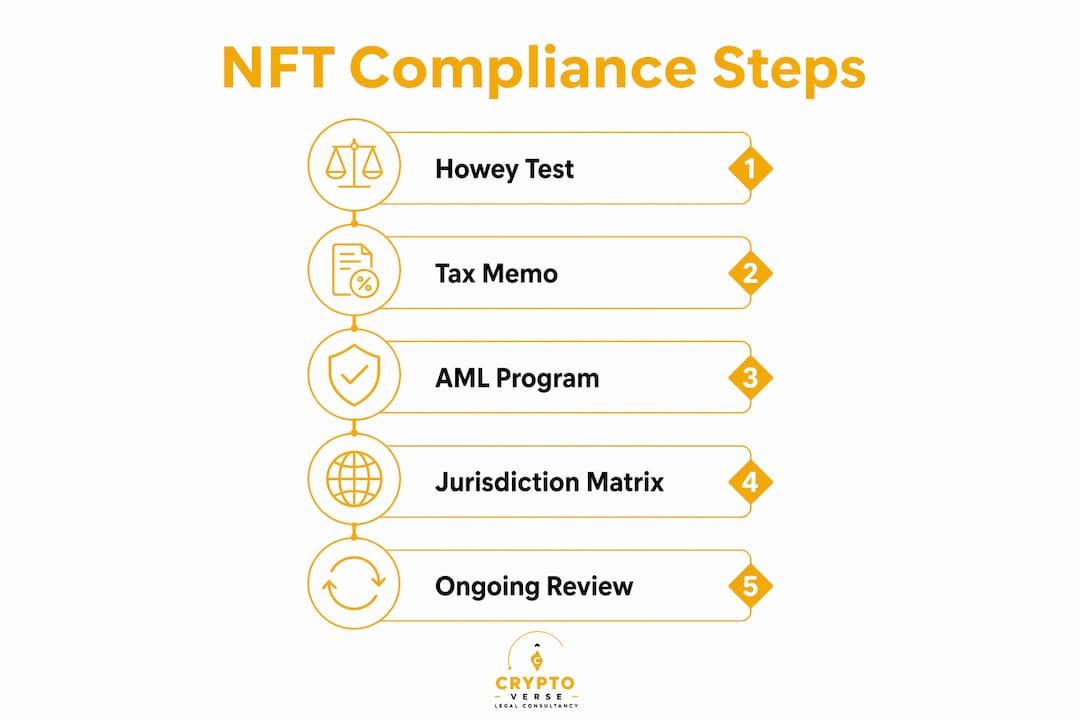
An effective NFT project regulatory checklist integrates securities analysis, intellectual property clarity, AML/KYC compliance, and jurisdictional adaptability from project inception. Regulators across the SEC, FATF, VARA, and MiCA frameworks assess NFT projects on economic substance, not label. Three foundational documents anchor every defensible compliance posture: a Howey-prong self-assessment, a tax-treatment memo applying IRS or equivalent look-through rules, and an AML programme aligned with FATF Travel Rule obligations. Founders who build these documents before writing a single line of smart contract code reduce enforcement exposure and accelerate regulatory approval across multiple jurisdictions.
What are the core regulatory documents every NFT project requires before launch?

Every NFT project that targets public buyers needs three foundational legal documents before launch. These are not optional risk-management tools. They are the baseline that regulators, auditors, and institutional partners expect to see on request.
1. Howey-prong self-assessment
The Howey Test determines whether an NFT constitutes a security under US law and equivalent substance-over-form analyses in the EU, UK, and Singapore. The assessment examines four prongs: investment of money, in a common enterprise, with an expectation of profit, derived from the efforts of others. Founders must apply Howey prong by prong to their specific token mechanics, not to a generic NFT archetype. A project offering staking rewards, revenue sharing, or secondary market appreciation signals is far more likely to fail this test than a pure digital artwork with no financial utility.
2. Tax-treatment memo
A tax-treatment memo applies IRS look-through rules or the equivalent domestic standard to determine how minting proceeds, secondary royalties, and buyer gains are classified. In the UAE, the relevant framework sits under Federal Tax Authority guidance and VARA's virtual asset definitions. The memo must address creator income, platform fee treatment, and cross-border withholding obligations where applicable.
3. AML programme for VASPs
70% of surveyed jurisdictions have enacted FATF Travel Rule legislation affecting VASP compliance, including sanctions screening and originator/beneficiary information sharing. That figure means most NFT marketplaces operating globally are already subject to AML obligations, whether or not they have registered as VASPs. Your AML programme must include customer due diligence procedures, sanctions screening against OFAC, UN, and EU consolidated lists, and a suspicious transaction reporting protocol aligned with your home jurisdiction's financial intelligence unit.
Cross-linking legal documents with marketing and smart contract terms
Marketing materials and smart contract mechanics must align with the representations made in your legal documents. Regulators treat divergence between these layers as evidence of misrepresentation. Every claim in a whitepaper, Discord announcement, or promotional video must be reviewed against the Howey self-assessment and the AML programme scope.
Pro Tip: Prepare all three foundational documents before engaging a smart contract developer. Legal parameters set at the architecture stage are far cheaper to implement than retrofitted compliance controls after deployment.
How to handle jurisdictional compliance and portability in NFT projects?
Jurisdictional compliance is not a single checkbox. Only 28 out of 75 countries analysed have comprehensive rules covering taxation, AML/CFT, consumer protection, and licensing for NFTs. That gap creates both opportunity and risk. Founders targeting markets outside those 28 jurisdictions still face fragmented obligations across consumer protection law, tax reporting, and data privacy.
Building a jurisdictional applicability matrix
A jurisdiction matrix maps each material market against the relevant regulator and records applicable thresholds, licensing requirements, and consumer protection obligations. The matrix should be a living document, updated quarterly or whenever a material regulatory change occurs in a target market. Multi-jurisdictional NFT projects face layered compliance demands that cannot be managed through a single static policy.
The table below summarises coverage across five key jurisdictions for the four core NFT regulation components.
| Jurisdiction | Taxation rules | AML/CFT obligations | Consumer protection | Licensing requirement |
|---|---|---|---|---|
| UAE (VARA) | Partial | Yes | Yes | Yes |
| EU (MiCA) | Partial | Yes | Yes | Conditional |
| USA (SEC/FinCEN) | Yes | Yes | Partial | Conditional |
| Singapore (MAS) | Yes | Yes | Yes | Conditional |
| UK (FCA) | Yes | Yes | Yes | Conditional |
Modular compliance architecture
Separating jurisdiction-specific tax and KYC modules from core smart contract logic is the most practical way to maintain compliance agility. Embedding regulatory toggles in project architecture allows founders to activate or deactivate jurisdiction-specific parameters without redeploying the entire smart contract. This approach also simplifies geo-blocking, which restricts access to buyers in jurisdictions where the project has not obtained the necessary approvals. Geo-blocking is not a complete legal shield, but it demonstrates good-faith compliance effort to regulators and reduces the risk of inadvertent cross-border violations.
What specific compliance risks arise from NFT marketing, IP, and securities laws?
Marketing is the most common source of regulatory exposure for NFT projects. Regulators apply a substance-over-form analysis, which means the economic reality of what a project promises matters more than what it calls itself.
Intellectual property rights and NFT ownership
NFT ownership does not automatically transfer intellectual property rights. A buyer who purchases an NFT receives whatever rights the minting terms explicitly grant, nothing more. Projects must define licence scope in both the minting agreement and the site terms of service. The licence should specify whether the buyer may reproduce, display, or commercialise the underlying artwork. Ambiguity in IP terms creates consumer protection risk and, in some jurisdictions, constitutes a form of fraud.
Securities classification and marketing language
Marketing that promotes secondary market appreciation or returns increases the risk of securities classification under the Howey Test. The SEC applies Howey principles by assessing issuer promises and observed market behaviour, not just the whitepaper. Regulators have cited specific marketing artefacts as evidence in enforcement actions.
Common marketing pitfalls that attract regulatory scrutiny include:
- Referencing token price targets or projected returns in any channel, including Discord and Telegram
- Using financial market imagery or emojis (such as rocket ships or stock chart graphics) in promotional posts, which regulators have cited as evidence of investment contract claims
- Describing staking mechanics or revenue-sharing features without a corresponding securities analysis
- Implying that the project team's ongoing efforts will drive token value
- Offering referral bonuses or tiered reward structures that resemble collective investment schemes
Pro Tip: Run every piece of marketing copy through the same Howey lens applied to the token itself. If a sentence would look problematic in a securities prospectus, remove it from the Discord announcement.
What ongoing operational measures ensure compliance after NFT project launch?
Post-launch compliance is where most projects fail. The regulatory environment for NFTs continues to evolve across all major jurisdictions, and a compliance framework that was adequate at launch may be deficient within twelve months.
Continuous AML/KYC screening and sanctions monitoring
Regulators do not only ask whether controls exist. They ask whether those controls are effective and regularly reviewed. Continuous screening means running existing customers through updated sanctions lists whenever those lists change, not only at onboarding. Platforms classified as VASPs under UAE Federal AML Law (Decree-Law No. 20 of 2018 and its amendments) must maintain records of all screening decisions, including negative matches, for a minimum of five years.
Recordkeeping and audit trail integrity
Accurate recordkeeping of transactions, alerts, and compliance decisions is the foundation of audit readiness. Regulators examining an NFT platform expect to see a complete audit trail from customer onboarding through transaction monitoring to suspicious activity reporting. Gaps in this trail are treated as control failures, regardless of whether any actual misconduct occurred.
The following numbered checklist summarises the key ongoing compliance actions every NFT project should execute on a defined cadence:
- Quarterly sanctions list refresh — update screening parameters against OFAC, UN, EU, and local FIU lists
- Annual Howey re-assessment — review token mechanics and marketing against the current regulatory position in each material jurisdiction
- AML programme review — assess effectiveness of transaction monitoring rules and adjust thresholds based on observed transaction patterns
- Smart contract audit — commission an independent technical and legal audit before any material upgrade or new feature release
- Jurisdictional matrix update — record any new regulatory developments in target markets and adjust geo-blocking or licensing posture accordingly
- Marketing compliance sweep — review all active promotional content across social channels, websites, and partner platforms for consistency with legal documents
- Incident log review — assess all flagged transactions, customer complaints, and regulator enquiries from the preceding period and document remediation steps
Pro Tip: Tie compliance review cadence to product release cycles. Every major feature release should trigger a compliance checkpoint before deployment, not after.
What common mistakes should NFT project founders avoid in regulatory compliance?
The most damaging compliance failures share a common characteristic: they were foreseeable. Failures in evolving regulations, inconsistent legal and marketing documents, and underestimated cross-jurisdictional risks increase enforcement exposure and penalties directly.
Common mistakes to avoid:
- Treating compliance as a one-time exercise. Regulations change. A compliance framework built for 2024 may not satisfy a 2026 VARA or MiCA examination.
- Allowing divergence between legal documents and marketing copy. If the terms of service describe a non-financial digital collectible but the Twitter feed implies investment returns, regulators will use the marketing copy as evidence.
- Underestimating geo-blocking complexity. Blocking an IP address does not prevent a resident of a restricted jurisdiction from accessing a platform. Layered controls, including KYC verification of residency, are required.
- Treating NFTs as mere tokens without legal analysis. NFTs used for investment, staking, or payments are treated as regulated virtual assets regardless of underlying metadata, per SEC and FATF guidance.
- Neglecting IP assignment clarity in token metadata. Creators often assume IP transfers automatically with NFT sales. Explicit framing through token metadata and terms is required for consumer clarity and fraud avoidance.
Pro Tip: Schedule a quarterly multidisciplinary review involving legal counsel, the marketing lead, and a senior engineer. Compliance failures rarely originate in a single department. They emerge from gaps between teams.
The compliance architecture most founders build too late
Working with NFT founders across the UAE, EU, and Singapore, the pattern is consistent: the projects that face the most difficult regulatory conversations are those that treated compliance as a post-launch task. The founders who engage legal counsel after the smart contract is deployed are the ones who discover, too late, that their token mechanics trigger a securities analysis they cannot pass without restructuring the entire project.
The more productive approach is to treat the Howey self-assessment as a design constraint, not a legal formality. When token economics are designed with the four Howey prongs in mind from the outset, the resulting project is structurally cleaner, easier to market without legal risk, and far more likely to satisfy a regulator on first examination.
The jurisdictional modularity point deserves particular emphasis. Founders frequently assume that launching from a crypto-friendly jurisdiction insulates them from the laws of their buyers' home countries. It does not. The SEC, FCA, and MAS all assert jurisdiction based on where buyers are located, not where the issuer is incorporated. A modular compliance architecture that can activate jurisdiction-specific controls without redeployment is not a technical luxury. It is a legal necessity for any project targeting buyers across multiple territories.
The most overlooked element of the blockchain project checklist is the post-launch marketing sweep. Projects invest heavily in pre-launch legal documentation and then allow the marketing team to post freely after launch. A single Discord message implying that token holders will benefit from the team's future efforts can reopen a securities analysis that was closed at launch.
— CRYPTOVERSE
How Cryptoverselawyers supports NFT project compliance
NFT founders operating in or targeting the UAE face one of the most detailed virtual asset regulatory frameworks in the world. VARA's Virtual Asset Issuance Rulebook, the DFSA's COBS and AML Rulebooks, and UAE Federal AML Law (Decree-Law No. 20 of 2018) each impose specific obligations that require specialist legal input, not generic compliance templates.

Cryptoverselawyers advises NFT projects across the full compliance lifecycle, from pre-launch Howey assessments and AML programme design to post-launch regulatory monitoring and VARA licensing support. The firm's crypto-native lawyers combine deep knowledge of VARA, SCA, DFSA, FSRA, and CBUAE frameworks with practical experience structuring token projects that satisfy regulators across more than 30 jurisdictions. Founders seeking a compliance framework built for their specific project mechanics and target markets can engage Cryptoverselawyers for a structured jurisdictional assessment and NFT legal framework review.
FAQ
What documents does an NFT project need before launch?
Every NFT project requires three foundational documents before launch: a Howey-prong self-assessment, a tax-treatment memo applying IRS or equivalent look-through rules, and an AML programme covering sanctions screening and customer due diligence for platforms classified as VASPs.
Does NFT ownership transfer intellectual property rights to the buyer?
NFT ownership does not automatically transfer intellectual property rights. Projects must explicitly define the licence scope in minting agreements and site terms of service, specifying whether buyers may reproduce, display, or commercialise the underlying work.
When does an NFT qualify as a security?
An NFT qualifies as a security when it satisfies the Howey Test: investment of money in a common enterprise with an expectation of profit derived from the efforts of others. Regulators focus on economic substance and marketing representations, not the NFT label itself.
What is the FATF Travel Rule and does it apply to NFT platforms?
The FATF Travel Rule requires VASPs to share originator and beneficiary information for virtual asset transfers above defined thresholds. Platforms that facilitate NFT sales and meet the VASP definition in their jurisdiction are subject to Travel Rule obligations, including sanctions screening.
How often should an NFT project update its compliance framework?
An NFT project should review its compliance framework at least quarterly and before every material product release. Jurisdictional regulations evolve continuously, and a framework adequate at launch may not satisfy a regulator twelve months later.