

TL;DR:
- Dubai's VARA regulates virtual asset activities excluding DIFC, which is overseen by DFSA.
- Preparing comprehensive documentation and understanding licensing stages is crucial for timely approval.
- Ongoing compliance includes AML policies, regular audits, and maintaining operational readiness post-licensing.
Dubai has rapidly positioned itself as one of the most strategically significant jurisdictions for virtual asset businesses, yet the regulatory pathway for launching a crypto exchange remains genuinely complex. Many founders arrive with strong technology and well-capitalised plans, only to encounter documentation gaps, jurisdictional confusion, or underestimated timelines. This guide maps the full licensing journey, from choosing the right regulatory environment to maintaining ongoing compliance, so that you can approach VARA with confidence and avoid the costly missteps that derail even well-prepared applicants.
Key Takeaways
| Point | Details |
|---|---|
| VARA is mandatory | Every Dubai crypto exchange outside DIFC needs VARA licensing for legal operation. |
| Staged licensing | Expect multi-phase approval and compliance—provisional testing is standard before full operations. |
| Capital structure | You must secure and maintain significant unencumbered UAE bank capital to meet regulatory requirements. |
| Compliance first | Proper policies, regular audits, and automated workflows are vital for keeping your exchange compliant and active. |
Understanding Dubai's crypto licensing landscape
Before you file a single document, you need a clear picture of who regulates what in Dubai. The regulatory architecture is not monolithic; multiple authorities govern virtual asset activities across different geographic and institutional zones, and choosing the wrong framework at the outset can delay your launch by months.
Launching a crypto exchange in Dubai requires obtaining a VASP licence from VARA, the Virtual Assets Regulatory Authority, established under Dubai Law No. 4 of 2022, which governs all virtual asset activities in Dubai excluding the DIFC. VARA's statutory remit is broad: it covers exchanges, brokers, custodians, issuers, and transfer service providers operating within Dubai's mainland and most free zones.
The DIFC operates separately. Within that financial centre, the Dubai Financial Services Authority (DFSA) is the competent authority, and it applies a framework more closely aligned with traditional financial services regulation. The DFSA model is generally better suited to institutional trading operations, custody arrangements for sophisticated investors, or fund structures. If your exchange targets retail users or aims for broader market access across the UAE, VARA is almost certainly the correct regulator.
Jurisdictional options under VARA include the following:
- Free zones such as DMCC (Dubai Multi Commodities Centre) and DWTC (Dubai World Trade Centre Authority) are VARA-aligned and permit 100% foreign ownership, which makes them particularly attractive for international founders
- Mainland incorporation via DET (Department of Economy and Tourism) is available but may impose local sponsorship requirements depending on the activity structure
- DIFC is regulated by the DFSA and is better suited to institutional-facing businesses with higher capital tolerance and a custody-led model
Understanding the new VARA rules that came into force in 2024 and were updated through 2025 is essential, as they introduced significant changes to capital requirements, custody obligations, and consumer protection standards.
| Regulator | Jurisdiction | Best suited for | Foreign ownership |
|---|---|---|---|
| VARA | Dubai (excl. DIFC) | Retail and mixed exchanges | Up to 100% (free zones) |
| DFSA | DIFC | Institutional, custody, funds | Subject to DIFC rules |
| FSRA | ADGM (Abu Dhabi) | Institutional, asset managers | Subject to ADGM rules |
| SCA | Federal UAE | Securities-linked tokens | Varies |
The distinction between VARA and DFSA is not merely administrative. Each regulator has a different philosophy. VARA was purpose-built for virtual assets and its rulebook reflects that, with granular requirements around order books, matching engines, and crypto-fiat rails. The DFSA's crypto framework, by contrast, is an extension of an existing financial services regime and prioritises investor protection for professional clients. Founders targeting mass-market crypto trading in Dubai belong squarely within VARA's framework.
With the landscape mapped out, the next step is choosing your licensing path and preparing key requirements.
Preparatory steps for successful licensing
Preparation is where most licensing applications succeed or fail. VARA reviews applications with considerable scrutiny, and incomplete or inconsistent documentation is the single most common cause of delays. Beginning the preparation phase with the same rigour you would apply to a regulatory submission is not optional; it is the only viable approach.
VARA licensing is activity-based; for crypto exchanges, you must apply specifically for Exchange Services, which covers the following regulated activities:
- Matching buy and sell orders for virtual assets
- Spot trading between virtual asset pairs
- Crypto-to-fiat and fiat-to-crypto conversion
- Operating and maintaining an order book
This means your application must define precisely which of these functions your platform will perform. Attempting to expand your activity set after licensing is time-consuming and requires re-engagement with VARA, so scoping your exchange services correctly at the outset is critical.
Key documentation required before application
- A detailed business plan covering market analysis, revenue model, technology architecture, and projected user volumes
- A full corporate structure chart identifying all ultimate beneficial owners (UBOs) with at least 5% ownership
- Evidence of UAE local presence, including a confirmed registered address and proposed physical office space
- A technology risk framework addressing platform security, disaster recovery, and cybersecurity protocols
- Draft AML/CFT policies aligned with FATF standards and UAE Federal AML Law
- CVs and fit-and-proper documentation for all senior management and key function holders
Capital adequacy is a particularly important preparatory consideration. The minimum capital for Exchange Services is the higher of AED 800,000 (representing 15% of fixed annual overheads) if you engage a VARA-licensed custodian, or AED 1,500,000 (25% of fixed annual overheads) if custody is handled otherwise. This capital must be maintained in a UAE-registered bank and must remain unencumbered at all times.

| Custody arrangement | Minimum capital (AED) | Overhead basis |
|---|---|---|
| VARA-licensed custodian engaged | 800,000 | 15% fixed annual overheads |
| No VARA-licensed custodian | 1,500,000 | 25% fixed annual overheads |
Pro Tip: Begin the bank account opening process in parallel with your VARA application preparation. UAE banks conduct their own thorough due diligence on virtual asset businesses, and delays at the banking stage have forced some applicants to postpone their submission date significantly.
Further details on the full scope of VARA licensing requirements, including activity-specific conditions and corporate governance expectations, are essential reading before you prepare your submission package.
Understanding VARA exchange services in full, including which activities trigger licensing and how different exchange models are classified, will ensure your application scope is accurate and complete.
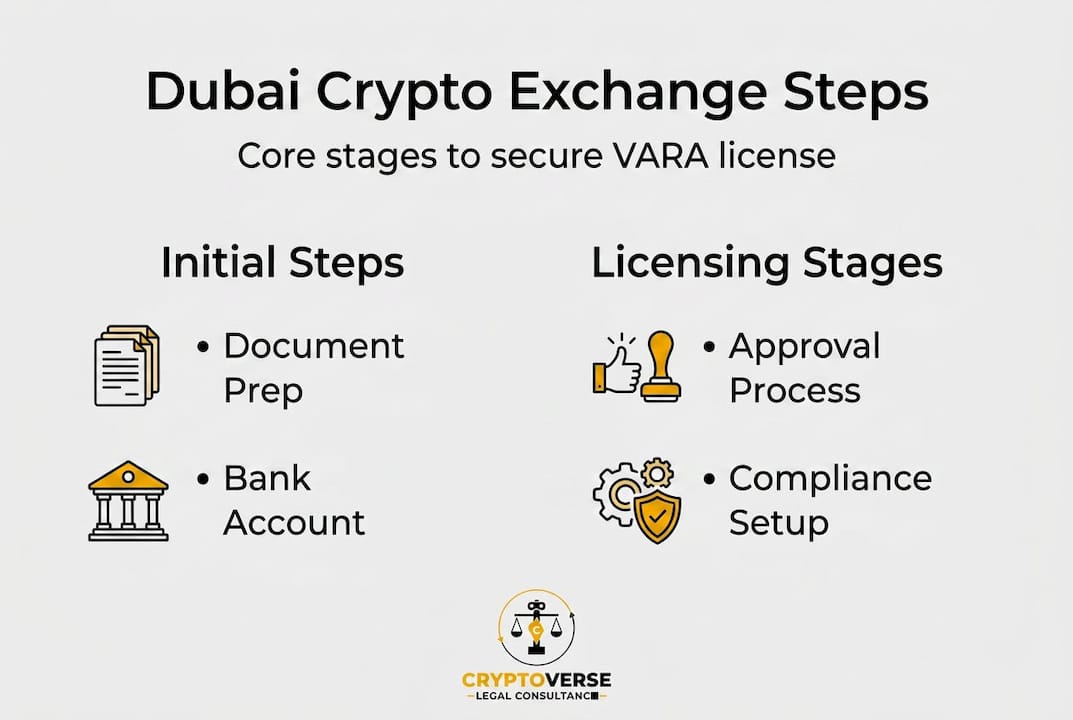
With all documentation and capital lined up, you are ready to begin VARA's multi-stage licensing process.
Navigating the VARA licensing stages
VARA's licensing process is structured and sequential. Attempting to compress stages or bypass preparatory requirements will not accelerate approval; it will trigger requests for further information that extend timelines. Understanding what each stage demands, and what it does not permit, is fundamental to planning your launch timeline realistically.
Stage 1: Approval to incorporate (ATI)
- Submit the Initial Disclosure Questionnaire (IDQ) to VARA, covering your proposed business model, UBO details, and jurisdiction of incorporation
- Provide your full business plan, technology overview, and proposed governance structure
- Pay approximately 50% of the applicable licensing fee at this stage
- Upon approval, you are permitted to incorporate your entity and establish your UAE presence
- Critically, ATI approval does not authorise any virtual asset operations or client-facing services
Stage 2: Full VASP licence
- Submit all operational policies: AML/KYC procedures, technology risk management framework, custody model documentation, and consumer protection policies
- Demonstrate a physical office with resident key function holders in place
- Commission independent audits of your technology infrastructure and compliance framework where required by VARA
- Undergo VARA's final review, which may include interviews with senior management and key function holders
- Upon approval, you receive your full VASP licence and may commence operations
The licensing process is two-staged at its core, with Stage 1 covering ATI via the IDQ and Stage 2 requiring the full policy suite, audits, physical office confirmation, and key staff verification. However, some practitioners refer to an intermediate MVP (Minimum Viable Product) phase.
The MVP phase allows a newly licenced exchange to operate with a limited user base under controlled conditions before scaling to full commercial operations. This is a significant and often underutilised feature of Dubai's regulatory framework, providing a risk-managed pathway to market that is not available in many competing jurisdictions.
Licensing timelines typically run between 3 and 9 months, with exchanges subject to greater complexity potentially reaching 12 months. Variables that affect timeline include the completeness of your initial submission, the responsiveness of your team to VARA queries, and the complexity of your corporate structure.
The VARA licensing roadmap provides a granular breakdown of each stage's requirements and how to structure your submission for optimal efficiency.
For founders considering a Dubai crypto market entry through a phased approach, the two-stage VARA process aligns well with a strategy of establishing presence first and scaling operations after full licensing.
Once your licence is granted, ongoing compliance becomes the engine of sustained success and risk management.
Ongoing compliance and operational best practices
Securing your VASP licence is not the conclusion of your regulatory obligations; it is the beginning of a continuous compliance programme. VARA operates an active supervisory regime, and licenced exchanges are expected to maintain full compliance readiness at all times, not merely at the point of annual review.
Core ongoing compliance obligations
- Maintain and continuously update your AML/CFT programme in line with FATF recommendations and UAE Federal AML Law (Federal Decree-Law No. 20 of 2018 and its amendments)
- Conduct periodic KYC reviews of existing customers, with enhanced due diligence for high-risk profiles and politically exposed persons (PEPs)
- File suspicious transaction reports (STRs) with the UAE Financial Intelligence Unit (UAEFIU) where required, within applicable timeframes
- Maintain a technology risk register and conduct regular penetration testing and vulnerability assessments of your trading platform
- Ensure all key function holders remain fit and proper; notify VARA of any changes to senior management or UBO structures promptly
- Commission annual external audits covering both financial statements and compliance frameworks, and submit results to VARA
- Retain transaction and customer records for a minimum of eight years in accordance with UAE regulatory requirements
VARA's rigorous process prioritises consumer protection and demands a high state of operational readiness, with the MVP phase providing a useful mechanism for testing systems and processes with limited users before full commercial exposure.
Consumer protection is a recurring theme in VARA's supervisory approach. This means your exchange must maintain clear terms of service, transparent fee structures, robust complaint handling procedures, and segregated client funds at all times.
Further guidance on compliance obligations for brokers and detailed requirements for AML/KYC platform operators provides a thorough basis for building your ongoing compliance architecture.
Pro Tip: Automate compliance workflows wherever technically feasible. Transaction monitoring, sanctions screening, and KYC verification can all be partially automated using purpose-built regtech tools. Automation reduces human error, creates auditable records, and significantly reduces the operational cost of compliance at scale.
With compliance secured, it is time to reflect on the lessons and pitfalls that Dubai crypto exchange founders most commonly encounter.
Lessons learned and common pitfalls when launching in Dubai
From a practical advisory standpoint, the most persistent pitfall we observe is not regulatory complexity itself; it is the assumption that regulatory complexity can be resolved after incorporation. Founders who treat licensing as an administrative step to complete whilst building their platform consistently encounter the most significant delays.
VARA's framework rewards preparedness. Exchanges that arrive at the IDQ stage with fully drafted AML/CFT policies, a finalised custody model, and an audited technology architecture consistently move through the process faster than those improvising documentation in response to VARA queries.
The MVP phase is genuinely distinctive to Dubai's regulatory environment. Most competing jurisdictions require full compliance from day one of operations. VARA's phased approach, whilst demanding in its own right, allows founders to validate their platform operationally before scaling to a full user base. This is a material advantage that is frequently overlooked in favour of pursuing the full licence immediately.
On the question of regulatory fit: VARA is better suited for retail exchanges, whilst DIFC and ADGM frameworks are more appropriate for institutional or custody-led models with higher capital capacity. Misaligning your exchange model with the wrong regulator is a costly and time-consuming error.
Staff vetting lapses are another underestimated risk. VARA assesses key function holders rigorously, and undisclosed regulatory sanctions, adverse financial history, or inadequate professional experience will stall an application. Review VARA enforcement practices to understand the standards applied. Build your team with VARA's fit-and-proper criteria in mind from the earliest stage of planning.
Expert help for launching your Dubai crypto exchange
Navigating VARA's licensing process without experienced regulatory counsel significantly increases the risk of delays, incomplete submissions, and costly compliance oversights.
CRYPTOVERSE Legal Consultancy provides end-to-end support for crypto exchange founders seeking Dubai VARA licensing. Our team of crypto-native lawyers guides you through every stage, from activity scoping and corporate structuring to AML/CFT policy drafting and VARA submission management. We also advise on the full range of UAE digital asset regulatory requirements, ensuring your platform is built on a compliant and scalable foundation. For a clear overview of what your exchange will need to address, explore the scope of regulated VARA activities before you begin.
Frequently asked questions
How long does it take to get a crypto exchange licence in Dubai?
Most exchanges secure licensing within 3 to 9 months, though more complex applications with multi-layered corporate structures or broader activity sets may take up to 12 months.
What is the minimum capital required for launching a crypto exchange under VARA?
You must maintain either AED 800,000 or AED 1,500,000 in an unencumbered UAE bank account, with the applicable threshold determined by whether you engage a VARA-licensed custodian or manage custody independently.
Is it possible for foreign-owned startups to launch a crypto exchange in Dubai?
Yes. Free zones such as DMCC and DWTC are fully VARA-aligned and permit 100% foreign ownership, making them the preferred incorporation route for international founders.
Which activities should be covered when applying for VARA Exchange Services?
Your application scope should explicitly cover matching buy/sell orders, spot trading, crypto-to-fiat conversion, and the operation of an order book, as each is a separately regulated activity under VARA's rulebook.
What is the role of the MVP stage in Dubai crypto licensing?
The MVP stage allows a licenced exchange to conduct limited operations with a restricted user base before full commercial launch, providing a controlled environment to stress-test compliance systems and platform performance before scaling.