

TL;DR:
- Canadian crypto startups and institutional investors must register as Money Services Businesses with FINTRAC before engaging in virtual currency dealing. Compliance requires tailored policies, appointment of a senior compliance officer, regular risk assessments, staff training, and independent effectiveness reviews to survive regulatory scrutiny. Failure to maintain proper registration, procedures, and reporting exposes operators to severe penalties and enforcement actions.
For crypto startups and institutional investors targeting Canadian markets, FINTRAC crypto compliance explained is rarely as straightforward as first assumed. The Financial Transactions and Reports Analysis Centre of Canada (FINTRAC) operates under the Proceeds of Crime (Money Laundering) and Terrorist Financing Act (PCMLTFA), imposing registration, reporting, and anti-money laundering obligations on any entity conducting virtual currency dealings in Canada. Enforcement has intensified sharply in 2026, with dozens of registrations revoked for technical failures that many operators never anticipated. This guide sets out precisely what is required, what traps to avoid, and how to build a programme that survives regulator scrutiny.
Key Takeaways
| Point | Details |
|---|---|
| Mandatory Fintrac registration | Crypto businesses dealing with virtual currencies in Canada must register as MSBs before starting operations. |
| Five-element AML program | A complete AML program including compliance officer, policies, risk assessment, training, and reviews is required. |
| Strict transaction reporting | Large virtual currency transactions ≥$10,000 CAD require timely reporting and client identification verification. |
| Enforcement risks | Failure to comply can lead to registration revocation, fines, and criminal penalties under Canadian law. |
| Tailored compliance essential | Generic AML policies fail Fintrac’s audits; programs must reflect the actual crypto business risk environment. |
Regulatory mandate and licensable activities under FINTRAC
FINTRAC's statutory remit covers a category of entities known as Money Services Businesses (MSBs). Under PCMLTFA, an MSB is defined as any person or entity offering designated financial services to the public, including foreign exchange, money transfers, cheque cashing, and, critically, virtual currency dealing. Registration with FINTRAC is the gateway obligation: crypto businesses must register as MSBs before commencing any virtual currency operations, with no grace period provided.
Virtual currency dealing is broadly defined. It encompasses buying, selling, exchanging, and transferring virtual currencies for fiat or other virtual currencies, whether as principal or agent. This means a platform facilitating peer-to-peer Bitcoin trades, an OTC desk executing institutional orders, and a crypto payment processor are all within scope. Operators building virtual asset platform compliance frameworks in other jurisdictions should not assume their existing licences satisfy Canadian obligations.
Key licensable MSB activity categories under FINTRAC:
- Foreign exchange dealing
- Remittance and money transfer services
- Cheque cashing
- Virtual currency dealing (buying, selling, exchanging, transferring)
- Issuance or redemption of money orders or traveller's cheques
- Crowdfunding platform services
Registration is valid for two years and must be renewed biennially. Failure to renew on time results in automatic expiry, which carries the same legal consequences as never having registered.
| Activity | Registration required | Renewal period | Threshold for reporting |
|---|---|---|---|
| Virtual currency buying/selling | Yes, before operation | Every 2 years | C$10,000 and above |
| Virtual currency transfer | Yes, before operation | Every 2 years | C$1,000 (travel rule) |
| Foreign exchange dealing | Yes, before operation | Every 2 years | C$10,000 and above |
| Crowdfunding platform | Yes, before operation | Every 2 years | Varies by transaction type |
Designing crypto AML programmes that meet FINTRAC's precise scope requirements is not optional. Misclassifying an activity or overlooking a service line can expose an entire operation to enforcement action.
Capital, prudential standards, and governance requirements for crypto MSBs
With regulatory mandates explained, understanding prudential and governance standards is essential for operational compliance. FINTRAC registration does not impose a minimum capital threshold for MSBs. However, entities conducting retail payment activities simultaneously fall under the Retail Payment Activities Act (RPAA), which requires prudential safeguarding measures and operational risk controls distinct from AML obligations. Crypto platforms offering payment functionality must assess both regimes carefully.
Governance obligations under FINTRAC are non-negotiable. Every registered MSB must appoint a designated compliance officer (DCO) with sufficient seniority and authority to implement and enforce the AML/CFT programme. The DCO cannot be a nominal appointment. FINTRAC examiners assess whether the officer genuinely oversees compliance activity, has access to board-level reporting, and possesses adequate knowledge of the Canadian AML/CTF regulatory framework.
Board-level oversight is expected across several operational dimensions:
- Approval and periodic review of the written AML/CFT programme
- Assessment of capital adequacy and operational risk exposures
- Direct accountability for material compliance failures
- Oversight of the independent effectiveness review process
Prudential discipline also informs how entities structure their treasury and custody models. Even absent a statutory capital minimum, regulator expectations around virtual asset AML controls and operational reserves form part of examiner assessments in practice.
Pro Tip: Engage senior management and board representatives early in your FINTRAC registration process. Compliance officers appointed as an afterthought, without decision-making authority or budget, are among the most common reasons FINTRAC identifies governance deficiencies during examinations. Embedding fintech regulatory compliance at board level from the outset avoids costly restructuring later.
Building and maintaining a FINTRAC-compliant AML/CFT programme
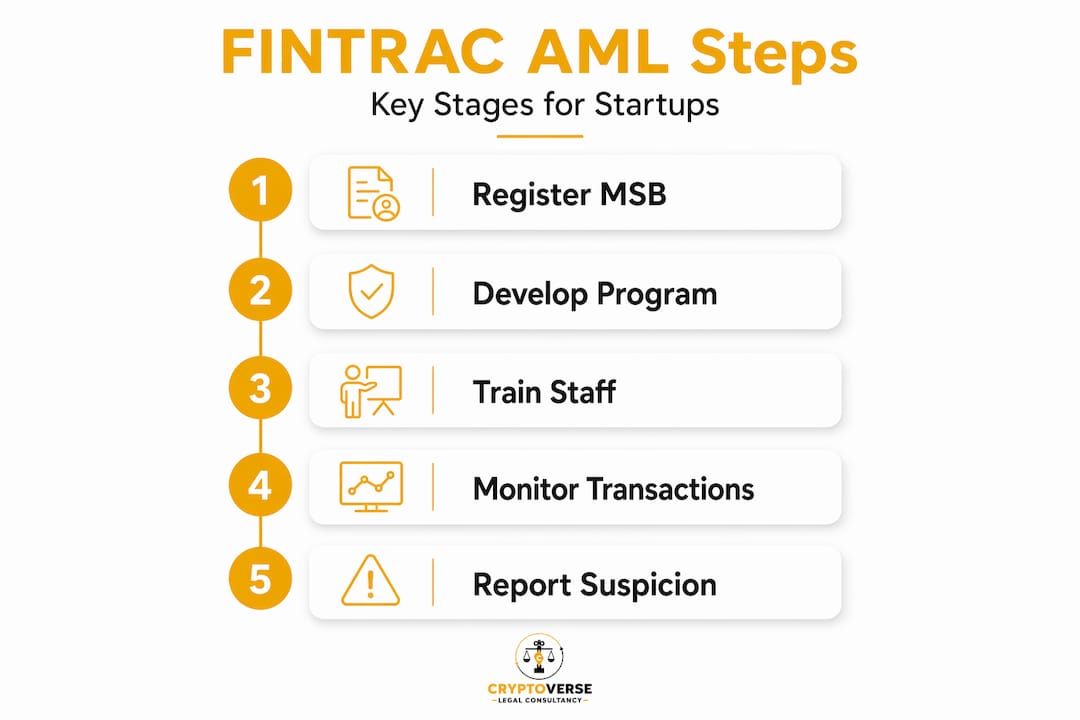
Understanding governance sets the stage for implementing the core AML programme that FINTRAC mandates for crypto compliance. As of 26 March 2026, all MSBs, including crypto platforms, must implement a five-element AML programme prior to commencing operations. Each element is mandatory. A programme missing even one element is treated as non-compliant in its entirety.
The five mandatory elements are:
- Designated compliance officer — appointed with clearly documented authority, appropriate qualifications, and direct reporting lines to senior management.
- Written policies and procedures — tailored specifically to the business's actual crypto operations. Generic templates downloaded from the internet will not satisfy FINTRAC. Policies must address the entity's specific services, customer base, transaction volumes, and delivery channels.
- Documented risk assessment — a written, business-specific evaluation of money laundering and terrorist financing (ML/TF) risks. For crypto MSBs, this must account for crypto-specific threats, including mixer and tumbler usage, high-velocity algorithmic trading, unhosted wallet transactions, and cross-chain bridging activity.
- Ongoing staff training — periodic, documented training for all relevant personnel covering Canadian AML/CTF obligations, FINTRAC reporting requirements, and emerging ML/TF typologies. Training records must be maintained and available for examination.
- Independent effectiveness review — conducted at least every two years by an independent party assessing whether the programme actually operates as designed, not merely whether it is written correctly.
"A compliance programme that exists but cannot be evidenced is, from FINTRAC's perspective, a programme that does not exist."
Documented evidence of implementation is as critical as the programme's content. FINTRAC examiners look for records demonstrating that AML compliance programmes function in practice, not just on paper.
Pro Tip: Review and update your AML policies whenever FINTRAC issues new guidance, when your product offering changes, or when new ML/TF typologies emerge in the virtual asset sector. Static crypto AML programmes are a leading cause of examination failures.
Transaction monitoring, reporting obligations, and the travel rule
After establishing your AML programme, focusing on transaction and reporting requirements ensures operational compliance in daily activities. FINTRAC imposes four primary reporting obligations on registered crypto MSBs.
Core FINTRAC reporting requirements for virtual currency MSBs:
- Large Virtual Currency Transaction Reports (LVCTRs): Required for any single virtual currency transaction totalling C$10,000 or more. Filing must occur within five business days of the transaction. Aggregation rules apply where multiple transactions by the same client within a 24-hour period collectively meet the threshold.
- Suspicious Transaction Reports (STRs): Must be filed within 30 days of the date an MSB first suspects a transaction is related to ML/TF. This deadline runs from suspicion formation, not from investigation completion.
- Electronic Funds Transfer Reports (EFTRs): Required for international electronic fund transfers of C$10,000 or more.
- Terrorist Property Reports: Filed immediately upon knowledge or reasonable grounds to suspect that property is owned or controlled by a designated terrorist entity.
Client identification and verification obligations apply to large transactions. MSBs must verify client identity using government-issued photo identification or credit file information before completing transactions at or above prescribed thresholds. Reviewing KYC requirements in detail is essential for platform design.
The travel rule is particularly significant for virtual asset transfers. Any virtual currency transfer of C$1,000 or more requires the transmitting MSB to collect, retain, and transmit originator and beneficiary information to the receiving institution. This mirrors FATF Recommendation 16 applied to traditional wire transfers.

| Reporting obligation | Threshold | Filing deadline | Verification required |
|---|---|---|---|
| LVCTR | C$10,000+ | 5 business days | Yes |
| STR | No threshold | 30 days from suspicion | Yes |
| EFTR | C$10,000+ (international) | 5 business days | Yes |
| Travel rule transmission | C$1,000+ | At time of transfer | Yes |
Firms building crypto exchange licences in the UAE that also serve Canadian clients must ensure their technology stack supports FINTRAC-compliant data capture and reporting from day one. Understanding VARA regulated activities alongside FINTRAC obligations is important for multi-jurisdictional operators.
Pro Tip: Build transaction monitoring rules directly referencing FINTRAC thresholds, with automated STR escalation workflows. Manual monitoring at high transaction volumes creates filing deadline risk and audit exposure.
Enforcement risks and practical structuring considerations
Recognising enforcement risks completes the understanding needed to structure compliant and resilient crypto MSB operations. In 2026, FINTRAC revoked over 50 MSB registrations, with crypto platforms disproportionately represented, for failures including lapsed registrations, missing compliance officers, and absent written programmes. Revocation removes the legal right to operate, and targeted enforcement against generic AML templates has become a defining feature of FINTRAC's 2026 examination approach.
Operating as an MSB without valid registration is a criminal offence under PCMLTFA. Penalties include fines, imprisonment, and permanent bars from operating financial services businesses. A 30-day review period exists following revocation, but reinstatement is not guaranteed and requires demonstrating immediate remediation.
Common enforcement triggers identified in 2026:
- Stale registration details (changed ownership, new services, updated addresses not notified to FINTRAC)
- Generic or template AML programmes not reflecting actual business activities
- Failure to file LVCTRs, STRs, or EFTRs within statutory deadlines
- Absent or unqualified designated compliance officers
- No documented risk assessment, or one that pre-dates significant business changes
- Foreign operators serving Canadian clients without Foreign MSB (FMSB) registration
"A compliance programme missing any element — or deficient — is non-compliant as a whole."
Foreign crypto businesses directing services at Canadian users must register as Foreign Money Services Businesses. This obligation applies regardless of where the entity is incorporated. Reviewing AML compliance risks and understanding common crypto licence rejection reasons provides useful parallel context for building rejection-resistant applications.
Pro Tip: Any material change to your business, including new services, new ownership, or changes to your compliance officer, must be reported to FINTRAC promptly. Stale registration data is one of the most preventable causes of revocation.
Why many crypto startups misunderstand FINTRAC compliance and how to get it right
The most persistent compliance failure in the Canadian crypto MSB space is not ignorance of the law. It is the treatment of FINTRAC registration as a formality rather than an ongoing operational obligation. Startups file their registration, download a template AML policy, and assume compliance is achieved. FINTRAC examiners routinely identify programmes built from generic templates that do not reflect the entity's actual risk profile, transaction volumes, or product architecture. Examination failure rates in this category are high, and the consequences extend beyond remediation notices to full revocation.
Effective FINTRAC compliance requires a programme that is embedded in the business's daily operations, not stored in a folder awaiting examination. The risk assessment must identify threats specific to the entity's customer geography, transaction types, and wallet infrastructure. Staff training must address the actual ML/TF typologies relevant to that entity's services. The independent effectiveness review must test whether the programme works in practice, not whether it reads well on paper.
From our experience advising clients across multiple regulated jurisdictions, the startups that navigate FINTRAC examinations successfully share several characteristics. They appoint compliance officers with genuine decision-making authority and adequate time allocation. They plan for three to six months of programme development before registration submission. They maintain crypto compliance best practices as a live function, with calendar-driven review cycles and documented update logs.
Practical lessons for crypto startups building FINTRAC-compliant programmes:
- Tailor every AML policy to your specific business model, not to a generic MSB template
- Update policies and risk assessments whenever products, markets, or customer types change
- Document every compliance decision, training session, and risk assessment update with dated records
- Monitor transaction flows against FINTRAC thresholds in real time, not via periodic manual review
- Allocate genuine budget to the compliance function before launch, not after your first examination notice
- Engage legal counsel with FINTRAC-specific expertise at the registration stage, not after a deficiency notice arrives
The cost of proper compliance infrastructure is a fraction of the cost of enforcement response, remediation, and reputational recovery following revocation.
Your partner for FINTRAC-compliant crypto regulatory guidance
Navigating FINTRAC's compliance obligations is demanding, particularly for operators managing multi-jurisdictional licensing frameworks simultaneously. CRYPTOVERSE Legal Consultancy provides specialist legal guidance to crypto startups and institutional investors across Canadian crypto regulations and beyond, helping you build registration-ready AML programmes, maintain governance structures that withstand examination, and respond to regulatory developments as they arise.
Our team advises on the full compliance lifecycle, from MSB registration through programme design, independent effectiveness reviews, and ongoing regulatory updates. For clients expanding across jurisdictions, we align FINTRAC compliance with VARA regulations and licensing requirements in the UAE, ensuring your governance architecture is consistent across markets. Whether you are launching a new exchange, structuring a multi-entity VASP operation, or reviewing your existing AML programme ahead of an examination, our digital asset legal consultancy services are structured to meet regulator expectations. We also advise on regulated activities under VARA for clients building dual-jurisdiction platforms.
Frequently asked questions
Who must register with FINTRAC as an MSB for virtual currency activities?
Any person or entity engaging in virtual currency dealing as a business directed at Canadian clients must register as an MSB with FINTRAC before commencing operations, including foreign operators serving Canadian users remotely.
What are the five mandatory elements of a FINTRAC AML compliance programme?
A FINTRAC AML programme must include a designated compliance officer, written policies and procedures, a documented risk assessment, ongoing staff training, and an independent effectiveness review conducted at least every two years.
What penalties can result from operating without FINTRAC registration?
Operating without valid registration is a criminal offence under PCMLTFA, carrying fines of up to C$2 million, imprisonment of up to five years, and permanent revocation of the right to operate as an MSB.
How does the travel rule apply to virtual currency transactions under FINTRAC?
The travel rule requires MSBs to collect and transmit originator and beneficiary information for virtual currency transfers of C$1,000 or more, mirroring the obligations applied to traditional wire transfers under FATF standards.
Are foreign MSBs providing services to Canadian clients required to register with FINTRAC?
Yes. Foreign MSBs directing services at Canadian clients must register as Foreign Money Services Businesses (FMSBs) with FINTRAC and comply with all AML/CFT obligations applicable to domestic MSBs.