

TL;DR:
- The DFSA crypto compliance framework governs virtual asset activities within the Dubai International Financial Centre. Starting in 2026, firms must conduct own token suitability assessments, monitor them regularly, and meet new capital requirements based on operational risk. Strong governance, technology controls, and ongoing compliance are essential to reduce enforcement risks and ensure regulatory adherence.
The Dubai Financial Services Authority (DFSA) crypto compliance framework is defined as the set of regulatory obligations governing virtual asset activities conducted within the Dubai International Financial Centre (DIFC). This dfsa crypto compliance guide covers the full scope of those obligations, including the landmark January 2026 shift to firm-led token suitability assessments, the July 2026 Activity-Based Capital Requirement (ABCR) model, and the conduct standards embedded across DFSA Rulebook modules GEN, COBS, AML, and MIR. For crypto entrepreneurs and compliance officers operating in or targeting the DIFC, understanding these requirements is not optional. The DFSA's regulatory framework for virtual assets now places direct accountability on firms, not the regulator, for every token they handle.
What are the DFSA licensable activities for crypto tokens?
The DFSA's statutory remit covers financial services carried out in or from the DIFC that involve crypto tokens. Firms must obtain DFSA authorisation before conducting any of the following activities:
- Dealing in investments as principal or agent using crypto tokens
- Arranging deals in crypto tokens on behalf of clients
- Managing assets where the portfolio includes crypto tokens
- Providing custody of crypto tokens on behalf of third parties
- Advising on investments that include crypto tokens
- Operating a crypto token exchange or multilateral trading facility
Each activity carries a specific licence category. The Category 3C licence is the primary authorisation for firms dealing in or managing crypto tokens. Firms must also obtain a crypto token endorsement on their Financial Services Permission, which specifies the tokens they are authorised to handle.
Collective investment fund managers operating in the DIFC face additional requirements. Where a fund holds crypto tokens, the manager must rely on a DFSA-licensed trustee or administrator for custody. The DFSA's COBS Rulebook governs client disclosures, suitability assessments, and best execution obligations. The Client Assets Rulebook applies to all firms holding client crypto tokens, requiring strict segregation from the firm's own assets. Firms that conduct regulated crypto activities without the correct endorsement face immediate enforcement exposure.
How does the DFSA's firm-led token suitability framework operate?
Effective 12 january 2026, the DFSA eliminated its Recognised Crypto Token list. The responsibility for token suitability shifted entirely to authorised firms. This is the most consequential structural change in the DFSA's crypto regime to date. Every firm must now conduct and document its own assessment before using, holding, or offering any non-fiat crypto token.
Under GEN Rule 3A.2.1, the suitability assessment must address five broad criteria:
- Token characteristics — the token's purpose, design, and economic function
- Governance — the quality and accountability of the issuer's governance structure
- Regulatory status — whether the token is regulated or recognised in other jurisdictions
- Market size and liquidity — trading volumes, market depth, and price stability
- Technology — the security, resilience, and auditability of the underlying protocol
Firms must conduct an initial assessment before any token is used and monitor suitability at least biannually. The DFSA also requires monthly reporting on tokens held and disclosure of any material changes in token characteristics. Firms that cannot defend their suitability decisions with documented evidence face enforcement action during thematic reviews.
Fiat-referenced tokens receive different treatment. The DFSA maintains a short approved list: Circle USD Coin (USDC), Circle Euro Coin (EURC), and Ripple USD (RLUSD). Firms using these tokens do not need to conduct a full suitability assessment. Algorithmic stablecoins are explicitly excluded from this simplified treatment. Algorithmic stablecoins require a full suitability assessment, which affects portfolio composition and risk calculations for any fund or service provider that holds them.
Pro Tip: Build your suitability assessment into your investment policy statement or token acceptance policy from day one. A standalone document that sits outside your risk management system will not satisfy DFSA scrutiny during a thematic review.
What are the DFSA capital and prudential requirements for crypto firms?
From 1 july 2026, the DFSA operates under the Activity-Based Capital Requirement (ABCR) model. The ABCR model scales capital requirements proportionally based on three operational metrics: Assets Under Management (AUM), Assets Safeguarded (ASA), and Client Orders Handled (COH). This replaces the older fixed-threshold capital frameworks with a more granular, risk-sensitive approach.

| Capital Driver | Metric Used | Regulatory Purpose |
|---|---|---|
| Assets Under Management | AUM | Reflects investment risk exposure |
| Assets Safeguarded | ASA | Covers custody and client asset risk |
| Client Orders Handled | COH | Captures operational and settlement risk |
| Operational Risk Capital | Basel-aligned standards | Addresses systemic and technology risk |
The ABCR model requires firms to model capital needs that reflect their actual operational scale, not a static minimum. A firm managing a large crypto fund with significant custody obligations will carry materially higher capital requirements than a boutique advisory firm. Operational risk capital is now calculated under Basel-aligned standards, which introduces a more structured methodology than many crypto firms have previously applied.
Liquidity planning must integrate with capital modelling. Firms should build internal capital adequacy assessment processes (ICAAPs) that account for crypto-specific risks, including token price volatility, custody failures, and counterparty default. Regulatory reporting under the ABCR regime requires quarterly submissions to the DFSA, with immediate notification obligations for any breach of minimum thresholds. Full guidance on the ABCR regime's legal impact is available for firms structuring their prudential frameworks.
Pro Tip: Do not treat capital modelling as a one-time exercise. Crypto AUM and custody volumes can shift materially within a single quarter. Your ICAAP should be a living document reviewed at least quarterly by the board.
Which governance, technology, and AML controls must DFSA crypto firms uphold?
The DFSA requires board-level governance and senior management accountability for embedding crypto compliance across all business functions. This is not a delegable obligation. The board must approve the firm's token acceptance policy, suitability framework, and AML/CFT programme, and must receive regular management information on compliance performance.
Key governance and control requirements include:
- Client asset segregation — all client crypto tokens must be held separately from the firm's own assets, with daily reconciliation and independent audit trails under the DFSA Client Assets Rulebook
- Custody controls — firms must implement technology risk management frameworks covering private key security, multi-signature authorisation, cold storage protocols, and operational resilience testing
- AML/CFT programme — firms must comply with Federal AML Law (Decree-Law No. 20 of 2018 and its amendments), the DFSA AML Rulebook, and FATF Recommendation 16 (the Travel Rule) for virtual asset transfers
- Travel Rule compliance — firms must collect, verify, and transmit originator and beneficiary information for all crypto transfers above the applicable threshold, and must screen counterparty VASPs before transacting
- Supervisory readiness — firms must maintain compliance manuals, training records, and audit logs in a format that supports DFSA inspection without advance preparation
The DFSA's regulatory framework applies GEN, COBS, AML, and MIR Rulebook modules to virtual asset activities. Each module carries specific obligations. MIR governs market conduct and manipulation prevention, which is particularly relevant for firms operating exchanges or providing liquidity. Firms should appoint a dedicated Money Laundering Reporting Officer (MLRO) with direct board access and sufficient authority to escalate concerns without interference.
Pro Tip: Map each DFSA Rulebook module to a specific internal policy owner. When the DFSA conducts a thematic review, they will ask who is responsible for each control area. "The compliance team" is not an acceptable answer.
What enforcement risks should crypto firms consider under the DFSA regime?
Enforcement exposure under the DFSA regime is highest where firms fail to document suitability decisions or allow capital to fall below ABCR thresholds. The DFSA conducts thematic reviews across authorised firms, and documentation alone is insufficient without operational embedding and effective oversight. A suitability policy that exists on paper but is not applied in practice will not withstand scrutiny.
Practical steps to reduce enforcement risk include:
- Conduct a gap analysis against GEN Rule 3A.2.1 and document findings with a remediation timeline
- Appoint a senior manager with named accountability for the token suitability framework
- Schedule biannual token reviews in the compliance calendar and retain all assessment records for a minimum of six years
- Integrate DFSA monthly reporting obligations into your compliance management system with automated alerts for submission deadlines
- Commission an independent internal audit of your AML/CFT programme at least annually, with findings reported to the board
Fund managers and service providers operating within the DIFC should also consider their corporate structure carefully. Multi-entity operations that span the DIFC and mainland UAE may require separate authorisations from the DFSA and either VARA or the SCA. Structuring decisions made at incorporation are difficult to reverse once a firm is operational. The 2026 regulatory shift places full responsibility on firms for token legitimacy, requiring a dynamic compliance culture embedded across business functions, not confined to the compliance department.
Continuous updating of your compliance programme is not optional. The DFSA publishes consultation papers and regulatory updates throughout the year. Firms that track these publications and adjust their frameworks proactively are materially less likely to face enforcement action than those that treat compliance as a static exercise.
The compliance burden has shifted, and most firms are not ready
Working with crypto firms across the DIFC, Cryptoverselawyers has observed a consistent pattern: founders and compliance officers understand the headline requirements but underestimate the operational depth the DFSA now expects. The shift from a regulator-maintained Recognised Token list to firm-led suitability assessment sounds administrative. In practice, it demands a compliance infrastructure that many firms have not yet built.
The firms that will thrive under the 2026 framework are those that treat suitability assessment as a core investment function, not a legal formality. That means integrating token review into portfolio management workflows, training portfolio managers and traders alongside compliance staff, and building audit trails that reflect genuine decision-making rather than retrospective documentation. The ABCR capital model reinforces this point. Capital requirements now move with your business. A firm that grows its AUM by 40% in a quarter must reassess its capital position immediately, not at the next annual review.
The supervision intensity the DFSA is signalling for 2026 and beyond is not a threat to well-governed firms. It is an opportunity. Firms that invest in governance infrastructure now will find regulatory engagement far less disruptive than those that scramble to produce documentation after a thematic review is announced. The conduct obligations under COBS are demanding, but they are also predictable. Predictability is an advantage for firms that plan ahead.
— CRYPTOVERSE
How Cryptoverselawyers supports DFSA crypto compliance
Cryptoverselawyers advises crypto firms at every stage of DFSA authorisation and ongoing compliance. From drafting token acceptance policies and suitability frameworks to building ICAAP models and AML/CFT programmes aligned with Federal AML Law and FATF standards, the firm provides regulator-ready legal solutions for the DIFC environment.

Cryptoverselawyers supports clients with DFSA licensing applications, Category 3C endorsements, governance policy design, Travel Rule implementation, and supervisory engagement. For firms operating across multiple UAE regulators, the firm also advises on VARA licensing and compliance and broader digital asset legal strategy. Contact Cryptoverselawyers to discuss your firm's DFSA compliance position and build a framework that stands up to scrutiny.
FAQ
What does the DFSA crypto compliance framework cover?
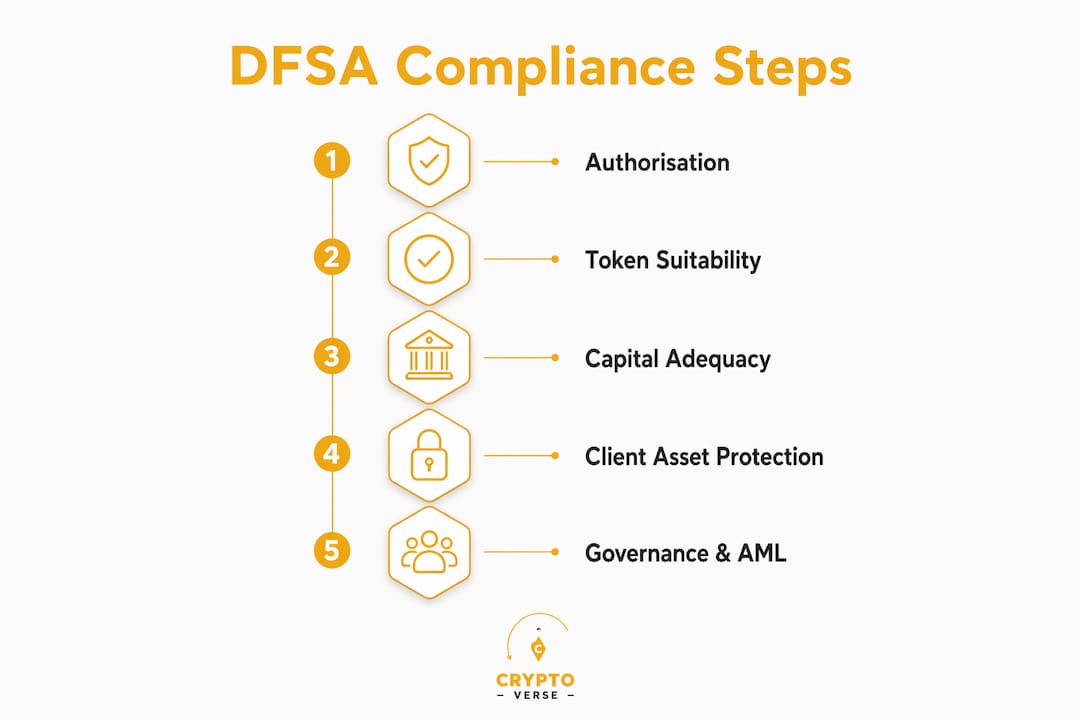
The DFSA crypto compliance framework covers authorisation, token suitability, capital adequacy, client asset protection, AML/CFT obligations, and market conduct for firms operating in the DIFC. It is implemented through GEN, COBS, AML, and MIR Rulebook modules.
What is the firm-led token suitability requirement under the DFSA?
From 12 january 2026, firms must conduct and document their own suitability assessments for all non-fiat crypto tokens, reviewing each token at least every six months and reporting monthly to the DFSA.
Which fiat-referenced tokens does the DFSA approve without full assessment?
The DFSA approves USDC, EURC, and RLUSD for use without a full suitability assessment. Algorithmic stablecoins are excluded from this treatment and require a complete assessment.
What is the ABCR model and when does it apply?
The Activity-Based Capital Requirement (ABCR) model applies from 1 july 2026. It scales capital requirements based on AUM, assets safeguarded, and client orders handled, replacing fixed-threshold capital frameworks.
What AML obligations apply to DFSA-authorised crypto firms?
DFSA-authorised crypto firms must comply with Federal AML Law (Decree-Law No. 20 of 2018), the DFSA AML Rulebook, and FATF Recommendation 16 (the Travel Rule), including counterparty VASP screening and transaction monitoring.