

TL;DR:
- UAE DeFi licensing involves navigating multiple regulators such as VARA, DFSA, FSRA, SCA, and CBUAE.
- The approval process includes two stages: approval to incorporate and full VASP license, totaling about 8-12 months.
- Successful licensing depends on clear activity mapping, strong documentation, and proactive regulator engagement.
Obtaining regulatory approval for a decentralised finance (DeFi) project in the UAE is one of the most technically demanding exercises in virtual asset law. The country operates multiple regulators across different jurisdictions, each with distinct statutory remits, and the VARA licensing process is structured as a formal two-stage procedure for new firms. Without a clear map of the landscape, founders routinely misidentify the correct authority, submit incomplete documentation, and lose months to avoidable back-and-forth. This guide sets out the full approval journey, covering regulatory bodies, preparation, process stages, and DeFi-specific edge cases, so you can proceed with accuracy and confidence.
Key Takeaways
| Point | Details |
|---|---|
| Know your regulator | VARA, SCA, CMA, and FSRA each cover different activities—always start by mapping the jurisdiction for your DeFi project. |
| Prepare documentation early | Collect business plan, IDQ, compliance policies, and pay initial fees before applying to avoid delays. |
| Follow two-stage licensing | DeFi firms must pass Approval to Incorporate and then Full VASP licensing, with each stage requiring specific submissions and fees. |
| Timeline is 8-12 months | Plan for up to a year for regulatory review, feedback, and licensing before launch or expansion. |
| Edge cases for on-chain DeFi | Protocols with no UAE nexus can avoid licensing, but business presence or client service triggers VASP requirements. |
Understanding UAE regulatory bodies for DeFi approval
Before submitting a single document, you must identify which authority has jurisdiction over your specific activities and geographic footprint. The UAE does not operate a single federal crypto regulator. Instead, authority is distributed across several bodies, each with a defined scope.
The table below summarises the key regulators and their primary remits:
| Authority | Jurisdiction | Primary focus |
|---|---|---|
| VARA (Virtual Assets Regulatory Authority) | Dubai (excluding DIFC) | Broad VASP licensing, DeFi, exchanges, brokers |
| DFSA (Dubai Financial Services Authority) | DIFC free zone | Investment tokens, regulated financial services |
| FSRA (Financial Services Regulatory Authority) | ADGM, Abu Dhabi | Institutional virtual asset activities |
| SCA / CMA (Securities and Commodities Authority) | Federal (UAE-wide) | Securities-linked tokens, federal operations |
| CBUAE (Central Bank of the UAE) | Federal | Payment tokens, stablecoins, stored value |
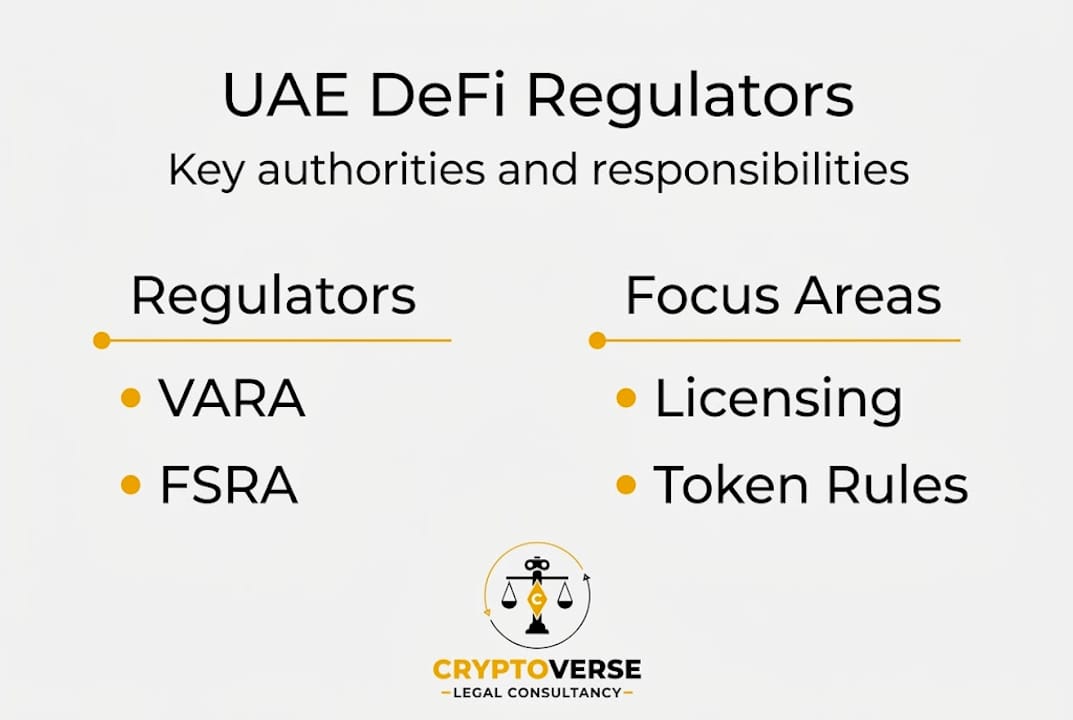
As confirmed by UAE licensing authority guidance, VARA covers Dubai operations outside the DIFC free zone, the FSRA governs institutional virtual asset business in ADGM, the DFSA handles DIFC-regulated activities, and the CBUAE's remit extends to payment tokens and stablecoin arrangements. Critically, if you intend to operate across the UAE at a federal level, you will typically require dual authorisation from both VARA and the SCA.
The most common scenario for a DeFi startup targeting Dubai is engagement with VARA, the Dubai virtual assets regulator. VARA holds the broadest mandate for virtual asset service providers (VASPs) in the emirate, covering activities such as exchange, brokerage, lending, custody, and management services. Many DeFi platforms offering on-chain lending or liquidity management to UAE-based users will fall squarely within VARA's jurisdiction.
Key questions to resolve at this stage include:
- Where is your entity incorporated or intending to incorporate? Dubai mainland, a Dubai free zone, ADGM, or DIFC each triggers a different regulatory pathway.
- What specific virtual asset services are you providing? Lending, borrowing, asset management, exchange, and custody each map to specific licensed activity categories.
- Are your users predominantly UAE-based, or is your UAE nexus limited to your operational base? User geography affects whether licensing is mandatory.
- Does your token fall within the definition of a regulated instrument? Some tokens trigger securities regulation under the SCA, not just VARA.
Failing to answer these questions before applying is one of the most common and costly errors. Firms that approach VARA with ambiguous activity descriptions often receive a request for additional information that delays the process by several months. The VARA licensing steps overview provides a useful framework for mapping your activities before initial engagement.
Preparing your DeFi business for regulatory approval
With the regulatory landscape mapped out, the preparation phase determines whether your application moves efficiently or stalls at the first review stage. Regulatory authorities assess not only your documents but also the quality, coherence, and completeness of your submission package.

The following table summarises the core documentation typically required:
| Document | Purpose | Notes |
|---|---|---|
| Initial Disclosure Questionnaire (IDQ) | Opens the approval process | Mandatory for VARA Stage 1 |
| Business plan | Demonstrates commercial viability and regulatory understanding | Must include revenue model, activity scope, and market analysis |
| AML/CFT policy | Shows compliance with FATF standards and UAE Federal AML Law | Must be tailored to your specific custody model and transaction flows |
| Technology and cybersecurity documentation | Demonstrates platform integrity | Includes architecture diagrams, penetration testing results, and incident response plans |
| Ownership and management details | Enables fit-and-proper assessment of principals | Corporate structure charts, CVs, and source-of-funds documentation |
| Compliance and governance framework | Evidences internal controls | Includes board composition, compliance officer appointment, and escalation procedures |
According to the VARA two-stage licensing process, Stage 1 requires submission of the IDQ, business plan, and ownership/management details, along with payment of 50 per cent of the applicable licensing fee. Upon satisfactory review, VARA issues an Approval to Incorporate (ATI), which permits the entity to be formally incorporated in Dubai.
Key preparation decisions to resolve early:
- Corporate structure: A limited liability company (LLC) or free zone entity each carries different implications for licensing eligibility and operational flexibility. Multi-entity structures for global DeFi operations require careful legal architecture.
- Compliance officer appointment: VARA requires a qualified compliance officer with demonstrable AML/CFT expertise. Identifying and appointing this individual early avoids delays at Stage 2.
- Technology audit readiness: Your platform must be documented to a level that satisfies VARA's IT and cybersecurity requirements. Many DeFi projects underestimate this component.
- Capital adequacy: Minimum capital requirements vary by licensed activity category. Confirm the applicable threshold before incorporating.
Pro Tip: Engage a specialist legal adviser before drafting your IDQ. Understanding who to hire for your VARA licence can significantly reduce preparation time, as experienced advisers know exactly which level of detail satisfies VARA reviewers and which omissions trigger follow-up queries. The VARA application requirements provide a detailed checklist to work from.
The cost of underpreparing at Stage 1 is significant. If VARA returns your application with requests for additional information, the clock does not stop. Timelines extend, fee payments may be affected, and in competitive market conditions, delays carry real commercial cost.
Step-by-step regulatory approval process for DeFi and VASP in the UAE
Once preparation is complete, the formal approval process follows a clearly structured sequence. For new firms, the VARA process for new applicants consists of two principal stages.
Stage 1: Approval to incorporate (ATI)
- Prepare and finalise your Initial Disclosure Questionnaire (IDQ), business plan, and management/ownership documentation.
- Submit the Stage 1 application package to VARA along with payment of 50 per cent of the total licensing fee.
- Await VARA's review. The authority may issue clarification requests during this period.
- Upon approval, receive the ATI. This document authorises you to incorporate your entity in Dubai and is a prerequisite for progressing to Stage 2.
Stage 2: Full VASP licence
As confirmed by the full VARA licensing guidance, Stage 2 requires submission of a complete documentation package aligned with VARA's detailed guidance notes. VARA will typically schedule formal meetings or request additional written responses during review. Upon satisfactory completion, remaining fees and first-year supervision charges are paid, and the VASP licence is issued, potentially with conditions attached.
The full Stage 2 process involves:
- Compile the complete application: AML/CFT policy, compliance framework, technology documentation, capital adequacy evidence, and all fit-and-proper materials.
- Submit to VARA for substantive review.
- Attend VARA feedback sessions and respond comprehensively to any queries raised.
- Pay the balance of licensing fees plus first-year supervision costs.
- Receive the VASP licence, noting any conditions imposed and timelines for satisfying them.
"Receiving a licence with conditions is normal, not a setback. What matters is understanding each condition clearly and building a realistic remediation plan before the supervision period begins."
Legacy operators follow a distinct path. Firms already operating in Dubai under prior arrangements must follow a separate sequence beginning with an Application Acknowledgment Notice, followed by either a Legacy Operating Permit (LOP) or a No Objection Certificate (NOC), as detailed in the VARA legacy operator guidance. This process runs separately from the new-firm pathway and carries its own documentary requirements.
The total timeline for the full two-stage process, including incorporation and supervision commencement, typically falls between eight and twelve months. This estimate assumes a well-prepared initial submission. Incomplete applications, significant queries, or changes to business model during the process can extend timelines considerably. For context on specific activity rules relevant to your operations, the VARA transfer and exchange rules are worth reviewing early.
Pro Tip: Build a detailed project plan for your licensing timeline, including internal milestones, external adviser deadlines, and buffer periods for VARA feedback. Treat the eight-to-twelve-month estimate as a planning baseline, not a guarantee.
DeFi edge cases and token issuance rules in the UAE
Beyond the standard VASP licensing route, DeFi businesses face specific regulatory questions that require precise analysis. The UAE's framework does not offer a standalone "DeFi licence." Instead, DeFi platforms are assessed against the regulated activities they provide.
When does a DeFi platform require VARA licensing?
If your protocol facilitates services that fall within VARA's defined regulated activities, including virtual asset management, lending and borrowing, exchange, or custody, and you have a UAE operational nexus, you require a VASP licence. The MANTRA DeFi licensing case demonstrates this clearly. MANTRA obtained the first VARA licence for DeFi activities by applying under the relevant regulated activity categories rather than seeking a purpose-built DeFi category that does not exist within the current framework.
Key considerations for DeFi platforms:
- UAE nexus matters. A protocol operating purely on-chain, with no UAE-based entity, no UAE-domiciled management, and no active marketing to UAE users, may not trigger mandatory licensing. However, this assessment is fact-specific and carries legal risk if applied loosely.
- Any UAE operations, client servicing, or token issuance activities require a VASP licence. There is no safe harbour for partially UAE-facing DeFi operations.
- Smart contract automation does not remove regulatory obligations. If the economic substance of your service constitutes a regulated activity, the delivery mechanism does not affect the licensing requirement.
Token issuance rules under VARA
VARA's Virtual Assets Issuance Rulebook divides tokens into distinct categories, each with specific requirements:
- Category 1 tokens (including Fiat-Referenced Virtual Assets, or FRVAs, and Asset-Referenced Virtual Assets, or ARVAs) require a full licence from VARA before issuance. These tokens are subject to the most demanding disclosure, reserve, and governance standards.
- Category 2 tokens can be issued through a VARA-licensed distributor, meaning the issuing project does not itself need to hold a VASP licence, provided the distributor manages the regulated distribution function.
This distinction is significant for DeFi projects planning token launches. If your token qualifies as Category 2 and you can structure distribution through a licenced distributor, your regulatory pathway is considerably lighter. The VARA token issuance rules provide detailed guidance on category classification and the specific obligations each triggers.
Pro Tip: Token classification should be resolved before you launch or publicise your token, not after. Misclassifying a token as Category 2 when it meets the legal definition of a Category 1 instrument carries significant regulatory and legal risk.
What most guides miss about DeFi regulatory approval in the UAE
Most published guides on VARA licensing list the steps accurately but omit what actually determines success in practice. The formal process is knowable. What is less discussed is the importance of the relationship and dialogue with VARA itself.
VARA is an active, responsive regulator. Its feedback during Stage 2 review is substantive, not bureaucratic. Firms that treat VARA queries as obstacles to overcome, rather than genuine opportunities to demonstrate regulatory understanding, consistently perform worse in the approval process. The ability to interpret VARA feedback accurately, and to respond with precise, well-evidenced answers, is a skill that requires direct regulatory experience.
The MANTRA licensing outcome is instructive not only because it confirms DeFi platforms can obtain VASP licences, but because it demonstrates that regulatory firsts require proactive engagement, legal creativity, and willingness to work with the authority rather than around it. Few guides address how to position novel DeFi activities within existing VARA activity categories in a way that satisfies the regulator's interpretive framework.
Additionally, the regulatory landscape continues to evolve. Token categorisation rules, AML/CFT obligations, and supervision expectations are subject to ongoing revision. Firms that document their compliance strategies in a futureproof manner, anticipating likely regulatory developments rather than simply meeting today's baseline, are substantially better positioned. Understanding how marketing crypto services intersects with licensing conditions is one area where firms are frequently underprepared.
Get support for your DeFi regulatory journey in the UAE
Navigating VARA, SCA, and the broader UAE regulatory framework demands more than a checklist. It requires precise legal strategy, strong documentation, and experience working directly with UAE authorities.

CRYPTOVERSE Legal Consultancy specialises exclusively in VARA regulations and licensing, guiding DeFi startups and established VASPs through every stage of the approval process, from IDQ preparation to full VASP licence and beyond. Our DeFi legal support services cover compliance framework design, AML/CFT policy drafting, and token categorisation analysis. For projects planning a token launch, our guidance on virtual assets issuance rules ensures your issuance structure meets VARA's requirements from day one. Contact us to discuss your project with a crypto-native lawyer who understands both the law and the technology.
Frequently asked questions
What does VARA require for DeFi regulatory approval in Dubai?
VARA requires submission of an IDQ, a business plan, compliance policies, and payment of initial and supervision fees as part of its formal two-stage approval process. Full documentation including AML/CFT policy and technology materials is required at Stage 2.
Do pure DeFi protocols need UAE licensing?
Pure on-chain protocols with no UAE business operations, entity, or active user base may not require VARA licensing, but any UAE-based operational activity, client servicing, or token issuance triggers a mandatory VASP licence requirement.
How long does the VASP licensing process take in the UAE?
The full two-stage process typically takes eight to twelve months from initial IDQ submission through to VASP licence issuance, assuming a well-prepared application and timely responses to VARA feedback.
Who regulates DeFi token issuance in the UAE?
VARA governs DeFi token issuance in Dubai, while VARA plus SCA dual authorisation is required for UAE-wide or federally-scoped virtual asset activities, depending on token classification and the geographic scope of the issuance.