

TL;DR:
- DeFi projects must navigate complex regulatory frameworks in the EU, US, and UAE that extend beyond on-chain code to governance, custody, and issuance activities. Compliance depends on identifying control points, implementing technical tools like modular hooks and KYT, and establishing legal structures with clear accountability. Governance and human oversight remain the most critical aspects for lawful operation and regulatory resilience in decentralized finance.
The decentralized finance legal process is defined as the structured set of regulatory obligations, governance requirements, and AML/CFT procedures that DeFi protocol founders and operators must satisfy to achieve lawful operation across major jurisdictions. This is not a theoretical concern. Regulators in the EU, US, and UAE are actively enforcing compliance obligations against identifiable actors in DeFi projects, regardless of whether the underlying code is autonomous. Frameworks including EU MiCA (Regulation 2023/1114), the US CLARITY Act 2025, and UAE VARA Regulations each extend their statutory remit beyond on-chain code to governance structures, front-end interfaces, token issuance, and custody arrangements. Founders who treat legal compliance as an afterthought face enforcement exposure that no technical architecture can fully mitigate. Understanding the DeFi compliance obligations applicable to your project from inception is the most effective risk management decision you will make.
What are the key regulatory mandates in the decentralized finance legal process?

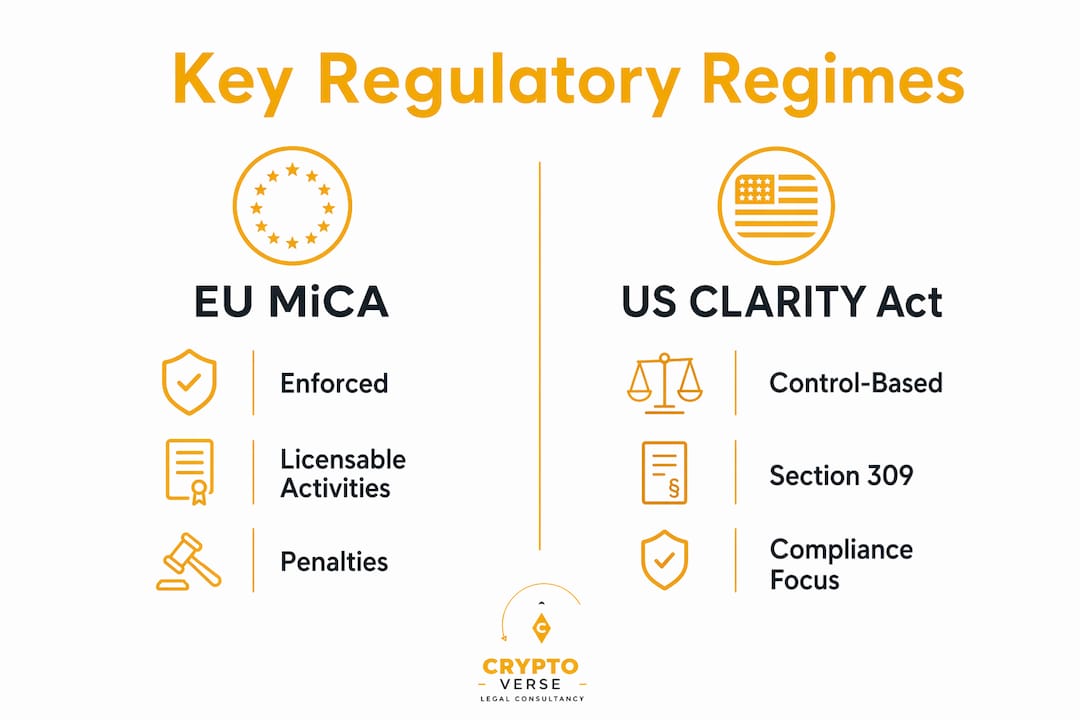
The legal framework for DeFi is defined by three primary regulatory regimes that founders operating globally must understand: EU MiCA, the US CLARITY Act, and UAE VARA Regulations. Each regime takes a distinct approach to the regulatory perimeter, but all three converge on one principle: identifiable actors with control over protocol components bear compliance obligations.
EU MiCA (Regulation 2023/1114) is fully enforced across all EU member states. Over €540 million in penalties were issued for MiCA non-compliance as of may 2026. That figure confirms that European supervisors, led by ESMA, treat DeFi enforcement as a priority rather than a future consideration. Recital 22 of MiCA offers a narrow exemption only for protocols that are fully decentralised with no intermediaries. In practice, ESMA clarifies that teams controlling front ends or token issuance face compliance obligations regardless of the protocol's on-chain architecture.
The US CLARITY Act 2025 regulates DeFi protocols based on control rather than code form. Section 309 of the Act provides exclusion criteria for developers and protocols that are genuinely non-custodial and lack unilateral rule-changing authority. Protocols that retain substantial control fall within CFTC and SEC enforcement jurisdiction. The control test is functional, not formal. A DAO with an admin key held by a founding team fails the exclusion test regardless of its governance branding.
UAE VARA Regulations govern virtual asset activities conducted in or from Dubai. VARA's Rulebooks cover exchange services, broker-dealer activities, custody, lending, and virtual asset issuance. Stablecoin integration and token issuance by DeFi protocols trigger VARA's licensing requirements under the Virtual Assets and Related Activities Regulations 2023.
The table below summarises the key regulatory regimes and the activities they regulate.
| Regulatory Regime | Jurisdiction | Licensable Activities | Enforcement Focus |
|---|---|---|---|
| MiCA (Regulation 2023/1114) | European Union | Token issuance, custody, exchange, stablecoin issuance | Front-end operators, token issuers |
| CLARITY Act 2025 (Section 309) | United States | Custodial services, protocols with unilateral control | CFTC/SEC jurisdiction over controlled protocols |
| VARA Regulations 2023 | UAE (Dubai) | Exchange, custody, lending, VA issuance | VARA Rulebook compliance, licensing |
| FSRA Virtual Asset Framework | UAE (ADGM) | Spot trading, custody, exchange | FSRA authorisation and conduct rules |
| MAS Digital Payment Token Framework | Singapore | Payment token services, custody | MAS licensing under PSA 2019 |
How can DeFi projects implement aml/cft compliance without full KYC?
Traditional Know Your Customer procedures are impractical in permissionless DeFi protocols where users interact pseudonymously via wallet addresses. The compliance solution is Know Your Transaction, or KYT, a behavioural transaction monitoring process that analyses on-chain activity patterns rather than collecting personal identity data.
KYT analyses behavioural transaction patterns to meet AML/CFT obligations in fully decentralised protocols. This approach supports real-time sanction screening and risk monitoring without requiring identity collection at the protocol layer. KYT does not replace KYC entirely. It functions as the primary compliance layer for permissionless interactions, with enhanced KYC triggered for high-risk scenarios such as large withdrawals, interactions with flagged addresses, or fiat on-ramp and off-ramp activity.
Practical AML/CFT compliance for DeFi protocols should incorporate the following elements:
- Modular compliance hooks embedded in smart contracts to check wallet addresses against global sanctions lists, including the OFAC SDN list, before transactions are processed.
- Real-time risk scoring of transaction counterparties using on-chain analytics providers such as Chainalysis, Elliptic, or TRM Labs.
- Tiered access controls that restrict protocol interaction for addresses flagged as high-risk or sanctioned, without requiring identity disclosure from compliant users.
- Travel Rule compliance for transfers above threshold values, using solutions compatible with the FATF Recommendation 16 framework and UAE Federal AML Law (Decree-Law No. 20 of 2018 and its amendments).
- Documented risk assessments covering the protocol's user base, geographic exposure, and transaction typologies, updated at least annually.
A risk-based approach is the standard expected by FATF, VARA, and ESMA alike. Protocols that can demonstrate a documented, proportionate AML/CFT framework are in a materially stronger position during regulatory review than those relying solely on the argument that code is neutral.
Pro Tip: Update your modular compliance hooks on a regular schedule. Weekly updates to sanction lists such as the OFAC SDN list are required to avoid legal liability for processing forbidden transactions. Build this into your operational calendar as a standing compliance obligation, not an ad hoc task.
What governance and control requirements must DeFi founders meet?
Governance is the primary compliance challenge in DeFi, distinct from technical code issues. Regulators do not attempt to police immutable smart contract code. They focus enforcement on identifiable actors who exercise control over protocol components. This distinction is the most operationally significant insight for any DeFi founder.
The following governance and control requirements define the regulatory perimeter for DeFi projects in 2026:
-
Identify and document your control points. Any team member or entity with upgrade authority, treasury access, or admin key control is an identifiable actor within the regulatory perimeter. Document these roles formally and assign compliance accountability to each.
-
Assess your decentralisation status honestly. The CLARITY Act's Section 309 exclusion and MiCA's Recital 22 exemption both require genuine decentralisation. A protocol governed by a multisig controlled by three founding team members does not satisfy either standard.
-
Manage front-end operator obligations. Front-end hosts are anchor points for regulatory enforcement under MiCA and VARA. If your team operates the primary user interface, you bear the compliance obligations of a crypto-asset service provider in the relevant jurisdiction.
-
Govern your DAO with legal clarity. DAOs are not legally invisible. Depending on jurisdiction, DAO token holders or core contributors may bear liability for protocol decisions. Establish a legal wrapper, such as a Cayman Islands foundation, a Marshall Islands DAO LLC, or a UAE-registered entity, to contain liability and satisfy regulatory expectations.
-
Avoid centralising features that contradict decentralisation claims. Upgrade keys, treasury control, and marketing authority held by a founding team create regulatory exposure. Marketing claims stressing decentralisation are risky if operational control remains centralised, as regulators use these claims as evidence against decentralisation defences.
-
Monitor case law developments. In Risley v. Universal Navigation, a US District Court dismissed claims against Uniswap on the basis that decentralised protocols governed by autonomous smart contracts are distinct from centralised intermediaries. This precedent is instructive but jurisdiction-specific. It does not provide immunity in EU or UAE regulatory proceedings.
Board-level governance documentation, including a compliance committee mandate, a conflicts-of-interest policy, and a clear record of who holds protocol control authority, is the minimum standard for a DeFi project seeking to demonstrate regulatory readiness.
What technical tools support lawful DeFi protocol operation?
Technical compliance in DeFi requires a deliberate architecture decision made at the protocol design stage. Retrofitting compliance controls into a deployed protocol is operationally complex and legally insufficient in most regulatory contexts.
The foundational technical tool is the modular compliance hook: a smart contract component that intercepts transactions before execution and checks the initiating address against a compliance feed. Compliance feeds include the OFAC SDN list, EU consolidated sanctions list, and UN Security Council designations. The tension between 'code is law' permanence and the need for mutable compliance responses is the defining technical challenge for DeFi legal compliance in 2026.
The table below compares the principal technical compliance approaches and their legal implications.
| Compliance Approach | Mechanism | Legal Implication | Operational Burden |
|---|---|---|---|
| Modular compliance hooks | Pre-transaction address screening via smart contract | Satisfies sanction screening obligations under MiCA and OFAC | Weekly sanction list updates required |
| On-chain KYT analytics | Behavioural pattern analysis via Chainalysis or TRM Labs | Supports AML/CFT risk monitoring without identity collection | Ongoing subscription and integration cost |
| Tiered access controls | Wallet-level permission tiers based on risk score | Enables proportionate restriction without full KYC | Requires governance decision on threshold criteria |
| Travel Rule solutions | FATF Recommendation 16 compliant messaging (e.g. Notabene, Sygna) | Satisfies Travel Rule obligations for qualifying transfers | Counterparty VASP integration required |
| Legal wrapper entity | DAO LLC, Cayman foundation, or UAE-registered entity | Provides regulatory accountability and liability containment | Corporate maintenance and governance costs |
Protocols that integrate compliance hooks at the architecture stage avoid the far greater cost of post-deployment remediation or regulatory enforcement. The evolving DeFi compliance requirements under MiCA and VARA make early technical compliance investment a commercial necessity, not an optional governance preference.
Pro Tip: When designing your compliance hook architecture, build in a governance mechanism that allows the sanctions feed to be updated without a full protocol upgrade. This preserves your ability to respond to new OFAC or EU designations within the required timeframe while maintaining protocol integrity.
Cryptoverselawyers' view: governance is the real compliance work
From our experience advising DeFi founders across the UAE, EU, and US jurisdictions, the most common and most costly mistake is treating compliance as a technical problem to be solved at the smart contract layer. It is not. Compliance is a governance problem, and governance is a human problem.
We have reviewed protocols where the founding team held upgrade keys, controlled the treasury multisig, operated the front end, and simultaneously marketed the project as fully decentralised. Every one of those control points creates regulatory exposure. Every marketing claim of decentralisation made while those controls exist becomes evidence against the founders in a regulatory proceeding.
The projects that achieve durable regulatory standing are those that approach decentralisation as a staged process with documented milestones. They begin with a legal wrapper entity, assign compliance accountability to named individuals, implement KYT and modular compliance hooks from day one, and progressively transfer control to community governance as the protocol matures. That is not a compromise of the DeFi ethos. It is the only credible path to operating at scale in regulated markets.
We also observe that founders consistently underestimate the operational burden of maintaining compliance infrastructure. Updating sanction feeds, reviewing AML risk assessments, and monitoring regulatory developments across multiple jurisdictions requires dedicated resource. Compliance that is not maintained is compliance that does not exist in the eyes of a regulator.
The web3 legal trends for 2026 confirm that regulators are accelerating enforcement timelines. Waiting for a regulatory inquiry before building your compliance framework will produce worse outcomes than any cost you might incur by acting now.
— CRYPTOVERSE
How Cryptoverselawyers can support your DeFi compliance strategy
DeFi founders operating in or targeting the UAE market face a specific and demanding regulatory environment. VARA's Rulebooks cover the full spectrum of virtual asset activities, and the VARA licensing and governance obligations for DeFi protocols require specialist legal input from the pre-launch stage.

Cryptoverselawyers advises DeFi founders on VARA licensing, AML/CFT framework design, governance structuring, and modular compliance architecture across the UAE's five crypto regulators: VARA, SCA, DFSA, FSRA, and CBUAE. Our team also supports compliance under MiCA, MAS, FCA, and FINTRAC frameworks for projects with multi-jurisdictional exposure. If you are building a DeFi protocol and need a regulator-ready legal framework, contact Cryptoverselawyers for a structured compliance assessment tailored to your protocol's architecture and target markets.
FAQ
What is the decentralized finance legal process?
The decentralized finance legal process is the set of regulatory obligations, governance requirements, and AML/CFT procedures that DeFi protocol founders and operators must satisfy under applicable law. It covers licensable activities, control point identification, sanctions compliance, and consumer protection obligations across jurisdictions including the EU, US, and UAE.
Does full decentralisation exempt a protocol from MiCA?
No. MiCA's Recital 22 exemption applies only to protocols that are fully decentralised with no identifiable intermediaries. Teams controlling front ends, token issuance, or upgrade authority face compliance obligations regardless of the protocol's on-chain architecture.
What is KYT and how does it support DeFi AML compliance?
KYT, or Know Your Transaction, analyses behavioural transaction patterns on-chain to meet AML/CFT obligations without requiring personal identity collection. It supports real-time sanction screening and risk monitoring, making it the primary compliance tool for permissionless DeFi protocols.
How does the US CLARITY act affect DeFi developers?
The CLARITY Act 2025 regulates DeFi protocols based on control rather than code form. Protocols that are genuinely non-custodial and lack unilateral rule-changing authority may qualify for exclusion under Section 309. Protocols retaining substantial control fall within CFTC and SEC enforcement jurisdiction.
What governance structure should a DeFi protocol adopt?
A DeFi protocol should establish a legal wrapper entity, such as a Cayman Islands foundation or UAE-registered company, to contain liability and satisfy regulatory accountability requirements. Named individuals must hold documented compliance responsibility for all control points, including front-end operation, treasury management, and upgrade authority.