

TL;DR:
- The UAE has a clear multi-authority regulatory framework for virtual assets, attracting serious businesses.
- Licensing involves activity-based approvals from VARA, SCA, and other authorities, with strict compliance standards.
- Successful compliance depends on local presence, robust AML/KYC frameworks, and understanding UAE-specific regulations.
The UAE has quietly become one of the world's most structured environments for virtual asset businesses, yet many founders and investment firms still assume its regulatory landscape is a fog of ambiguity. That assumption is costly. The country now operates a mature, multi-authority framework that rewards businesses willing to engage seriously with its requirements. This guide cuts through the noise, mapping out the key regulators, licensing mechanics, and operational compliance obligations that every crypto entrepreneur and fund manager needs to understand before entering the UAE market.
Key Takeaways
| Point | Details |
|---|---|
| Multiple regulators | UAE crypto regulation is divided between VARA, SCA, and local financial centres. |
| Licence requirements | VARA and SCA licences require strict AML procedures and local business presence. |
| Real-world compliance | Operational effectiveness is vital to avoid licence rejection or penalties. |
| UAE advantage | The UAE offers a more open, business-friendly environment than many Western jurisdictions. |
| Expert help matters | Tailored legal support dramatically improves compliance and licensing outcomes. |
The UAE regulatory landscape for crypto
The UAE's approach to virtual asset regulation has shifted decisively over the past five years. What began as a period of limited oversight, where crypto activity proceeded in a largely informal environment, has evolved into one of the most clearly articulated regulatory architectures in the world. The rationale behind this evolution is straightforward: the UAE recognised early that clear rules attract quality capital, build investor confidence, and close the door to illicit financial flows.
Today, the UAE operates through a multi-authority model. Each regulator holds a distinct statutory remit, and understanding which body governs your activity is the starting point for every licensing conversation.
Key regulatory authorities
| Authority | Jurisdiction | Primary focus |
|---|---|---|
| VARA | Dubai (excluding DIFC) | Virtual asset service providers |
| SCA | Federal UAE | Securities and investment-linked virtual assets |
| DFSA | DIFC, Dubai | Financial services within DIFC |
| FSRA | ADGM, Abu Dhabi | Financial services within ADGM |
| CBUAE | Federal UAE | Payment systems and stored value |
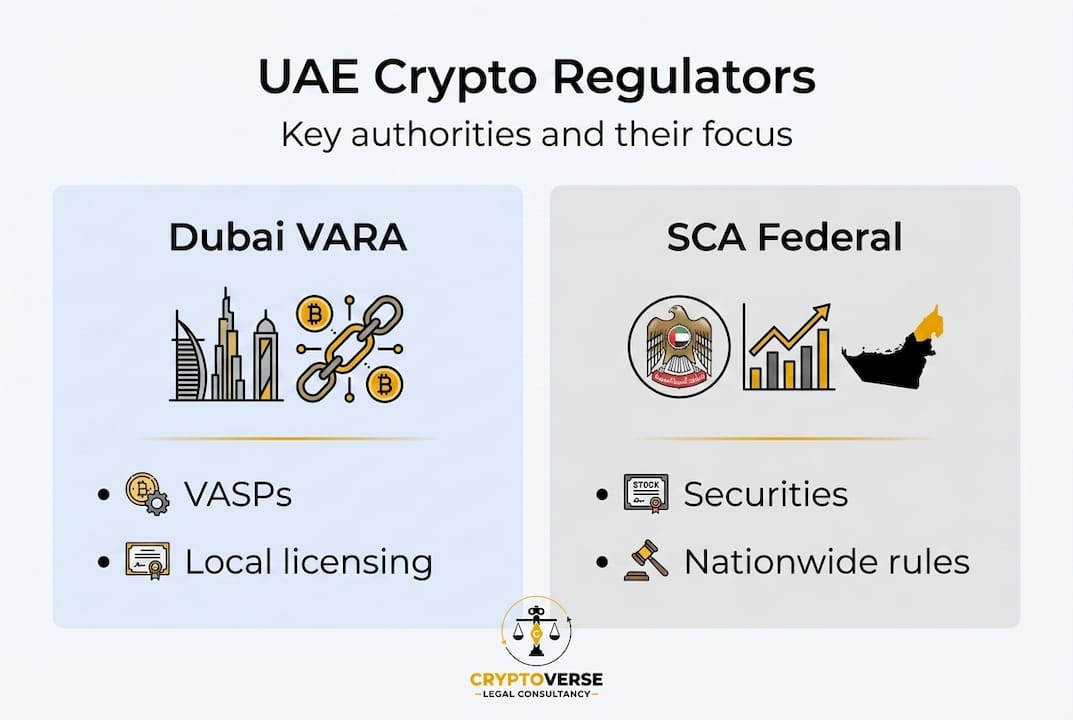
As noted in VARA's published framework, VARA governs Dubai while the SCA covers the wider UAE, creating a two-tier system where jurisdiction and activity type together determine the applicable licensing regime.
The Dubai Virtual Asset Regulatory Authority, known as VARA, is the most visible actor in this space. Established under Dubai Law No. 4 of 2022, it holds authority over virtually all virtual asset activity conducted within Dubai, with the exception of businesses operating inside the Dubai International Financial Centre. VARA's regime is notable for its granularity: it does not issue a single, blanket licence but instead requires businesses to obtain specific permissions for each regulated activity.
Beyond Dubai, the Securities and Commodities Authority governs virtual assets that fall within its securities framework on a federal level. This is particularly relevant for token issuers and investment platforms whose products may be classified as securities under UAE law. For those seeking crypto legal support in UAE across multiple Emirates, navigating SCA's federal reach alongside VARA's Dubai-specific rules is a common structural challenge.
The UAE's position is also regionally distinctive. Unlike many jurisdictions that have adopted a wait-and-see posture towards digital assets, the UAE has actively courted crypto businesses through regulatory clarity, designated free zones, and sandbox frameworks. This positions it not merely as a permissive location, but as a genuinely enabling one. Businesses exploring blockchain legal support frequently cite the UAE's collaborative regulatory tone as a key differentiator from European and North American counterparts.
It is also worth noting that regulatory perimeter questions, such as whether an airdrop constitutes a regulated activity, carry real legal consequences. The implications of airdrops under UAE law illustrate just how far the regulatory net extends, even to activities that many founders mistakenly treat as outside the formal compliance framework.
Decoding virtual asset licensing: VARA, SCA, and beyond
With an understanding of regulatory bodies, it is crucial to grasp how licensing actually works in the UAE's two-tier system.
A Virtual Asset Service Provider, or VASP, is defined under UAE law as any entity that conducts one or more virtual asset activities on behalf of customers. These activities include exchange services, transfer services, custody, administration, and the operation of trading platforms. A VASP must secure the appropriate licence from VARA or SCA depending on jurisdiction and activity.
VARA's activity-based licensing model
VARA's regime is activity-based, meaning that separate permissions are required for issuance, custody, exchange, and other regulated functions. A business intending to operate both a trading platform and a custody service must obtain separate approvals for each. This architecture is more demanding than a single-licence model but provides regulators and counterparties with precision about what a firm is authorised to do.
The typical licensing process under VARA follows these stages:
- Pre-application preparation: Assess which activities require licensing, identify the correct licence category, and confirm the entity structure (mainland Dubai versus a free zone).
- Initial approval (Provisional Approval): Submit a business plan, ownership structure, and details of key personnel for VARA's preliminary review.
- Minimum viable product review: Demonstrate that your technology platform meets VARA's technical standards before full approval.
- AML/KYC framework submission: Provide detailed anti-money laundering and know-your-customer policies, procedures, and controls.
- Operational licence issuance: Upon satisfactory review, VARA issues the operational licence, permitting commercial activity to begin.
SCA's federal regime
The SCA oversees virtual assets that qualify as securities or investment instruments at the federal level. Its licensing requirements overlap with VARA in certain cases, particularly where a Dubai-based firm issues tokens that the SCA may classify as investment contracts. Firms must carefully assess which regulator holds primary jurisdiction, as dual compliance obligations can arise for activities that span both frameworks.
A useful comparative exercise is examining how these requirements stack up against regimes elsewhere. For example, a comparison with New Zealand crypto laws demonstrates that the UAE's structured, activity-based approach provides more legal certainty, even if it demands more upfront compliance investment. Similarly, the EU crypto regulation framework under MiCA takes a similar activity-based stance, though with heavier capital requirements and longer approval timelines.
Key licence requirements
- Minimum capital: VARA specifies minimum paid-up capital thresholds that vary by activity type. Custody providers face higher requirements than exchange-only operators.
- Local presence: A physical office in Dubai is mandatory. Registered address services alone do not satisfy this requirement.
- Fit and proper assessment: Senior management, beneficial owners, and directors must each pass VARA's suitability review.
- Technology standards: The platform must meet cybersecurity and operational resilience standards specified in VARA's technology guidelines.
- Insurance: Professional indemnity and, in some cases, cyber insurance, are required for certain licence categories.
Pro Tip: Engaging a qualified legal adviser before drafting your business plan saves significant time. Regulators assess the quality of your application documents as a signal of your firm's governance maturity.
Practical compliance for crypto businesses in the UAE
Knowing how to obtain a licence is only half the process. Delivering on operational compliance is where firms win or lose their regulatory standing in practice.
Non-compliance with AML procedures remains the main reason for VASP licence rejection in the UAE. The pattern is consistent: firms invest heavily in technology and product but underestimate the complexity of building a credible AML/CFT framework. Regulators can identify the difference between a policy document assembled at pace and one that reflects genuine institutional commitment.

AML/KYC requirements in practice
Effective AML/KYC compliance in the UAE requires more than a template policy. At minimum, a regulated VASP must implement:
- Customer due diligence (CDD): Identity verification for all customers at onboarding, with enhanced due diligence for high-risk profiles, politically exposed persons (PEPs), and customers from high-risk jurisdictions.
- Transaction monitoring: Real-time or near-real-time screening of transactions against sanctions lists and internal risk thresholds.
- Suspicious activity reporting (SAR): Clear escalation procedures and timely reporting to the UAE Financial Intelligence Unit (uAEFIU).
- Travel Rule compliance: For transfers above the applicable threshold, the originator and beneficiary information must be transmitted between obliged entities. Detailed guidance on AML and Travel Rule obligations provides a useful baseline, though UAE-specific adaptations are necessary.
- Record-keeping: Transaction records, customer files, and compliance decisions must be retained for a minimum of five years and made available to VARA or SCA upon request.
Common compliance pitfalls
The following failures account for the majority of enforcement actions and licence rejections observed in practice:
- Inadequate screening technology that cannot handle the volume or complexity of customer flows.
- Compliance officers who lack virtual asset-specific knowledge or adequate seniority to enforce policies internally.
- Poor documentation of compliance decisions, particularly where high-risk onboarding decisions were approved without a recorded rationale.
- Failure to update AML policies in line with regulatory guidance updates, of which there have been several since VARA's establishment.
- Insufficient controls around crypto custody compliance, particularly where client assets are held in omnibus wallets without adequate segregation records.
Pro Tip: Build your compliance function before you build your customer base. Retrofitting AML controls onto a live operation is significantly harder than designing them in from the outset. Regulators reward firms that demonstrate this sequencing.
Operationally, compliance is also a matter of culture. A firm where the compliance officer holds genuine authority to pause onboarding or suspend a transaction performs better under regulatory scrutiny than one where compliance is subordinated to commercial pressure. VARA and SCA expect to see evidence of this governance structure in board minutes, organisational charts, and staff training records.
Comparing the UAE's approach with other global jurisdictions
To appreciate UAE advantages, it helps to see how its regulation compares to global leaders.
"The UAE's regulatory environment is seen as more agile and business-friendly than many Western counterparts."
This characterisation is well-supported by market data. The EU's MiCA framework, which came into full effect in 2024, imposes significant capital adequacy requirements, passporting obligations, and white paper disclosure mandates that collectively create a compliance burden suited to well-resourced incumbents. The UK's FCA registration process for cryptoasset businesses has seen rejection rates exceeding 80% in recent cohorts, reflecting a highly cautious supervisory posture. Singapore's MAS, whilst respected for its clarity, applies substantial minimum financial requirements and a relatively slow approval timeline.
Comparative overview
| Jurisdiction | Typical approval timeline | Regulatory posture | Capital requirements |
|---|---|---|---|
| UAE (VARA) | 3 to 6 months | Enabling and structured | Moderate, activity-based |
| EU (MiCA) | 6 to 18 months | Prescriptive | High |
| UK (FCA) | 12 to 24 months | Restrictive | Moderate to high |
| Singapore (MAS) | 6 to 12 months | Cautious but clear | High |
The UAE's posture is distinctive in several respects. It operates regulatory sandboxes that allow firms to test products under supervised conditions before full commercial launch. It maintains open dialogue with the industry through VARA's published rulebooks and consultation papers. It offers a range of jurisdictional options, including mainland Dubai, DIFC, and ADGM, each with specific advantages depending on your target market and product structure.
The crypto-friendly countries guide maps a broader set of options, but for businesses targeting the Middle East, South Asia, or Africa, the UAE's geographic and reputational positioning is difficult to replicate. By contrast, firms focused on European retail distribution may find that establishing in the UAE as a primary base adds complexity around passporting and customer access under MiCA's framework.
For firms weighing the UK crypto business rules against the UAE option, the contrast in regulatory tone is striking. The FCA's emphasis on consumer protection has resulted in stringent marketing restrictions and onboarding friction that affect product design fundamentally.
When choosing the UAE as your regulatory home, the following factors favour that decision:
- Your primary markets are the GCC, MENA, or South and Southeast Asia.
- You require a faster path to commercial operation than European timelines permit.
- Your business model covers multiple activity types that benefit from VARA's defined licensing menu.
- You intend to leverage the UAE's strong network of institutional investors and family offices.
Why understanding UAE crypto regulation beats following global trends blindly
Many foreign firms enter the UAE licensing process with a compliance framework built for another jurisdiction, usually Europe or Singapore, and assume the adaptation will be minimal. This is a consistent and expensive error. UAE regulations are not simply a lighter version of MiCA or MAS. They reflect a distinct regulatory philosophy, one shaped by the UAE's specific risk tolerance, economic policy objectives, and the institutional culture of its regulators.
VARA and SCA expect applicants to demonstrate genuine local commitment. That means a real office, locally knowledgeable compliance staff, and documentation that reflects an understanding of the UAE Federal AML Law rather than a generic FATF policy template. Firms that treat the UAE application as a copy-paste exercise from their European filing regularly find themselves in a prolonged back-and-forth that delays approval by months.
A comparison with New Zealand crypto laws or other jurisdictions can provide useful benchmarks, but local regulatory fluency is what actually moves applications forward. Firms that invest in understanding the specific expectations of UAE regulators, and that engage with those regulators proactively and transparently, consistently achieve better outcomes than those who rely on template compliance.
The UAE rewards preparation, authenticity, and substance. That is a principle worth internalising before any application is filed.
Expert legal support for your UAE crypto venture
Navigating VARA and SCA requirements demands more than a general understanding of crypto law. It requires precise, jurisdiction-specific legal counsel built around the specific demands of UAE regulators.

CRYPTOVERSE Legal Consultancy provides end-to-end support for crypto businesses seeking to establish, licence, and operate in the UAE. From drafting AML/CFT frameworks that satisfy VARA regulatory guidance to structuring entities for SCA licensing compliance, our team works across the full regulatory lifecycle. Our UAE blockchain lawyers bring direct experience with VARA, SCA, DFSA, FSRA, and CBUAE engagements. Whether you are preparing your first licence application or conducting a compliance audit of an existing operation, contact us to book a consultation and assess your regulatory readiness.
Frequently asked questions
Who regulates crypto businesses in the UAE?
VARA governs Dubai while the SCA oversees most other Emirates and activities at the federal level, meaning your applicable regulator depends on where you operate and what services you offer.
What does a VASP licence allow you to do?
A VASP licence authorises you to legally provide regulated virtual asset services, including exchange, custody, transfer, and platform operations, within the UAE under the supervising authority's framework.
What are the main reasons for VASP licence rejection?
Non-compliance with AML procedures and poor documentation are the most frequent grounds for rejection, accounting for a substantial majority of unsuccessful applications across both VARA and SCA processes.
Do UAE crypto regulations apply to foreign companies?
Yes, foreign entities must comply with UAE-specific rules when operating within the country or actively serving UAE-based clients, regardless of where the firm is incorporated.
How fast can a crypto licence be obtained in the UAE?
The UAE's more agile environment means approval timelines of three to six months are achievable for well-prepared applicants, which is considerably faster than the twelve to twenty-four month processes common in the UK or EU.
Recommended
- UAE Blockchain Legal Frameworks 2026: Navigate Licensing - Cryptoverse Legal Consultancy
- Crypto law terminology explained for UAE compliance 2026 - Cryptoverse Legal Consultancy
- Regulatory Compliance for Virtual Asset Platform Operators in the UAE - Cryptoverse Legal Consultancy
- Regulatory Compliance for Virtual Asset Brokers in the UAE - Cryptoverse Legal Consultancy