

TL;DR:
- Successful global VASP licensing requires multiple jurisdiction-specific licenses, not a single permit.
- Different regulators in the UAE, EU, and other regions have unique requirements, including physical presence and asset lists.
- Proper planning, compliance, and regulator engagement are essential to avoid delays and rejections.
Many virtual asset service providers (VASPs) and crypto startups enter new markets with a fundamental misconception: that holding one regulatory licence is sufficient for global operations. This assumption leads to costly delays, regulator escalations, and in some cases, complete market shutdowns. The reality of cross-border licensing is considerably more complex, with each jurisdiction operating under its own statutory framework, approved asset lists, and capital requirements. This guide breaks down what you actually need to know to operate legally across the UAE, the European Union, and beyond, with a focus on practical steps, accurate comparisons, and jurisdiction-specific requirements.
Key Takeaways
| Point | Details |
|---|---|
| Multiple licences needed | Most crypto businesses need at least two licences to operate cross-border legally. |
| UAE requires local setup | ADGM and similar UAE regimes demand a local office and significant capital commitment. |
| MiCA enables EU passporting | A single MiCA licence lets you serve 27 EU countries but still requires strategic groundwork. |
| Mistakes are costly | Missed compliance steps or poor preparation commonly lead to delays or rejections. |
| Expert support is key | Specialist advisors can streamline complex, multi-jurisdictional licence processes. |
Understanding cross-border crypto licensing: Why multiple licences matter
The belief that a single licence unlocks all markets is one of the most persistent misconceptions in the VASP industry. In practice, no single national or regional regulator has the statutory remit to authorise virtual asset activities in another jurisdiction. Every country or financial free zone imposes its own requirements around permitted activities, capital adequacy, local presence, and the specific virtual assets that may be traded or custodied.
For most globally operating VASPs, holding multiple licences is not optional. It is the operational baseline. The question is not whether you need more than one licence; it is how to sequence your applications efficiently, manage costs, and avoid compliance gaps that could expose your business to enforcement action.
Key licensing obstacles for global VASPs
The following obstacles consistently arise in multi-jurisdictional licensing engagements:
- Activity-specific authorisation: In the Abu Dhabi Global Market (ADGM), the Financial Services Regulatory Authority (FSRA) licenses activity-based services such as custody, multilateral trading facility (MTF) exchange, and broker-dealer functions. Capital requirements range from USD 250,000 to over USD 1 million depending on activity, and physical presence is mandatory.
- Jurisdiction-specific token lists: The FSRA maintains a firm-specific Accepted Virtual Assets (AVA) list, meaning the tokens you can offer in ADGM are subject to regulatory approval. This is not a formality; it directly shapes which products you can launch.
- Local presence mandates: Several jurisdictions, particularly within the UAE, require a licensed entity to maintain a staffed physical office in-country. Remote or nominee arrangements are not acceptable.
- Passporting limitations: The EU's Markets in Crypto-Assets Regulation (MiCA) offers passporting for CASPs (crypto-asset service providers), enabling a single licence in one EU member state to be extended across all 27 states via a notification procedure. Capital requirements under MiCA start at €50,000 and can exceed €150,000. No physical presence is required in host states.
Pro Tip: Begin your licensing strategy by mapping your business model precisely. Define where your users are located, which virtual assets you intend to support, and what services you will provide. This analysis determines which jurisdictions require licensing and in what order you should pursue them.
Understanding ADGM crypto assets and the EU crypto-asset regulation frameworks at the outset of your planning is not a box-ticking exercise. It is the foundation of a sustainable multi-market strategy.
UAE licensing pathways: ADGM, VARA and SCA compared
The UAE's crypto regulatory landscape is unique globally in that it hosts multiple distinct regulators, each with separate statutory remit, applicable geography, and licensing architecture. For any VASP seeking to operate in the UAE, the choice of regulatory pathway is a strategic decision with significant operational and financial consequences.
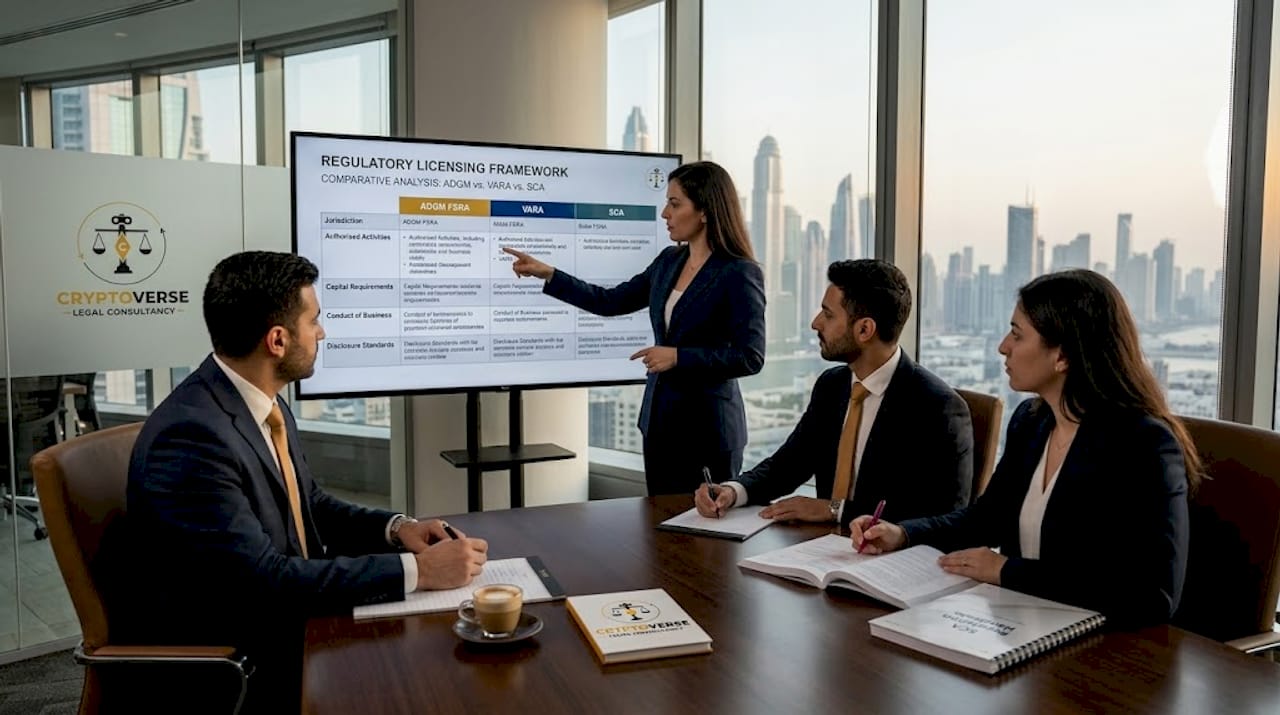
Overview of the three primary UAE crypto regulators
ADGM (Abu Dhabi Global Market) via FSRA: ADGM is a financial free zone in Abu Dhabi. The FSRA licenses activity-specific virtual asset activities including custody, MTF exchange, and broker-dealer services. Capital requirements sit between USD 250,000 and over USD 1 million, depending on the category of licence. Physical presence within ADGM is required, and all activities are subject to the FSRA's AVA approval process.
VARA (Virtual Assets Regulatory Authority): VARA oversees virtual asset businesses operating in Dubai (excluding the Dubai International Financial Centre). Launched under Dubai Law No. 4 of 2022, VARA has developed a comprehensive rulebook covering exchanges, brokers, custodians, lending platforms, and more. VARA is known for its structured approach to Virtual Asset Service Provider (VASP) licences, with requirements tailored to the specific activities and risk profile of each applicant.
SCA (Securities and Commodities Authority): The SCA operates at the federal level and has jurisdiction over crypto assets that qualify as securities or commodities across the wider UAE (outside of free zones). VASPs offering tokenised securities or structured crypto products targeting mainland UAE clients may fall under SCA remit, particularly for initial token offerings and exchange-traded crypto instruments.
Comparison of UAE licensing regimes
| Regulator | Geography | Activities covered | Capital requirement | Physical presence |
|---|---|---|---|---|
| FSRA (ADGM) | Abu Dhabi free zone | Custody, MTF, broker-dealer | USD 250k to 1M+ | Required |
| VARA | Dubai (excl. DIFC) | Exchange, custody, broker, lending | Variable by activity | Required |
| SCA | Federal UAE (mainland) | Tokenised securities, ICOs | Variable | Required |
Choosing the right UAE regime for your business
- If you are establishing a trading platform or custodian targeting institutional clients in Abu Dhabi, the FSRA pathway in ADGM offers the clearest institutional framework.
- If your operations are focused on retail or institutional clients in Dubai with a broad range of VASP services, VARA regulations and licensing are the applicable route.
- If your products involve tokenised securities, structured products, or public token offerings targeting the UAE mainland, SCA licensing for VASPs is relevant and should be assessed alongside your corporate structuring plan.
Your choice between these pathways should never be made on cost alone. Regulatory fit, the scope of permitted activities, and the speed of the approval process are equally material factors.
Europe's MiCA regime: Passporting and unified compliance
The introduction of MiCA represents the most significant regulatory development in global crypto law since the Financial Action Task Force (FATF) updated its guidance on virtual assets. For startups and established VASPs seeking access to European markets, MiCA offers a structurally distinct pathway from anything available in the UAE or Asia-Pacific.
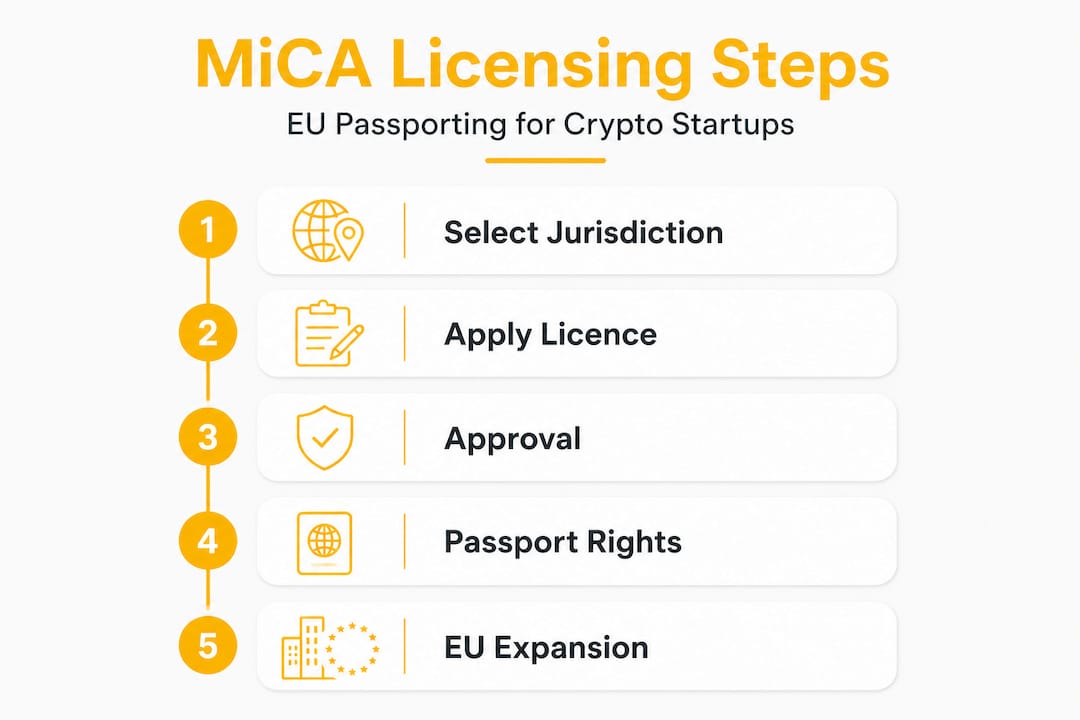
The single licence, passport everywhere model
Under MiCA, a crypto-asset service provider authorised in one EU member state can passport services across all 27 EU member states via a straightforward notification procedure. There is no requirement to establish a physical entity in each host state. Capital requirements range from €50,000 for basic CASP authorisation to over €150,000 for firms providing multiple services or managing significant assets.
Common EU licensing jurisdictions for CASPs
Ireland and Lithuania are among the most frequently selected member states for initial MiCA authorisation. Both offer regulatory authorities with established crypto licensing processes, relatively predictable timelines, and commercially sensible cost structures. Germany, France, and the Netherlands are also notable but carry more intensive supervisory expectations.
MiCA CASP licensing data by jurisdiction
| Member state | Regulatory authority | Estimated timeline | Notable feature |
|---|---|---|---|
| Ireland | Central Bank of Ireland | 6 to 12 months | English-language process, EU financial hub |
| Lithuania | Bank of Lithuania | 3 to 6 months | Faster process, lower operational costs |
| Germany | BaFin | 6 to 12 months | Rigorous but prestigious |
| Netherlands | AFM / DNB | 6 to 9 months | Strong institutional credibility |
Steps to passport your MiCA licence across the EU
- Select the most suitable member state for initial authorisation based on your timeline, cost, and operational model.
- Prepare and submit your CASP authorisation application, including AML/CTF policies, governance documentation, and proof of required capital.
- Obtain authorisation from the national competent authority (NCA) of the chosen member state.
- Notify the NCA of your intent to provide services in additional EU member states, specifying the services and countries in scope.
- Wait for the notification to be communicated to host-state NCAs, typically within a few weeks of submission.
- Commence compliant operations in host states, subject to the rules of MiCA and any supplementary national requirements.
The MiCA rules for tokenized assets and the broader MiCA CASP compliance guide provide essential reading for any VASP structuring its EU entry strategy.
Critical challenges and tips for smooth multi-jurisdictional licensing
Understanding the regulatory regimes is only half the battle. Execution matters as much as strategy. The majority of licence application delays and rejections arise not from lack of intent but from procedural missteps, documentation errors, and inadequate preparation.
Where applicants commonly go wrong
The following issues are the most frequent causes of application delays or outright refusals:
- Incomplete or inconsistent documentation: Regulators assess not just the substance of your application but the quality of your governance documents. AML/CTF policies that are generic, inconsistent with your described business model, or lifted from template libraries without customisation are a reliable pathway to rejection.
- Business model mismatch: Applying for a licence that does not match your actual operational model is a common error. For example, applying for a broker-dealer licence in ADGM when your platform functions as an exchange will result in a misaligned application that requires significant remediation.
- Overlooking the AVA process in ADGM: Many applicants are surprised to discover that the FSRA's activity-based licensing framework requires firm-specific approval of each virtual asset on your platform. Failing to account for this in your launch timeline creates material delays.
- Underestimating passporting procedural steps: While MiCA passporting simplifies cross-border EU access, it still requires formal notification, correct categorisation of services, and compliance with any host-state supplementary requirements. Treating it as automatic is a mistake.
Steps for a smooth, compliant multi-jurisdictional launch
- Conduct a thorough business model analysis and identify all applicable jurisdictions before submitting any application.
- Engage local legal counsel in each target jurisdiction to obtain current regulatory interpretations, not just published guidance.
- Build your AML/CTF and governance frameworks to the standard of the most demanding regulator in your target set.
- Establish the required physical presence early, particularly for UAE licensing, to avoid delays caused by premise fit-out and staffing timelines.
- Maintain a compliance calendar that tracks application status, renewal deadlines, and regulatory reporting obligations across all jurisdictions.
Pro Tip: Regulators in the UAE and EU are not adversarial, but they are thorough. Proactive communication with the relevant authority before submission, sometimes referred to as pre-application engagement, can significantly reduce the risk of a formal refusal and shorten the overall timeline.
Regulatory interpretations evolve faster than published rulebooks. What was acceptable practice under a prior version of VARA's rulebook may not satisfy current requirements. Staying current requires active monitoring, not periodic reviews.
For Dubai VARA licensing specifically, the rulebook has undergone several updates since VARA's establishment, making ongoing legal counsel a practical necessity rather than a discretionary cost.
Our take: What most crypto licence guides don't reveal
Most licensing guides focus on checklists: capital amounts, document lists, timelines. What they consistently omit is the significance of regulatory relationships and the interpretive flexibility that regulators retain even within published frameworks.
Published guidance represents the minimum threshold, not the complete picture. Regulators exercise judgement. We have seen well-capitalised, well-documented applications face prolonged review because the applicant's governance arrangements raised informal concerns that were never articulated in a formal refusal. Those concerns only surface through direct engagement.
The startups that navigate multi-jurisdictional licensing most efficiently are those that treat compliance as a structural commitment from day one, not as a final milestone before product launch. They hire or retain compliance expertise before they need it, build their policies around their actual operating model, and engage regulators as stakeholders rather than gatekeepers.
Understanding why licence applications fail before you apply is one of the most valuable investments of time and legal budget you can make.
How Cryptoverse Legal can help with your cross-border crypto journey
Navigating the combined complexity of UAE and EU licensing requires more than familiarity with published rules. It requires current, jurisdiction-specific knowledge and the ability to present your business model in a form that regulators recognise and trust.
CRYPTOVERSE Legal advises VASPs and crypto startups across the full licensing lifecycle, from business model scoping and pre-application engagement through to licence approval and ongoing compliance. Whether you need Dubai crypto licensing advisory support for a VARA or FSRA application, broader digital asset legal support for corporate structuring and AML/CTF policy design, or EU crypto regulatory guidance under MiCA, our team brings the regulatory depth and practical experience to move your application forward efficiently. Contact us to discuss your licensing strategy.
Frequently asked questions
Do I need a physical office for a UAE crypto licence?
Yes, a physical presence is required for licensing approval across UAE regulators including ADGM, where the FSRA mandates that licensed entities maintain an established office within the free zone.
How quickly can a MiCA licence be used in other EU countries?
A MiCA licence can typically be passported within 3 to 6 months after initial member-state authorisation, following the formal notification procedure to host-state authorities.
Is the capital requirement the same for all EU crypto licences under MiCA?
No, capital requirements under MiCA vary between €50,000 and €150,000 or more, depending on the category of services provided and the specific member state's supplementary requirements.
Can a UAE licence cover EU countries automatically?
No, a UAE licence has no regulatory effect in the EU. You must obtain separate CASP authorisation under the MiCA regime in an EU member state to provide services across European markets.
What causes most cross-border crypto licence applications to fail?
Documentation errors, a poorly defined or misrepresented business model, and failure to address local compliance requirements are the most frequent causes of rejection across both UAE and EU licensing processes.
Recommended
- Cayman Crypto: Skip the Licence? | Cryptoverse Lawyers
- [Bermuda DABL: Class T, M & F Guide | ]Cryptoverse Lawyers](https://cryptoverselawyers.io/bermuda-digital-asset-business-licence-guide/)
- Decoding the Crypto License Puzzle - Cryptoverse Legal Consultancy
- Why crypto-native law firms cut UAE licensing by 30% - Cryptoverse Legal Consultancy