

TL;DR:
- Cross-border crypto businesses must comply with multiple jurisdictions' rules, including FATF standards.
- Non-compliance risks hefty fines, loss of banking access, and criminal penalties, harming growth.
- Early investment in structured compliance offers a competitive advantage and smoother market entry.
Crypto's reputation as borderless technology does not translate into borderless legal freedom. The moment your business touches users, wallets, or transactions in a second jurisdiction, you inherit that jurisdiction's regulatory obligations — and the two frameworks rarely align neatly. Regulators worldwide have moved decisively since 2022 to close gaps that allowed virtual asset service providers (VASPs) to sidestep local rules. Today, operating across borders without a structured compliance architecture puts banking relationships, licences, and investor confidence at serious risk. This article sets out the core principles, key authorities, reporting obligations, and penalties that every cross-border crypto business must understand.
Key Takeaways
| Point | Details |
|---|---|
| Global rules apply | FATF, OECD and local authorities define compliance standards for all cross-border crypto activity. |
| UAE is progressive but strict | Dubai and Abu Dhabi offer fintech sandboxes and tax incentives but set high standards for VASP licensing and AML controls. |
| Cost of non-compliance is steep | Fines can hit millions; lost trust may prevent banking partnerships or business survival. |
| Reporting is non-negotiable | Automated tax and transaction data reporting is mandatory for all VASPs with UAE links. |
| Trust is your edge | Businesses that prioritise real compliance win on credibility, investor confidence, and market access. |
Understanding cross-border crypto compliance: Core principles
Cross-border crypto compliance refers to the full set of legal, regulatory, and operational obligations a VASP must satisfy when its activities span more than one jurisdiction. This goes beyond simply registering an entity in a favourable location. It requires that the business meets the rules of every country where it has users, conducts transactions, holds assets, or employs staff.
Why is cross-border compliance structurally more demanding than domestic compliance? Because each jurisdiction applies its own definitions of a virtual asset, its own licensing thresholds, and its own customer due diligence standards. A business that is fully compliant in Singapore may still breach UAE rules if it onboards UAE residents without a local licence. A token classified as a utility token in one market may be treated as a security in another.
The FATF Travel Rule: A global baseline
The Financial Action Task Force (FATF), the global standard-setter for anti-money laundering (AML) and counter-terrorist financing (CTF), publishes Recommendation 16, commonly known as the Travel Rule. Under this rule, VASPs must collect and transmit originator and beneficiary information, including full name, wallet address, and date of birth or physical address, for every qualifying transfer. In the UAE, the threshold is AED 3,500. The Travel Rule now applies across 99 jurisdictions, making it the most widely adopted cross-border crypto standard in force.
Key compliance concepts every cross-border VASP must embed into its operations include:
- Know Your Customer (KYC): Verified identity data for every user, including source of funds for high-value accounts.
- AML/CTF screening: Ongoing transaction monitoring against sanctions lists and suspicious activity indicators.
- Travel Rule transmission: Structured data sharing between the originating VASP and the beneficiary VASP before or simultaneously with the transfer.
- Suspicious Transaction Reports (STRs): Mandatory reporting to the relevant financial intelligence unit when red flags are identified.
- Record retention: Most jurisdictions, including the UAE, require a minimum five-year retention period for transaction records and customer files.
How global standards shape local enforcement
FATF recommendations do not carry direct legal force, but they are implemented through national legislation. In the UAE, the key pillars of UAE crypto regulation are built on Federal Decree-Law No. 20/2018 and its amendments, alongside regulator-specific rulebooks issued by VARA, the DFSA, and the FSRA. When FATF updates its standards, the UAE has consistently moved quickly to legislate accordingly, which is a key reason the country was removed from the FATF grey list in 2024.
| Compliance obligation | Domestic VASP | Cross-border VASP |
|---|---|---|
| KYC on all users | Required | Required in each jurisdiction served |
| Travel Rule transmission | Above threshold | Must also verify counterpart VASP is regulated |
| STR filing | Single FIU | Multiple FIUs may apply |
| Licence requirement | One jurisdiction | Licence per jurisdiction, or approved equivalence |
| Data retention | Local standard | Highest standard across all active jurisdictions |
"The Travel Rule is not optional compliance. It is the baseline against which regulators in nearly every major crypto market now assess VASP fitness."
Who regulates cross-border crypto in the UAE and beyond?
Having established what cross-border compliance entails, it is important to understand which bodies enforce these rules and what makes the UAE framework both rigorous and commercially attractive.
UAE regulatory authorities
The UAE operates a multi-regulator model, which reflects the country's distinct legal zones. The three primary authorities relevant to VASPs are:
- VARA (Virtual Assets Regulatory Authority): Established under Dubai Law No. 4 of 2022, VARA holds statutory remit over all virtual asset activities in Dubai, including the free zones, with the exception of the Dubai International Financial Centre (DIFC).
- DFSA (Dubai Financial Services Authority): Regulates crypto-related activities within the DIFC, applying its own investment token and crypto token frameworks.
- ADGM FSRA (Financial Services Regulatory Authority of Abu Dhabi Global Market): Oversees virtual asset businesses within the Abu Dhabi Global Market (ADGM) free zone under its Digital Asset Framework.
Under Federal Decree-Law No. 10/2025, VARA, ADGM FSRA, and DFSA are all required to enforce AML/CTF obligations consistent with FATF standards and to issue VASP licences before any regulated activity may commence. Businesses operating without a licence face criminal exposure, not merely administrative penalties.
Licensing: Costs, timelines, and capital requirements
Understanding platform operator compliance rules in the UAE requires attention to specific resource commitments. The typical parameters for a VARA licence application are as follows:
- Minimum capital requirements range from USD 100,000 to USD 1,000,000 depending on the regulated activity category.
- Application fees range from AED 40,000 to AED 150,000 in the first year, exclusive of legal and advisory costs.
- Timelines from submission to approval typically run three to six months for well-prepared applications.
- A detailed business plan, source of funds declaration, AML/CTF policy, and technology audit are standard documentation requirements.
- Ongoing annual licence fees and regulatory reporting obligations apply post-approval.
Other influential regulatory jurisdictions
Cross-border VASPs must also account for rules in the markets where their users reside. Key frameworks include:
- EU MiCA (Markets in Crypto-Assets Regulation): Full implementation from December 2024 onwards. Passport rights within the EU, but strict reserve, disclosure, and governance requirements for stablecoin issuers.
- MAS (Monetary Authority of Singapore): Payment Services Act licensing for digital payment token services.
- FCA (UK): Registration requirement for crypto asset firms, with a registered firm list published publicly.
- FINTRAC (Canada): Money service business registration and Travel Rule implementation for all crypto exchanges.
Pro Tip: Start your licensing process at least six months before planned launch. Regulators in the UAE and the EU routinely request supplementary documentation, and delays in document preparation are the single largest cause of timeline overruns.
Critical reporting, record-keeping and cross-jurisdictional tax rules
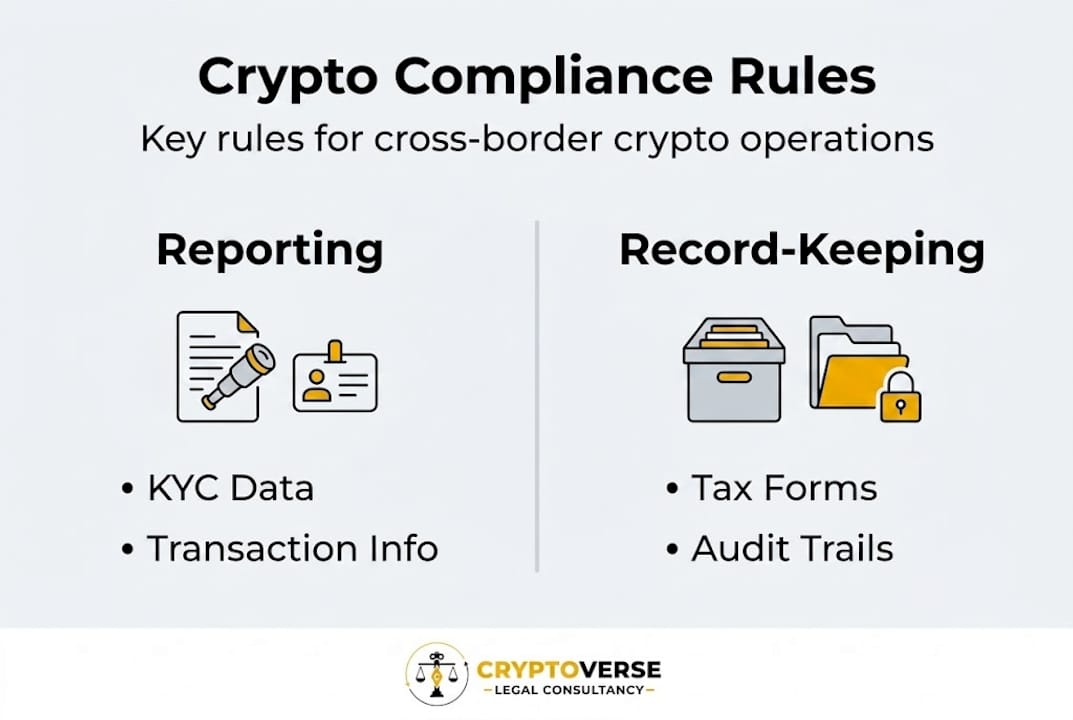
Once you understand which authorities govern your operations, the next layer of obligation involves specific reporting and documentation standards. These rules have expanded significantly since the OECD published its Crypto-Asset Reporting Framework (CARF).
CARF and automatic exchange of information
CARF is the international standard requiring automatic exchange of tax-relevant information on crypto transactions between jurisdictions. The UAE has committed to implementing CARF, meaning that RCASPs (Reporting Crypto-Asset Service Providers) must report user data to the UAE Ministry of Finance where a relevant nexus exists, including residency, management location, or branch operation in the UAE.
The nexus hierarchy under UAE CARF guidance works as follows:
- A RCASP incorporated in the UAE reports all relevant users.
- A RCASP managed or controlled from the UAE reports where incorporated-entity rules do not apply.
- A branch operating in the UAE reports if neither of the above conditions applies to the parent entity.
Where a RCASP has nexus in multiple jurisdictions, reporting follows the hierarchy to avoid duplication while ensuring full coverage.
What must be reported under CARF
The categories of reportable information under CARF include:
- User identity data: Full legal name, date of birth, tax identification number, and jurisdiction of tax residence.
- Transaction data: Type of crypto asset, transaction volume in USD equivalent, and counterpart wallet details for transfers above the de minimis threshold.
- Account balances: Aggregate holdings at year-end for each reportable account.
Businesses must collect this data at onboarding through their KYC process and maintain it in a format compatible with automatic exchange. The VARA transfer rules in Dubai also require that transfer-level data be retained to support both CARF reporting and Travel Rule compliance.
Minimum customer due diligence requirements
For every user, the minimum due diligence standard across UAE and FATF-aligned jurisdictions requires:
- Government-issued photo identification, verified against a live selfie or biometric check.
- Proof of residential address dated within three months.
- Source of funds declaration for transactions above the enhanced due diligence threshold.
- Politically Exposed Person (PEP) and sanctions screening at onboarding and on an ongoing basis.
Pro Tip: Cross-check user-supplied address and tax residency data against IP geolocation and payment method origin at onboarding. Inconsistencies are a primary trigger for regulatory scrutiny during audits. Documenting your cross-check process demonstrates proactive compliance to examiners.
The cost of non-compliance: Fines, penalties and reputational risk
Understanding the legal requirements carries limited value unless you also understand what happens when businesses fail to meet them. The enforcement record from 2024 and 2025 makes clear that regulators are no longer issuing warnings alone.

Recent enforcement data
The figures from the past twelve months are material:
- MiCA enforcement actions totalled €486 million in 2025, an 18% increase year on year, with an average per-case penalty of €4.8 million to €6.8 million across 224 cases. 68% of those cases involved unlicensed CASPs (crypto-asset service providers).
- In the UAE, VARA and federal authorities issued AED 339 million in penalties in the first half of 2025 alone.
- Binance's global settlement reached USD 4.3 billion, the largest crypto enforcement outcome in history, arising directly from AML failures and unlicensed operations across multiple jurisdictions.
"The cost of building a compliant framework is a fraction of the cost of a single major enforcement action, before reputational damage is even considered."
Why non-compliance blocks business growth
Beyond fines, the operational consequences of non-compliance are severe:
- Banking access: UAE and European banks conduct enhanced due diligence on crypto clients. A business without a valid licence or with an adverse regulatory history is routinely declined for corporate accounts and payment rails.
- Partnership risk: Institutional partners, including payment processors, custodians, and market makers, require counterpart compliance certification before onboarding.
- Investor confidence: Venture capital and family office investors increasingly require regulatory clean status before closing rounds. An enforcement action, even a minor one, can suspend a fundraising process.
- Criminal liability: In the UAE, operating a VASP without a licence carries criminal as well as administrative penalties under Federal Decree-Law No. 10/2025.
Steps to avoid these outcomes
The supervision and enforcement framework applied by VARA and federal authorities rewards proactive engagement. Businesses that take the following steps significantly reduce their enforcement exposure:
- Obtain the correct licence before launching any regulated activity.
- Implement a documented AML/CTF policy aligned with FATF standards and reviewed at least annually.
- Appoint a qualified Money Laundering Reporting Officer (MLRO) with the relevant technical knowledge.
- Conduct periodic independent audits of Travel Rule transmission and KYC record quality.
- Maintain an escalation policy for STRs that defines response timelines and responsible personnel.
The compliance investment associated with these steps is substantial. However, as AML frameworks demonstrate, the cost of a properly structured compliance programme is consistently lower than the financial and operational cost of enforcement, remediation, and reputational recovery.
What most miss about cross-border crypto compliance
The prevailing view in early-stage crypto ventures is that compliance is a drag on growth, a cost centre to be minimised until scale demands attention. This view is demonstrably incorrect, and those who hold it tend to learn the lesson at considerable expense.
The businesses that invest in structured compliance from day one acquire a durable commercial advantage. Stable banking relationships, which remain the single largest operational constraint for crypto businesses globally, flow to licensed, compliant entities. Institutional counterparts, who represent the highest-value segment of the market, conduct thorough due diligence before engagement, and the quality of your compliance infrastructure is a direct factor in their decision.
There is also a market positioning dimension. When regulators in a new jurisdiction assess whether to grant a licence, they evaluate the applicant's compliance history across all prior jurisdictions. A clean record is a material asset during the VASP licensing process and can compress timelines and reduce scrutiny.
The real cost is not compliance itself. It is the opportunity cost of lost partnerships, declined banking applications, and delayed market entry that accumulates when compliance is treated as an afterthought. Forward-thinking founders treat the licence, the AML policy, and the Travel Rule infrastructure as core product components from inception.
Expert legal support for compliance success
Navigating cross-border crypto compliance requires specific expertise in both the regulatory frameworks and the practical mechanics of virtual asset operations.

CRYPTOVERSE Legal Consultancy advises VASPs, exchanges, and founders across the UAE's regulatory landscape, including VARA regulations and licensing, AML/CTF policy design, and multi-jurisdictional structuring. Our team has direct experience with VARA regulated activities and can guide your business from pre-application through to full regulatory approval. Whether you need a Travel Rule compliance review, a CARF readiness assessment, or end-to-end digital asset legal support, we deliver regulator-ready frameworks built for practical operation. Contact CRYPTOVERSE Legal to arrange a consultation tailored to your compliance requirements.
Frequently asked questions
What is the Travel Rule and who does it apply to in the UAE?
The Travel Rule requires VASPs to transmit detailed sender and receiver information for crypto transfers above AED 3,500, impacting all regulated exchanges, brokers, and custodians operating in or serving users in the UAE.
What are the penalties for non-compliance with cross-border crypto regulations?
Penalties range from multi-million dirham fines in the UAE, with AED 339 million issued in H1 2025 alone, to up to 10% of global turnover under MiCA in the EU, and may include criminal liability for unlicensed operation.
How long does it take to get a VASP licence in Dubai?
The typical licensing timeline ranges from three to six months, depending on documentation quality and capital requirements, with minimum capital from USD 100,000 to USD 1,000,000 depending on activity type.
Who must report under the UAE's Crypto-Asset Reporting Framework (CARF)?
Any crypto exchange or provider with a UAE nexus, including residents, branches, and entities managed from the UAE, must report relevant user data automatically under CARF to the UAE Ministry of Finance.