

TL;DR:
- Web3 corporate structuring involves creating multiple legal entities like DevCo, TokenCo, and DAOs to manage compliance, liability, and investor trust. The dual-entity and layered wrapper models help separate operational, token issuance, and governance functions, enabling regulatory adherence and credibility. Proper entity setup costs between $15,000 and $50,000, and deferred structuring risks significant legal and financial penalties.
Corporate structuring in Web3 is defined as the deliberate design of multiple legal entities to separate operational, token issuance, and governance functions, with the primary objective of managing regulatory compliance, limiting liability, and enabling investor confidence. The industry term for this practice is multi-entity architecture, and it is the foundational legal framework for any serious Web3 venture in 2026. A standard setup typically combines a DevCo (the operating company), a TokenCo (the token issuance and treasury vehicle), and an optional DAO wrapper for decentralised governance. Understanding what is corporate structuring in Web3 is not an academic exercise. It directly determines whether your project can raise capital, obtain a licence from regulators such as VARA or the SCA, and survive regulatory scrutiny. Setup costs range from $15,000 to $50,000, with a formation timeline of four to eight weeks. That investment is modest relative to the legal exposure of getting it wrong.
What is corporate structuring in Web3 and how does multi-entity architecture work?
Multi-entity architecture in Web3 assigns distinct legal, financial, and operational roles to separate entities, preventing a single regulatory action or liability event from collapsing the entire project. The standard multi-entity structure pairs a DevCo with a TokenCo, each incorporated in jurisdictions suited to their specific functions.
The core components of a typical Web3 multi-entity structure are:
- DevCo (Development Company): Usually a Delaware C-corporation or a Cayman Islands exempted company. This entity employs the core team, holds intellectual property, enters into service contracts, and interfaces with institutional investors through conventional equity instruments. It is the operational hub of the project.
- TokenCo (Token Issuance Vehicle): Incorporated in a crypto-friendly jurisdiction such as the British Virgin Islands, Switzerland (under FINMA oversight), or Singapore (under MAS). This entity manages token issuance, controls the project treasury, and holds digital assets. Separating it from DevCo prevents token-related regulatory exposure from contaminating the operating company.
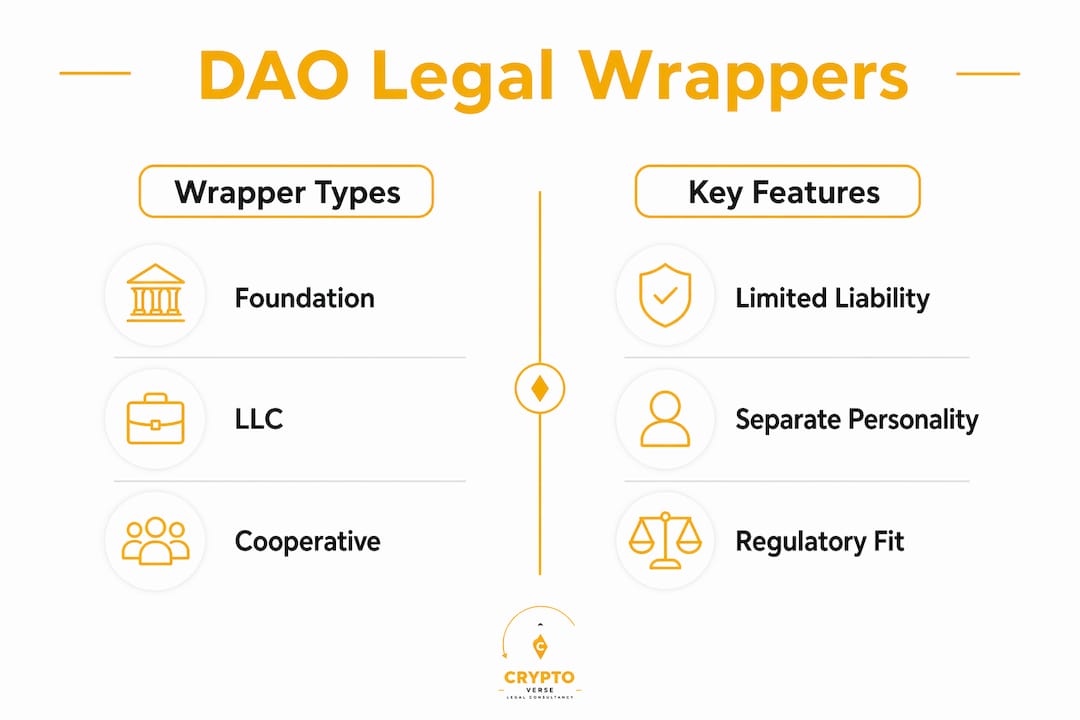
- DAO wrapper (optional but increasingly standard): A legal entity, often a foundation company in the Cayman Islands or a Marshall Islands DAO LLC, that provides the decentralised autonomous organisation with a legal personality. This enables the DAO to sign contracts, open bank accounts, and interface with regulators without exposing individual token holders to unlimited liability.
The strategic rationale for this separation is clear. Commingling treasury control with token issuance within a single entity exposes the entire project to unified liability and regulatory risk. If a regulator classifies your token as a security and your treasury is held in the same entity as your employment contracts and IP, the enforcement action affects everything simultaneously.
Pro Tip: Register your TokenCo before conducting any public token sale or community distribution. Retroactively separating a commingled structure after fundraising is significantly more expensive and legally complex than building the architecture correctly from the outset.

A clean multi-entity structure also signals credibility to institutional investors. Successful Web3 fundraising depends on formal entity separation, clear service agreements, and token logic aligned with economic incentives. Investors conducting due diligence will examine your cap table, your inter-entity agreements, and your token legal opinion before committing capital.
How does the Coin-to-Company model reconcile decentralised governance with securities regulation?
The Coin-to-Company (C2C) model is a structuring framework developed to enable community participation through token ownership while maintaining a legally distinct equity structure that avoids securities law triggers. It is one of the most practically useful frameworks for Web3 founders who want both a token economy and a compliant equity fundraising pathway.
The C2C model operates through the following sequential steps:
- Establish a dual-entity foundation. DevCo is incorporated as the operating company with conventional equity. A separate DAO or token-issuing entity is established alongside it. The two entities are linked through service agreements and IP licences, not through shared ownership or commingled finances.
- Issue tokens as utility instruments only. Token ownership in the C2C model grants utility rights and governance participation but confers no equity interest, profit share, or financial claim against DevCo. This distinction is the legal foundation of the model's securities law defence.
- Implement voluntary token locking. Token locking is used as a non-contractual participation mechanism to align community engagement with protocol governance. Critically, it does not create a contractual right or financial entitlement, which means it does not trigger securities classification under the Howey test or equivalent frameworks in the UAE, EU, or Singapore.
- Raise equity through established exemptions. DevCo issues equity to investors under Regulation D (Rule 506(b) or 506(c)) for US-connected investors, or under Rule 701 for compensatory equity grants to employees and contractors. These are well-established pathways that regulators understand and accept.
- Formalise inter-entity relationships. Service agreements between DevCo and the DAO or TokenCo define the scope of services, IP licences, and revenue flows. These documents are critical for tax treatment, transfer pricing compliance, and demonstrating arm's-length dealings to regulators.
"In the C2C model, token ownership does not confer equity or financial interest in DevCo. Compliance is maintained by ensuring token sales are purely commercial utility sales, entirely distinct from equity sales." — The Coin-to-Company Model
The C2C model is particularly relevant for founders building DeFi protocols, decentralised science (DeSci) platforms, and community-governed networks. Separating token ownership from equity also opens established equity funding pathways such as Regulation D offerings and compensatory grants under Rule 701, which institutional investors and family offices are already familiar with.
What are the legal wrapper options for DAOs and how do they compare?
Legal wrappers for DAOs provide separate legal personality and limited liability, enabling the DAO to function as a recognised legal actor. Without a wrapper, DAO members may face unlimited joint and several liability for the organisation's obligations, a risk that is commercially unacceptable for any serious project.
The principal wrapper options available in 2026 are compared below:
| Wrapper type | Jurisdiction | Key characteristics | Best suited for |
|---|---|---|---|
| Foundation company | Cayman Islands | Non-profit structure, no shareholders, governed by a council | Protocol governance, grant distribution |
| DAO LLC | Marshall Islands, Wyoming | Members have limited liability, flexible governance docs | Community-governed protocols |
| Association | Switzerland | Non-profit, member-based, FINMA-familiar | DeFi protocols with Swiss nexus |
| Private limited company | Singapore, BVI | Standard corporate structure adapted for DAO governance | Token issuance, treasury management |
| Unincorporated association | UK | Minimal formation requirements, but no separate legal personality | Early-stage, low-risk activities only |
The choice of wrapper depends on the DAO's primary activities, its regulatory exposure, and the jurisdictions in which it operates. A layered multi-entity approach uses a base-layer wrapper for governance and separate entities for high-risk operations such as employment, licensing, and custody. This architecture improves liability management and provides regulators with a clear map of accountability.
Beneficial ownership obligations apply to all wrapper structures. DAO legal wrappers require at least one controlling person for compliance with beneficial ownership laws, including the US Corporate Transparency Act, EU AML directives, and UK PSC (Persons with Significant Control) requirements. Founders must plan for UBO reporting from the outset, mapping on-chain governance actors to off-chain legal accountability.
Pro Tip: Governance documents for your DAO wrapper must explicitly bind both on-chain and off-chain decision-making. A smart contract vote that contradicts the wrapper's constitutional documents creates legal uncertainty and potential enforceability disputes. Align both layers before launch.
Legal wrappers also serve as operational hubs that interface with banks, payment processors, and counterparties. A DAO without a legal wrapper cannot open a corporate bank account, enter into employment contracts, or apply for a VASP licence under VARA or the SCA. This practical limitation makes the wrapper not merely a compliance tool but a commercial necessity. Founders building in the UAE should note that VARA's Virtual Asset Issuance Rulebook and the SCA's virtual asset framework both require a licensed legal entity as the regulatory counterparty, not a smart contract address.
How does Web3 corporate governance differ from traditional models?
Web3 corporate governance is defined by four structural pillars: transparency, programmability, participation, and sovereign ownership. These pillars replace the conventional corporate governance model, in which a board of directors exercises fiduciary authority over management decisions, with a framework in which smart contracts enforce decisions and token holders vote on protocol upgrades, treasury allocations, and parameter changes.
The practical implications for founders are significant:
- On-chain governance replaces board resolutions. Governance proposals, voting periods, quorum thresholds, and execution logic are encoded in smart contracts. This creates an auditable, tamper-resistant record of every governance decision, which regulators increasingly view as a positive compliance attribute.
- Sovereign ownership guarantees user control. Sovereign ownership ensures that users retain control over their assets and digital identity without reliance on intermediaries. For founders, this means the governance architecture must be designed to prevent admin key abuse and unilateral protocol changes.
- Active stewardship replaces passive holding. Web3 governance has moved beyond passive token holding to active protocol stewardship. This shift requires integrated on-chain and off-chain legal frameworks to ensure that governance decisions are enforceable and that off-chain obligations, such as service agreements and employment contracts, remain aligned with on-chain outcomes.
- Contributor agreements are non-negotiable. Formal service agreements before the first equity split or hire are critical to preventing intellectual property ownership disputes. In Web3 projects, where contributors may be pseudonymous and distributed across jurisdictions, a missing or ambiguous contributor agreement can render IP ownership legally contested.
Common governance failures that Cryptoverselawyers observes in practice include: raising equity before completing entity separation, issuing tokens without a formal legal opinion, and failing to document the relationship between on-chain governance outcomes and off-chain legal obligations. Each of these failures creates material legal risk and can delay or prevent VASP licensing under VARA, the DFSA, or the FSRA. Founders should also be aware that the UAE Federal AML Law (Decree-Law No. 20 of 2018, as amended) imposes AML/CFT obligations at the entity level, not the protocol level. Your legal wrapper must have a compliant AML/CFT programme in place before commencing regulated activities.
For a detailed review of the most common Web3 legal mistakes that founders make during the structuring phase, Cryptoverselawyers has published a dedicated resource covering entity formation errors, token classification risks, and governance document deficiencies.
Our perspective on structuring discipline in Web3
The founders who encounter the most serious legal difficulties are not those who chose the wrong jurisdiction. They are those who deferred structuring decisions until after they had already raised capital, issued tokens, or onboarded contributors without formal agreements. By that point, the cost of correction is multiples of what a properly designed structure would have cost at inception.
The C2C model represents a genuine advance in reconciling decentralised community participation with the realities of securities regulation. Its voluntary token locking mechanism is elegant precisely because it is non-contractual. However, the model only works if the inter-entity documentation is airtight. We have reviewed projects where the concept was sound but the service agreements between DevCo and the DAO were either absent or internally inconsistent, creating exactly the kind of ambiguity that regulators exploit during enforcement.
The shift towards layered DAO wrappers is the correct direction. A single wrapper trying to serve as governance vehicle, employer, and licensed entity simultaneously is a structural liability. Mapping activities to purpose-built entities, each with its own compliance programme and governance documents, is not over-engineering. It is the minimum standard for a project that intends to operate across multiple jurisdictions and regulatory regimes.
Regulatory frameworks are evolving rapidly. MiCA in the EU, the VARA Virtual Asset Issuance Rulebook, and MAS's revised payment services framework all impose entity-level obligations that a smart contract cannot satisfy. Founders who build adaptable multi-entity architectures from the outset will spend less time and capital on restructuring as these regimes mature.
— CRYPTOVERSE
How Cryptoverselawyers supports your Web3 structuring
Cryptoverselawyers advises Web3 founders and legal teams on multi-entity architecture, DAO legal wrappers, and token compliance frameworks across the UAE and more than 30 jurisdictions worldwide. The firm's crypto-native lawyers provide VARA licensing and compliance support, covering the full spectrum from pre-application structuring through to regulatory approval and ongoing governance obligations. Cryptoverselawyers also advises on SCA virtual asset licensing, AML/CFT programme design aligned with FATF standards and UAE Federal AML Law, and cross-border tax planning for multi-entity Web3 structures.
Whether you are designing a DevCo and TokenCo separation, selecting a DAO wrapper jurisdiction, or navigating the C2C model for your token economy, Cryptoverselawyers delivers regulator-ready legal frameworks built for the complexity of Web3 in 2026. Contact the team for a bespoke structuring consultation.
FAQ
What is the difference between DevCo and TokenCo in Web3?
DevCo is the operating company that employs the team, holds IP, and raises equity. TokenCo is a separate entity, typically in a crypto-friendly jurisdiction, that manages token issuance and treasury. Separating them prevents token-related regulatory exposure from affecting the operating company.
How much does it cost to set up a Web3 multi-entity structure?
A standard multi-entity setup costs between $15,000 and $50,000 and takes four to eight weeks to complete. Costs vary depending on the number of entities, jurisdictions selected, and complexity of the inter-entity agreements required.
Do DAOs need a legal wrapper to operate?
Yes. Without a DAO legal wrapper, members face potential unlimited joint and several liability, and the DAO cannot open bank accounts, enter contracts, or apply for regulatory licences. A wrapper is a commercial and compliance necessity, not an optional formality.
What is the Coin-to-Company model and why does it matter?
The C2C model separates token ownership from equity ownership, allowing founders to issue utility tokens for community governance while raising equity through established securities law exemptions such as Regulation D. This separation prevents tokens from being classified as securities while preserving a compliant investment pathway.
What are the UBO reporting obligations for DAO wrappers?
DAO wrappers must identify at least one controlling person for beneficial ownership compliance under instruments including the US Corporate Transparency Act and EU AML directives. Founders and governance actors are typically designated as UBOs, and this must be planned for when selecting the wrapper structure and jurisdiction.